





100 – NR2410 – ATELIER MASS, NEW ENVIRONMENTS, STUDIO DE PEISAJ ANA HORHAT, BLU.works


Main authors: ATELIER MASS (Silviu Aldea, Camelia Sisak, Tamás Sisak) + NEW ENVIRONMENTS (Giacomo Gallo, Robert Younger)
Co-authors: SAH (Ana Horhat), BLU.works (Jacopo Gennari Feslikenian)
Architecture collaborators: Violeta Frișan, Robert Vasiluț, Roxana Udrescu, Cristian Duda, Vlad Birtaș, Andreea Ștefănescu (Atelier MASS), Abhinand Krishnakumar Menon (BLU.works)
Specialty collaborators: Felicia Radoviciu, Teodora Pascu, Ivona Svinți-Nechita (landscaping), Teodora Constantinescu, Oana Paraschiv (urban planning), Bogdan Simionescu (visuals)
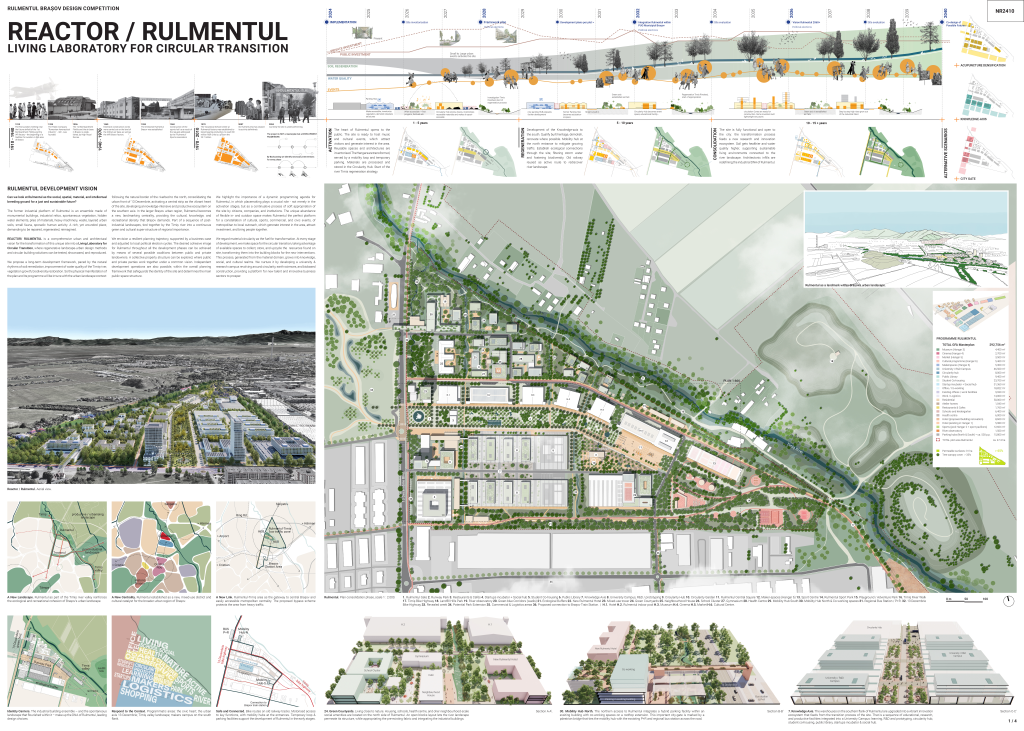
“ The proposal responds to the brief with a clear urban development concept for the competition site. The wider area to be developed under inclusion of private stakeholders is well addressed by laying out a precisely structured network of public spaces, carefully densified areas and a good mix of functions aimed at maximizing activity on the site. ” – appreciation of the Jury
RULMENTUL DEVELOPMENT VISION
Can we look at Rulmentul as the social, spatial, material and intellectual breeding ground for a just and sustainable future?
The former industrial platform of Rulmentul is an ensemble made of monumental buildings, industrial relics, spontaneous vegetation, hidden water elements, piles of materials, heavy machinery, waste, layered urban soils, small fauna, sporadic human activity. A rich, yet wounded place, demanding to be repaired, regenerated, reimagined.
REACTOR / RULMENTUL is a comprehensive urban and architectural vision for the transformation of this unique site into a Living Laboratory for Circular Transition, where regenerative landscape-urban design methods and circular building solutions can be tested, showcased, and reproduced.
We propose a long-term development framework, paced by the natural rhythms of soil remediation, improvement of water quality of the Timiș river, vegetation growth, biodiversity restoration. So the physical manifestation of the plan and its programme will be in tune with the urban-landscape context: following the natural border of the riverbed to the north, consolidating the urban front of 13 Decembrie, activating a central strip as the vibrant heart of the site, developing a knowledge-intensive and productive ecosystem on the southern axis. In the larger Brașov urban region, Rulmentul becomes a new, landmarking centrality, providing the cultural, knowledge, and recreational density that Brașov needs. Part of a sequence of post-industrial landscapes, tied together by the Timiș river into a continuous green and cultural super-structure of regional importance.
We envision a resilient planning trajectory, supported by a business case and adjusted to local political election cycles. The desired cohesive image for Rulmentul throughout all the development phases can be achieved by means of several possible coalitions between public and private landowners. A collective property structure can be explored, where public and private parties work together under a common vision. Independent development operations are also possible, within the overall planning framework that safeguards the identity of the site and determines the main public space structure.
We highlight the importance of a dynamic programming agenda for Rulmentul, in which placemaking plays a crucial role – not merely in the activation stages, but as a continuative process of soft appropriation of the site by citizens, companies, and institutions. The unique abundance of flexible in- and outdoor space makes Rulmentul the perfect platform for a constellation of cultural, sports, commercial, and civic events, from metropolitan to local outreach, which generate interest in the area, attract investment and bring people together.
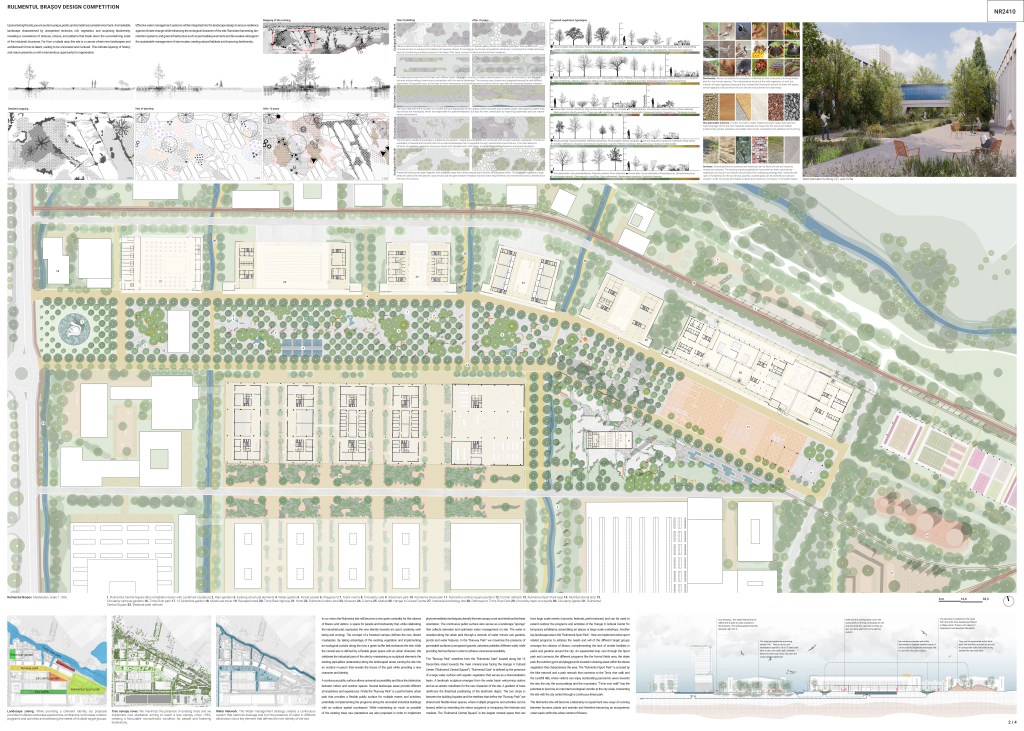
LANDSCAPING CONCEPT
Upon entering the Rulmentul site, you encounter a unique, poetic, and sometimes surreal environment where nature intertwines with various built elements. This remarkable landscape is characterised by unexpected tectonics, rich vegetation, and surprising biodiversity, revealing a coexistence of textures, colours, and patterns that break down the overwhelming scale of the industrial structures. Far from a tabula rasa, this site is a canvas where new landscapes and architectural forms lie latent, waiting to be uncovered and nurtured. This intricate layering of history and nature presents us with a tremendous opportunity for regeneration.
In our vision the Rulmentul site will become a new green centrality for the citizens of Brasov and visitors. A space for people and biodiversity that, while celebrating the industrial past, expresses the new identity towards art, sport, creativity, well-being and ecology. The concept of a forested campus defines the new vibrant masterplan. By taking advantage of the existing vegetation and implementing an ecological corridor along the river, a green buffer belt embraces the site, while the central axis is defined by a flexible green space with an urban character. We celebrate the industrial past of the site by maintaining as sculptural elements the existing pipe-pillars (estacades) along the landscaped areas, turning the site into an outdoor museum that reveals the traces of the past while providing a new character and identity.
Effective water management systems will be integrated into the landscape design to ensure resilience against climate change while enhancing the ecological character of the site. Rainwater harvesting, bio-retention systems, and green infrastructure such as permeable pavements and bio-swales will support the sustainable management of stormwater, creating natural habitats and improving biodiversity. A continuous public surface allows universal accessibility and blurs the distinction between indoor and outdoor spaces. Several landscape areas provide different atmospheres and experiences. Firstly the “Runway Park” is a performative urban park that provides a flexible public surface for multiple events and activities, potentially complementing the programs along the renovated industrial buildings with an outdoor spatial counterpart. While maintaining as much as possible of the existing trees new plantations are also proposed in order to implement phytoremediation techniques, densify the tree canopy cover and reinforce the linear orientation. The continuous public surface also serves as a landscape “sponge” that collects rainwater and optimises water management on site. The water is revealed along the urban park through a network of water mirrors, rain gardens, ponds and water features. In the “Runway Park” we maximise the presence of permeable surfaces (compacted gravels, calcestre, pebbles, different soils) while providing hard surfaces in order to achieve universal accessibility.
The “Runway Park” stretches from the “Rulmentul Gate” located along the 13 Decembrie street towards the main mineral area facing the Hangar 6 Cultural Center (“Rulmentul Central Square”). “Rulmentul Gate” is defined by the presence of a large water surface with aquatic vegetation that serves as a bioremediation basin. A landmark sculpture emerges from the water basin welcoming visitors and as an artistic manifesto for the new character of the site. A gradient of trees reinforces the theatrical positioning of the landmark object. The two strips in between the building façades and the treelines that define the “Runway Park” are shared and flexible linear spaces, where multiple programs and activities can be hosted, either by extending the indoor programs or temporary, like festivals and markets. The “Rulmentul Central Square” is the largest mineral space that can host large scale events (concerts, festivals, performances) and can be used to extend outdoor the programs and activities of the Hangar 6 Cultural Center for temporary exhibitions, assembling art pieces or large scale workshops. Another key landscape area is the “Rulmentul Sport Park”. Here we implement active sport related programs to address the needs and will of the different target groups amongst the citizens of Brasov, complementing the lack of similar facilities in parks and gardens around the city. An experiential loop runs through the Sport park and connects the different programs like the formal fields area, the skate park, the outdoor gyms and playgrounds located in clearing areas within the dense vegetation that characterises the area. The “Rulmentul Sport Park” is crossed by the bike network and a path network that connects to the Timis river walk and the Landfill hills, where visitors can enjoy outstanding panoramic views towards the site, the city, the surroundings and the mountains. “Timis river walk” has the potential to become an important ecological corridor at the city scale, connecting the site with the city center through a continuous linear park.
The Rulmentul site will become a laboratory to experiment new ways of co-living between humans, plants and animals and therefore becoming an ecosystemic urban oasis within the urban context of Brasov.
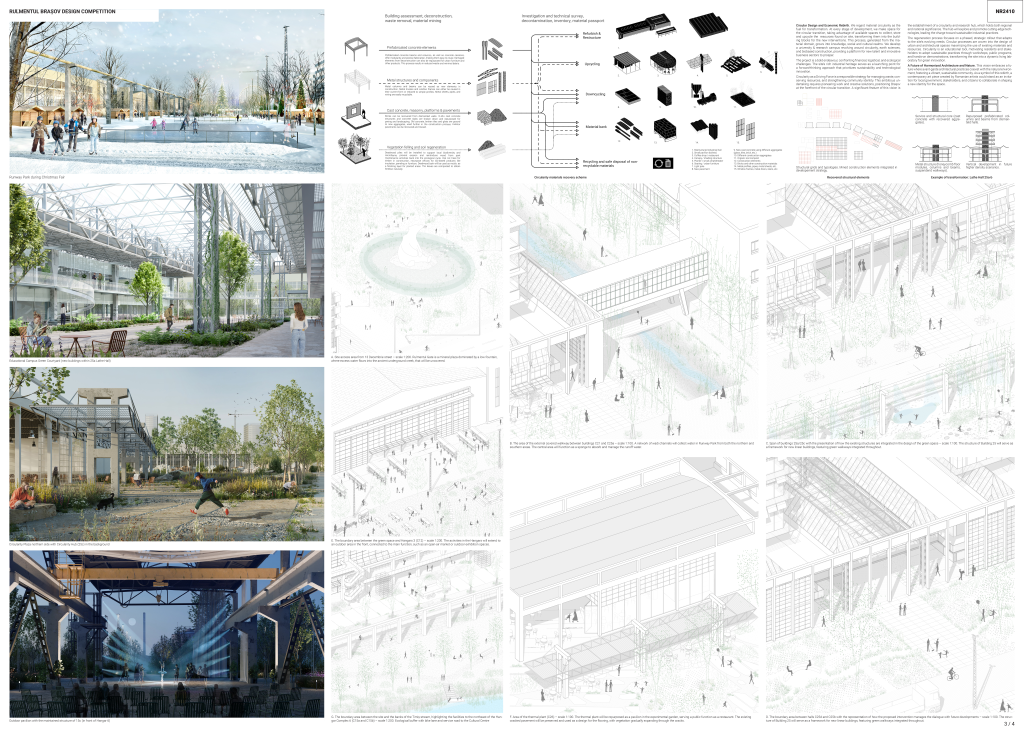
CIRCULAR DESIGN AND ECONOMIC REBIRTH
We regard material circularity as the fuel for transformation. At every stage of development, we make space for the circular transition, taking advantage of available spaces to collect, store and upcycle the resources found on site, transforming them into the building blocks for the new interventions. This process, generated from the material domain, grows into knowledge, social and cultural realms. We develop a university & research campus revolving around circularity, earth sciences, and biobased construction, providing a platform for new talent and innovative business sectors to prosper.
The project is a bold endeavour, confronting financial, logistical, and ecological challenges. The site’s rich industrial heritage serves as a launching point for a forward-thinking approach that prioritizes sustainability and technological innovation.
Circularity as a Driving Force is a responsible strategy for managing waste, conserving resources, and strengthening community identity. This ambitious undertaking requires pioneering work and creative solutions, positioning Brașov at the forefront of the circular transition. A significant feature of this vision is the establishment of a circularity and research hub, which holds both regional and national significance. The hub will explore and promote cutting-edge technologies, leading the charge toward sustainable industrial practices.
The regeneration process focuses on a phased, strategic rollout that adapts to the site’s evolving needs. Circular processes are woven into the design of urban and architectural spaces maximizing the use of existing materials and resources. Circularity is an educational tool, motivating residents and stakeholders to adopt sustainable practices through workshops, public programs, and hands-on demonstrations, transforming the site into a dynamic living laboratory for green innovation.
A Future of Harmonized Architecture and Nature. This vision embraces a future where avant-garde architectural practices coexist with the natural environment, fostering a vibrant, sustainable community. As a symbol of this rebirth, a contemporary art piece created by Romanian artists could stand as an invitation for local government, stakeholders, and citizens to collaborate in shaping a new identity for the space.
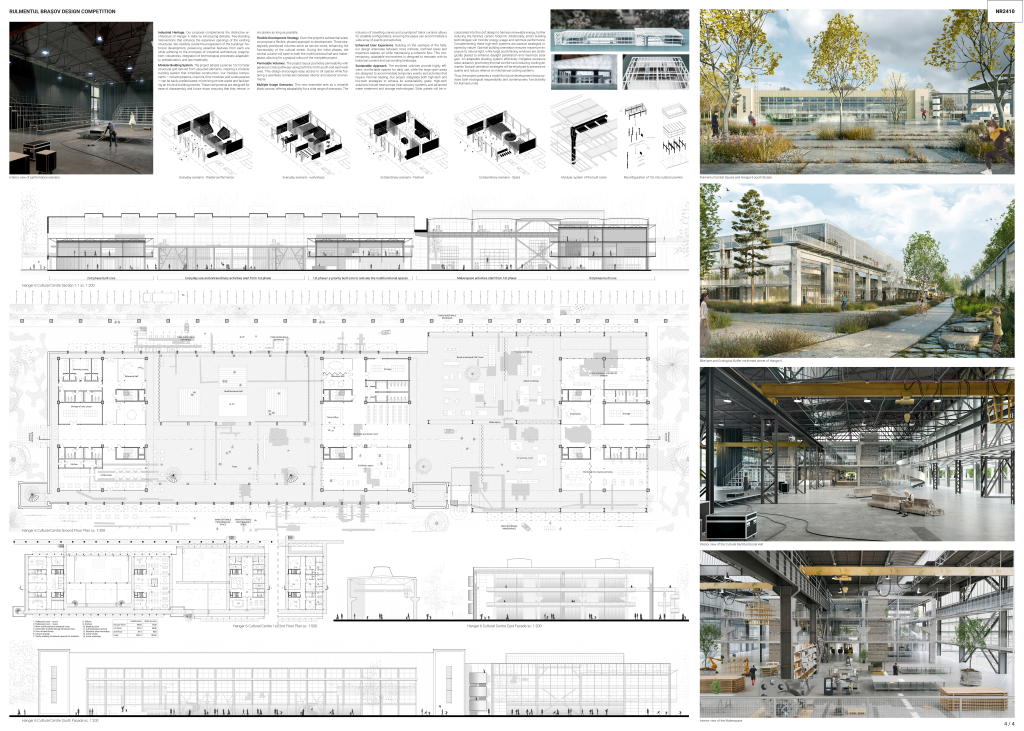
THE REHABILITATION OF HANGAR 6
Industrial heritage. Our proposal complements the distinctive architecture of Hangar 6 Halls by introducing delicate, free-standing interventions that enhance the expansive openings of the existing structures. We carefully curate the progression of the buildings’ historical development, preserving essential features from each era while adhering to the principles of industrial architecture: pragmatism, robustness, integration of technological processes, adaptability, prefabrication, and raw materiality.
Modular Building System. The project adopts a precise 12×12 meter structural grid derived from upcycled elements, inspiring a modular building system that simplifies construction. Our modular components — including beams, columns, floor modules, and windowpanes — can be easily prefabricated, minimizing on-site waste and facilitating an intuitive building process. These components are designed for ease of disassembly and future reuse, ensuring that they remain in circulation as long as possible.
Flexible Development Strategy. Given the project’s substantial scale, we propose a flexible, phased approach to development. Three strategically positioned volumes serve as service cores, enhancing the functionality of the cultural center. During the initial phases, the central volume will cater to both the multifunctional hall and makerspace, allowing for a gradual rollout of the complete project.
Permeable Volumes. The project layout promotes permeability with generous cross pathways along both the north-south and east-west axes. This design encourages easy access to all spaces while fostering a seamless connection between interior and exterior environments.
Multiple Usage Scenarios. This new ensemble acts as a versatile blank canvas, offering adaptability for a wide range of scenarios. The inclusion of travelling cranes and soundproof black curtains allows for scalable configurations, ensuring the space can accommodate a wide array of events and activities.
Enhanced User Experience. Building on the vastness of the halls, our design alternates between more intimate, confined areas and expansive spaces, all while maintaining a coherent flow. This contemporary, adaptable environment is designed to resonate with its historical context and surrounding landscape.
Sustainable Approach. The enclosed volumes provide highly efficient, comfortable spaces for daily use, while the large open areas are designed to accommodate temporary events and activities that require minimal heating. Our project integrates both high-tech and low-tech strategies to achieve its sustainability goals. High-tech solutions include solar panels, heat pumps, heat recovery systems, and advanced water treatment and storage technologies. Additionally, smart building technologies will monitor energy usage and optimise performance. Complementing these high-tech systems are passive strategies inspired by nature. Optimal building orientation ensures maximum exposure to natural light, while large south-facing windows are strategically placed to enhance daylight penetration and maximise solar gain. An adaptable shading system effectively mitigates excessive solar radiation, promoting thermal comfort and reducing cooling demands. Natural ventilation strategies will be employed to enhance air quality and reduce reliance on mechanical cooling systems.
Thus, the project presents a model for future development that prioritises both ecological responsibility and contemporary functionality for the Rulmentul site.