





100 – UN8002 – ATELIER UNBUILT SRL


Main Author: Aurelia Stan
Co-authors: Dorobanțu Iuliana- Maria, Oprescu Rebeca, Alexoaie Flavia-Marina, Simina Haiduc, Teodora-Gabriela Rășcanu, Adrian Cerbu, Turcu George-Alexandru, Alexandru Miculiț, Bogdan Lapteș, Dorin Cucu
Specialty collaborators: structural engineer Cătălin Popp, building services engineer Ionel Oprea
“The project consistently pursued a certain direction, but the Jury considered that the adopted attitude is inappropriate for the purpose of the competition. The project fails to focus on both the characteristics of the study area and on the requirements of the brief. The proposed solution is radical and cost-intensive, involving major investments.” – appreciation of the Jury
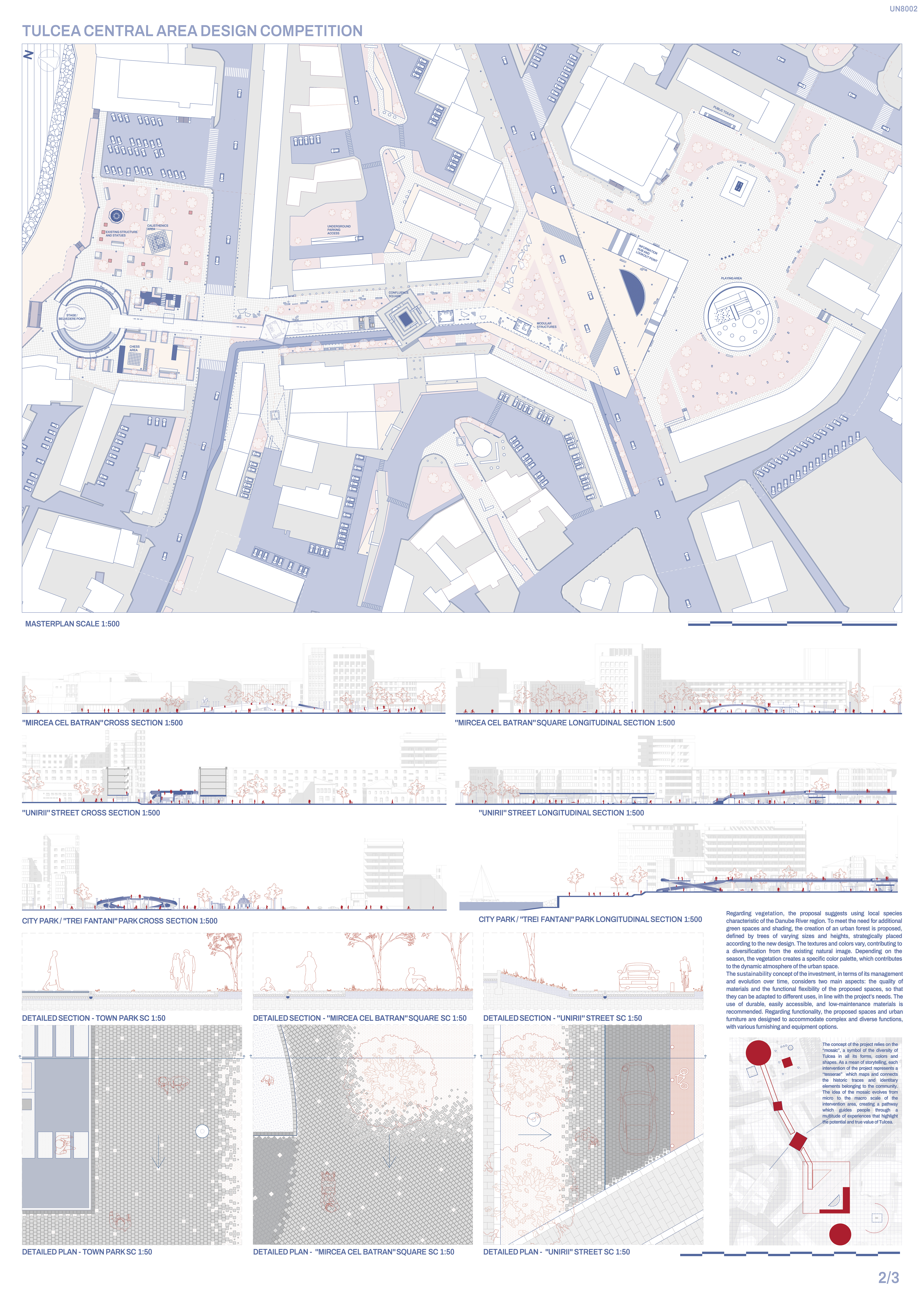
The concept of the project relies on the “mosaic”, a symbol of the diversity of Tulcea in all its forms, colors and shapes. As a mean of storytelling, each intervention of the project represents a “tesserae” which maps and connects the historic traces and identitary elements belonging to the community. The idea of the mosaic evolves from micro to the macro scale of the intervention area, creating a pathway which guides people through a multitude of experiences that highlight the potential and true value of Tulcea.
The proposal aims to improve the socio-economic and cultural context in the city of Tulcea by implementing two key strategies regarding the arrangement of the spaces proposed in the theme: the macro-level strategy and the micro-level strategy.
The macro-level strategy addresses the three main areas, defined as follows: ‘’Mircea Cel Batran’’ square and ‘’Parcul Orasenesc’’ represent the potential for the development of two main urban activity centers, while ‘’Strada Unirii’’ (Union Street) serves to bind these activity centers into a cohesive system.
At the micro scale, the definition of activity hubs considers the following factors: the first factor aims to improve the relationship with the context and the functionalization of the spaces, with the goal of creating an active urban space that is deeply rooted in the local culture, while the second factor concerns integrating these hubs into a system of public spaces at an urban scale through both physical and functional connections between them.
Regarding the first activity hub, namely ‘’Piața Mircea Cel Bătrân’’ (Mircea the Elder Square), the two previously mentioned factors are materialized in the project as follows:
The proposal capitalizes on existing elements that have left their mark on the memory of the place, specifically the Mosaic Fountain and the Monument to Mircea the Elder. For both of these objects, the proposal suggests creating modern structures with multiple functions: directing flows, framing key perspectives, integrating them functionally into the context by sheltering diverse functions, and providing both lookout points and social platforms.
Regarding the connection and unification of the two hubs, achieved through the redevelopment of ‘’Strada Unirii’’, the following interventions are proposed:
A footbridge will be constructed to take the pedestrian flow from the square and lead it towards a culminating point near the Danube River. Along its path, the footbridge integrates a series of spatial events designed to introduce urban and social dynamics. One important example is the intersection of the main path with flows coming from the historic areas, through the passages of the blocks that flank the axis. These formal and functional “accidents” generate small urban pockets that direct flows and allow for the appearance of secondary functions.
For the second activity hub, namely ‘’Parcul Orășenesc’’ (City Park), two main interventions are proposed:
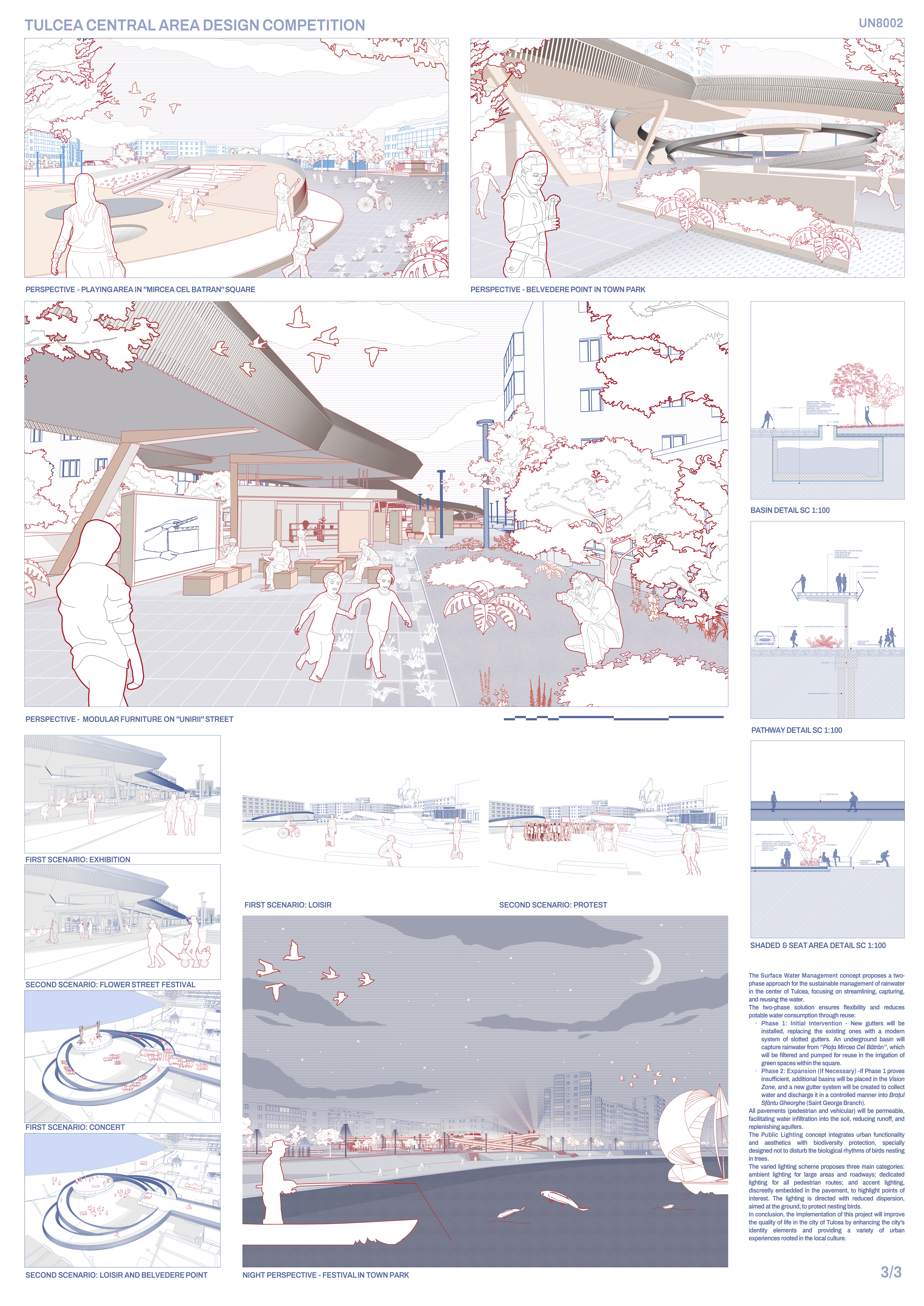
The first consists of a terminal and culminating point of the footbridge, marked by an architectural object that acts as an urban landmark, allowing multiple usage scenarios.
The second intervention involves the reorganization of the park by integrating socially catalytic functions, such as an area for diverse creative activities and a recreational zone.
Regarding vegetation, the proposal suggests using local species characteristic of the Danube River region. To meet the need for additional green spaces and shading, the creation of an urban forest is proposed, defined by trees of varying sizes and heights, strategically placed according to the new design. The textures and colors vary, contributing to a diversification from the existing natural image. Depending on the season, the vegetation creates a specific color palette, which contributes to the dynamic atmosphere of the urban space.
The sustainability concept of the investment, in terms of its management and evolution over time, considers two main aspects: the quality of materials and the functional flexibility of the proposed spaces, so that they can be adapted to different uses, in line with the project’s needs. The use of durable, easily accessible, and low-maintenance materials is recommended. Regarding functionality, the proposed spaces and urban furniture are designed to accommodate complex and diverse functions, with various furnishing and equipment options.
The Surface Water Management concept proposes a two-phase approach for the sustainable management of rainwater in the center of Tulcea, focusing on streamlining, capturing, and reusing the water.
The two-phase solution ensures flexibility and reduces potable water consumption through reuse:
- Phase 1: Initial Intervention
New gutters will be installed, replacing the existing ones with a modern system of slotted gutters. An underground basin will capture rainwater from ‘’Piața Mircea Cel Bătrân’’, which will be filtered and pumped for reuse in the irrigation of green spaces within the square. - Phase 2: Expansion (If Necessary)
If Phase 1 proves insufficient, additional basins will be placed in the Vision Zone, and a new gutter system will be created to collect water and discharge it in a controlled manner into Brațul Sfântu Gheorghe (Saint George Branch).
All pavements (pedestrian and vehicular) will be permeable, facilitating water infiltration into the soil, reducing runoff, and replenishing aquifers.
The Public Lighting concept integrates urban functionality and aesthetics with biodiversity protection, specially designed not to disturb the biological rhythms of birds nesting in trees.
The varied lighting scheme proposes three main categories: ambient lighting for large areas and roadways; dedicated lighting for all pedestrian routes; and accent lighting, discreetly embedded in the pavement, to highlight points of interest.
The lighting is directed with reduced dispersion, aimed at the ground, to protect nesting birds.
In conclusion, the implementation of this project will improve the quality of life in the city of Tulcea by enhancing the city’s identity elements and providing a variety of urban experiences rooted in the local culture.