




112 – TM2613 – NORMA ARHITECTURA SI URBANISM SRL + BOCA STEFANIA LILIANA BIA + RECREATIV ARHITECTURA PEISAGERA SRL


Main authors: Boca Ștefania Liliana, Dâmbean Andreea, Fleșeriu Alexandru Nicolae, Kotró -Kosztándi Anna, Olteanu Alexandra, Péter Eszter, Secher Leonid, Uglea Claudia Andreea
Co-authors: Belea Iulia, Dubei Bianca
Architecture collaborators: Máté Krisztina, Márton Annámaria
Specialty collaborators: Tetelea Cristian Demostene
Country or countries of origin: Romania
OAR Territorial branch: Transilvania
” This project proposes a new landscape structure for the city based on a hybrid of urban and natural river morphology as an “urban meander” or a new “hydrological milieu.” The robust and well-considered vegetation scheme increases biodiversity and spatial experience at the urban scale across diverse conditions.
The project’s biodiversification scheme, unfolding over time under different conditions, reconnects citizens to the local urban ecology, allowing them to witness the evolution of the landscape over many years. The Municipal Park was carefully rethought, resulting in new, more functional spaces and improved microclimates.
The project’s foundation in ecological principles would jump-start self-sustaining processes that would economically increase biodiversity. Increased permeability, at large and small scales, will benefit managing intensive rain events. The simple earthwork in the hippodrome (cut and fill) will increase biodiversity.” – appreciation of the Jury
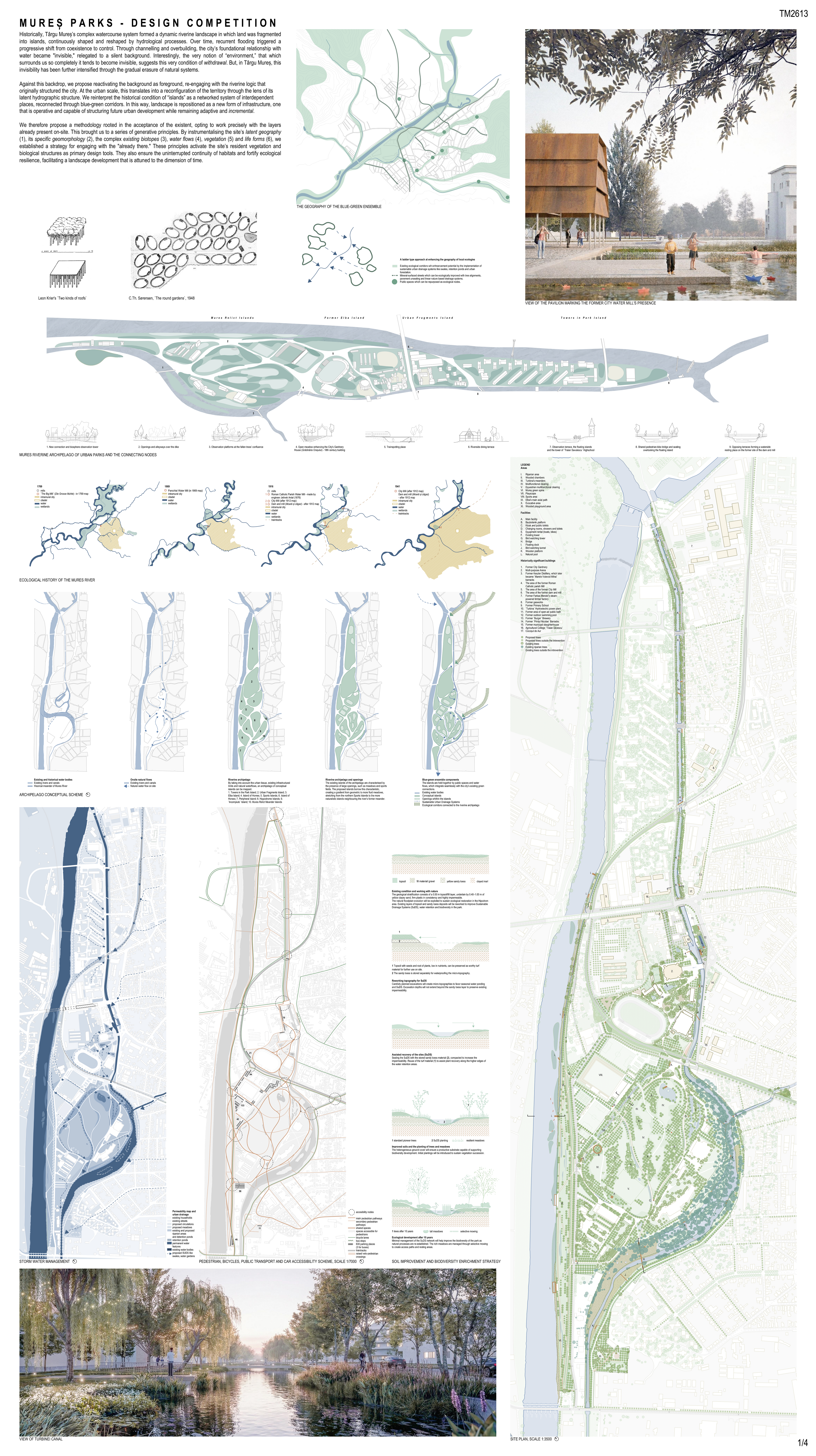
Historically, Târgu Mureș’s complex watercourse system formed a dynamic riverine landscape in which land was fragmented into islands, continuously shaped and reshaped by hydrological processes. Over time, recurrent flooding triggered a progressive shift from coexistence to control. Through channelling and overbuilding, the city’s foundational relationship with water became “invisible,” relegated to a silent background. Interestingly, the very notion of “environment,” that which surrounds us so completely it tends to become invisible, suggests this very condition of withdrawal. But, in Târgu Mureș, this invisibility has been further intensified through the gradual erasure of natural systems.
Against this backdrop, we propose reactivating the background as foreground, re-engaging with the riverine logic that originally structured the city. At the urban scale, this translates into a reconfiguration of the territory through the lens of its latent hydrographic structure. We reinterpret the historical condition of “islands” as a networked system of interdependent places, reconnected through blue-green corridors. In this way, landscape is repositioned as a new form of infrastructure, one that is operative and capable of structuring future urban development while remaining adaptive and incremental.
We therefore propose a methodology rooted in the acceptance of the existent, opting to work precisely with the layers already present on-site. This brought us to a series of generative principles. By instrumentalising the site’s latent geography (1), its specific geomorphology (2), the complex existing biotopes (3), water flows (4), vegetation (5) and life forms (6), we established a strategy for engaging with the “already there.” These principles activate the site’s resident vegetation and biological structures as primary design tools. They also ensure the uninterrupted continuity of habitats and fortify ecological resilience, facilitating a landscape development that is attuned to the dimension of time.
The area between the Mureș riverbank and the former meander was known in the 17th century as “Bercul Tăiat din Sus,” where berc translates to grove, thicket, or small woodland. This linguistic trace suggests that the landscape was historically a mosaic structure of varied tree densities, clearings, and transitional woodland ecologies. Our strategy for the Hippodrome area is to reinterpret the former character of the area as a tool for spatial production. Working with an economy of means and with the existing vegetation (as much as possible), vegetation is treated as a structuring element, capable of generating spatial order, different atmospheres, programmatic flexibility, and ecological succession over time.
One of the principles we used here is based on differentiated woodland typologies, organised according to vertical and horizontal canopy distribution, built on established European practices of woodland development. These typologies form a sequence of spatial chambers, a mosaic of woodlands and open habitats, collectively composing a field of varied experiences.
The site’s topography and existing soil conditions are leveraged to introduce water and vegetation into key areas using low-cost principles, facilitating retention, infiltration, seasonal variation, and setting in motion processes of ecological succession that extend across the site. Here, water remains ephemeral.
By introducing water to the site, a riparian belt is formed around the Hippodrome, tracing the former meander of the Mureș River. Here, pioneer floodplain species establish an initial structure and ecological stability. Additional woodland types are organised into distinct “chambers,” ranging from open to more enclosed atmospheres: gallery forests, hazel groves, tall-pillar woodlands, and orchards. At the core, Miyawaki forests are strategically deployed as adaptive spatial devices: they reinforce edges, generate new clearings, and accommodate future programmatic shifts, ensuring long-term flexibility and an evolving landscape.
Within this broader system, certain areas are allowed to operate with minimal intervention, as non-designed landscapes. For example, ecological intelligence already is the primary structuring force in the area of the Relict Meander, so we recognise the area as a living temporal archive, where hydrological, biological, and geomorphological processes are already active. Our intervention here is minimal, consisting only of lightweight furniture and bridges. We proposed a series of nature-based solutions, such as planting pioneer species seedlings in support of the beaver population. In parallel, to support avian nesting habitats within reed-dominated areas, we proposed a series of small clearings and islands for them to take shelter.
At the same time, the Mureș riverbank is reinterpreted as a form of social infrastructure. Long used informally for fishing, swimming, and canoeing, these activities are gently supported. Vegetation is deployed to stabilize access, frame sequences of shaded and semi-shaded spaces, and reinforce continuity along the water’s edge. Water quality is addressed through ecological filtration systems such as floating islands, enabling the return of direct human interaction with the river. In this way, water itself becomes a form of social infrastructure.
Within the Municipal Park, we propose to create a continuous landscape structure that reconnects historical traces, ecological processes, and contemporary public use. Within the former Elba Park, we worked through selective subtraction and amplification: built accretions are strategically cleared to reveal and reinforce latent spatial orders that persist within the terrain. Key relics, such as the historic City Gardnery and the faint trace of the former park’s main axial alignment, are reestablished as structuring elements. In the areas of the former water mills, new public programs are introduced, reinterpreting historical productive infrastructures as contemporary amenities. Water functions here simultaneously as cultural infrastructure and ecological element. The existing, now-vacant outdoor swimming pool is reimagined as a natural pool, integrated into a larger hydrological system that draws from Turbinei Canal.
Turbinei Canal itself is reconceived as a dynamic landscape corridor, where water, vegetation, and spatial experience are closely intertwined. Vegetative insertions along its banks and within the water body reinforce its ecological capacity, while a system of floating islands contributes to water purification, supports aquatic habitats, and subtly reconfigures the canal’s flow by introducing variations in current, effectively generating a sequence of micro-meanders within an otherwise linear infrastructure. Of course, across all areas of intervention, native and locally adapted species were organised into interacting successional systems, while maintenance follows a low-intensity, phased approach that supports gradual self-organisation.