





130 – AT1617 – RAM ARHITECTURA SRL


Autori principali: ROTAR ALEXANDRA MARIA, IULIA DIMITRIU, BIANCA ELENA TRANTESCU
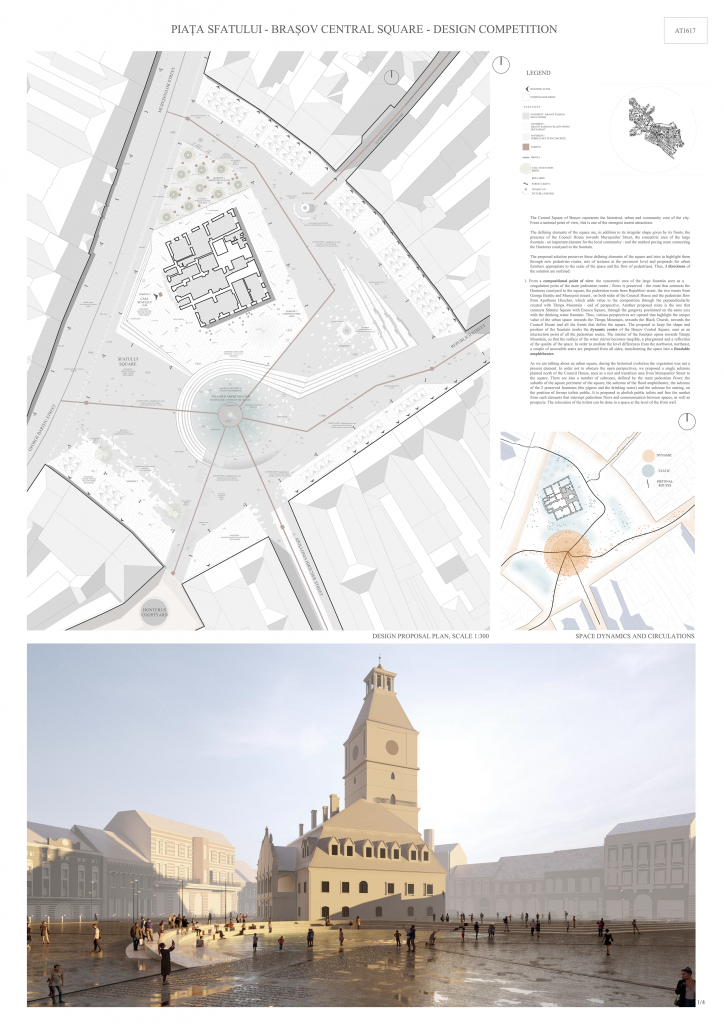
The Central Square of Brașov represents the historical, urban and community core of the city. From a national point of view, this is one of the strongest tourist attractions.
The defining elements of the square are, in addition to its irregular shape given by its fronts, the presence of the Council House towards Mureșenilor Street, the concentric area of the large fountain – an important element for the local community – and the marked paving route connecting the Honterus courtyard to the fountain.
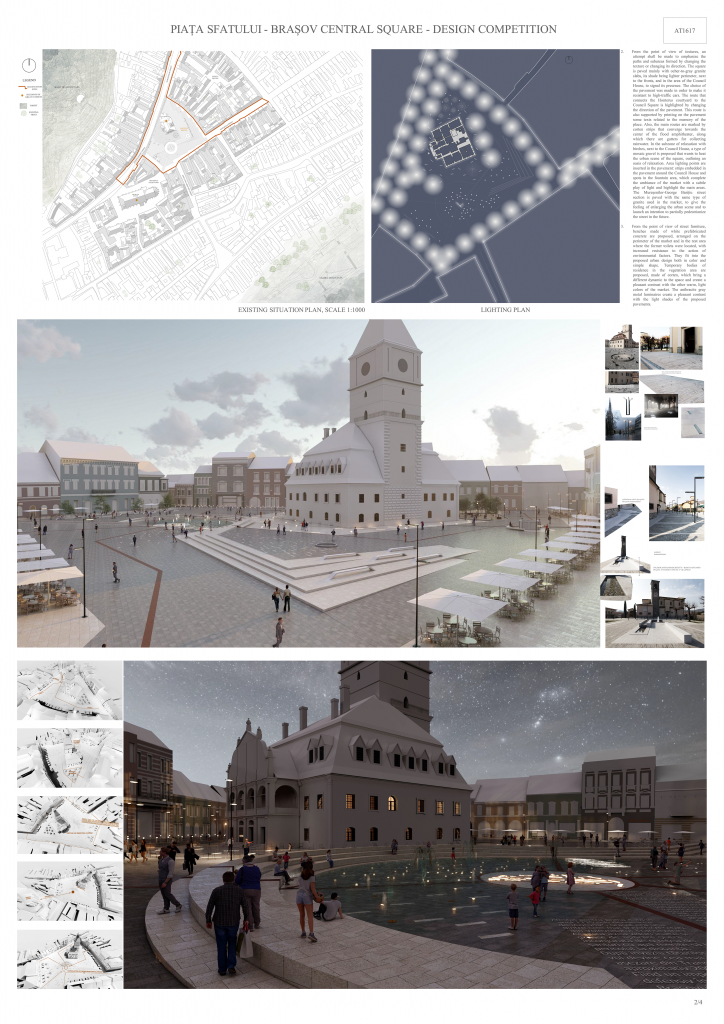
The proposed solution preserves these defining elements of the square and tries to highlight them through new pedestrian routes, sets of textures at the pavement level and proposals for urban furniture appropriate to the scale of the space and the flow of pedestrians. Thus, 3 directions of the solution are outlined:
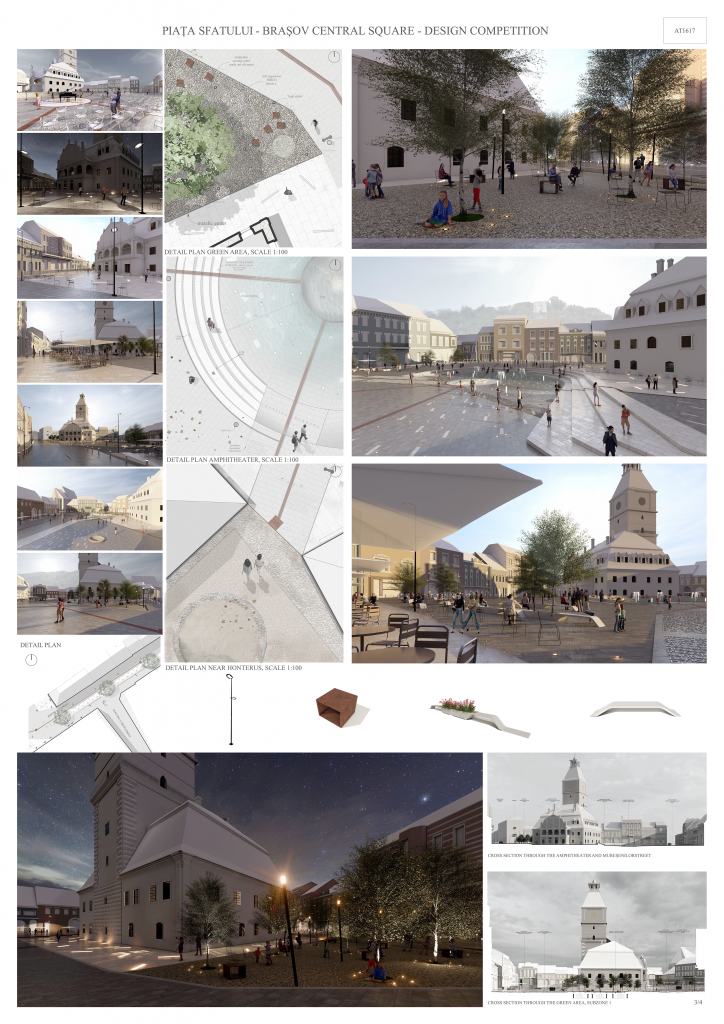
- From a compositional point of view: the concentric area of the large fountain seen as a coagulation point of the main pedestrian routes / flows is preserved – the route that connects the Honterus courtyard to the square, the pedestrian route from Republicii street, the two routes from George Barițiu and Mureșenii streets , on both sides of the Council House and the pedestrian flow from Apollonia Hirscher, which adds value to the composition through the perpendicularity created with Tâmpa Mountain – end of perspective. Another proposed route is the one that connects Sfatului Square with Enescu Square, through the gangway positioned on the same axis with the drinking water fountain. Thus, various perspectives are opened that highlight the unique value of the urban space: towards the Tâmpa Mountain, towards the Black Church, towards the Council House and all the fronts that define the square. The proposal to keep the shape and position of the fountain marks the dynamic center of the Brașov Central Square, seen as an intersection point of all the pedestrian routes. The interior of the fountain opens towardsTâmpa Mountain, so that the surface of the water mirror becomes tangible, a playground and a reflection of the quality of the space. In order to mediate the level differences from the northwest, northeast, a couple of accessible stairs are proposed from all sides, transforming the space into a floodable amphitheater.
As we are talking about an urban square, during the historical evolution the vegetation was nota present element. In order not to obscure the open perspectives, we proposed a single subzone planted north of the Council House, seen as a rest and transition area from Mureșenilor Street to the square. There are also a number of subzones, defined by the main pedestrian flows: the suburbs of the square perimeter of the square, the subzone of the flood amphitheater, the subzone of the 2 preserved fountains (the pigeon and the drinking water) and the subzone for seating, on the position of former toilets public. It is proposed to abolish public toilets and free the market from such elements that interrupt pedestrian flows and communication between spaces, as well as prospects. The relocation of the toilets can be done in a space at the level of the front wall. - From the point of view of textures, an attempt shall be made to emphasize the paths and subareas formed by changing the texture or changing its direction. The square is paved mainly with ocher-to-gray granite slabs, its shade being lighter perimeter, next to the fronts, and in the area of the Council House, to signal its presence. The choice of the pavement was made in order to make it resistant to high-traffic cars. The route that connects the Honterus courtyard to the Council Square is highlighted by changing the direction of the pavement. This route is also supported by printing on the pavement some texts related to the memory of the place. Also, the main routes are marked by corten strips that converge towards the center of the flood amphitheater, along which there are gutters for collecting rainwater. In the subzone of relaxation with birches, next to the Council House, a type of mosaic gravel is proposed that wants to heat the urban scene of the square, outlining an oasis of relaxation. Area lighting points are inserted in the pavement: strips embedded in the pavement around the Council House and spots in the fountain area, which complete the ambiance of the market with a subtle play of light and highlight the main areas. The Mureșenilor-George Barițiu street section is paved with the same type of granite used in the market, to give the feeling of enlarging the urban scene and to launch an intention to partially pedestrianize the street in the future.
- From the point of view of street furniture, benches made of white prefabricated concrete are proposed, arranged on the perimeter of the market and in the rest area where the former toilets were located, with increased resistance to the action of environmental factors. They fit into the proposed urban design both in color and simple shape. Temporary bodies of residence in the vegetation area are proposed, made of corten, which bring a different dynamic to the space and create a pleasant contrast with the other warm, light colors of the market. The anthracite gray metal luminaires create a pleasant contrast with the light shades of the proposed pavements.
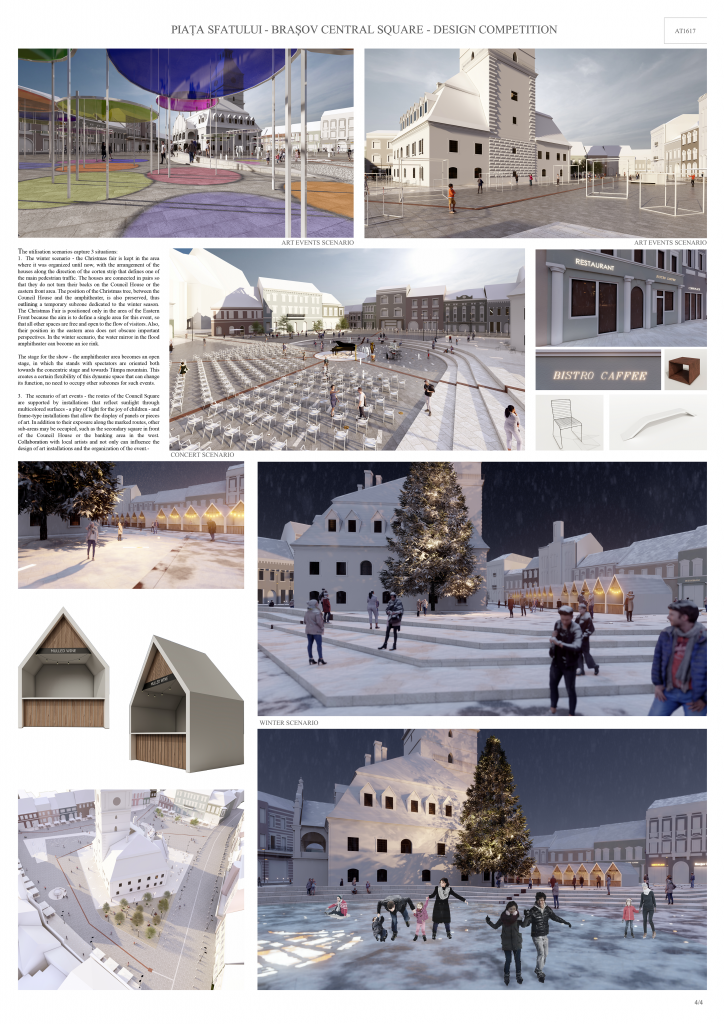
The utilisation scenarios capture 3 situations:
- The winter scenario – the Christmas fair is kept in the area where it was organized until now, with the arrangement of the houses along the direction of the corten strip that defines one of the main pedestrian traffic. The houses are connected in pairs so that they do not turn their backs on the Council House or the eastern front area. The position of the Christmas tree, between the Council House and the amphitheater, is also preserved, thus outlining a temporary subzone dedicated to the winter season. The Christmas Fair is positioned only in the area of the Eastern Front because the aim is to define a single area for this event, so that all other spaces are free and open to the flow of visitors. Also, their position in the eastern area does not obscure important perspectives. In the winter scenario, the water mirror in the flood amphitheater can become an ice rink.
- The stage for the show – the amphitheater area becomes an open stage, in which the stands with spectators are oriented both towards the concentric stage and towards Tâmpa mountain. This creates a certain flexibility of this dynamic space that can change its function, no need to occupy other subzones for such events.
- The scenario of art events – the routes of the Council Square are supported by installations that reflect sunlight through multicolored surfaces – a play of light for the joy of children – and frame-type installations that allow the display of panels or pieces of art. In addition to their exposure along the marked routes, other sub-areas may be occupied, such as the secondary square in front of the Council House or the banking area in the west. Collaboration with local artists and not only can influence the design of art installations and the organization of the event.