





110 – TM1504 – SC CUMULUS ARCHITECTURE SRL


Main author: arh. Adrian Razvan Soare
Coauthors: arh. Mihnea Gradinariu, arh. Adrian Perdica, arh. Flavius Busuioc, arh. Raluca Grecea
Architecture collaborators: arh. Magda Vieriu, arh. Octavian Hrebenciuc, arh. Vlad Somacescu, arh. Yasmin Asan, Arh. Ioan Stetca, arh. Ruxandra Grigoras, arh. Costin Beekman
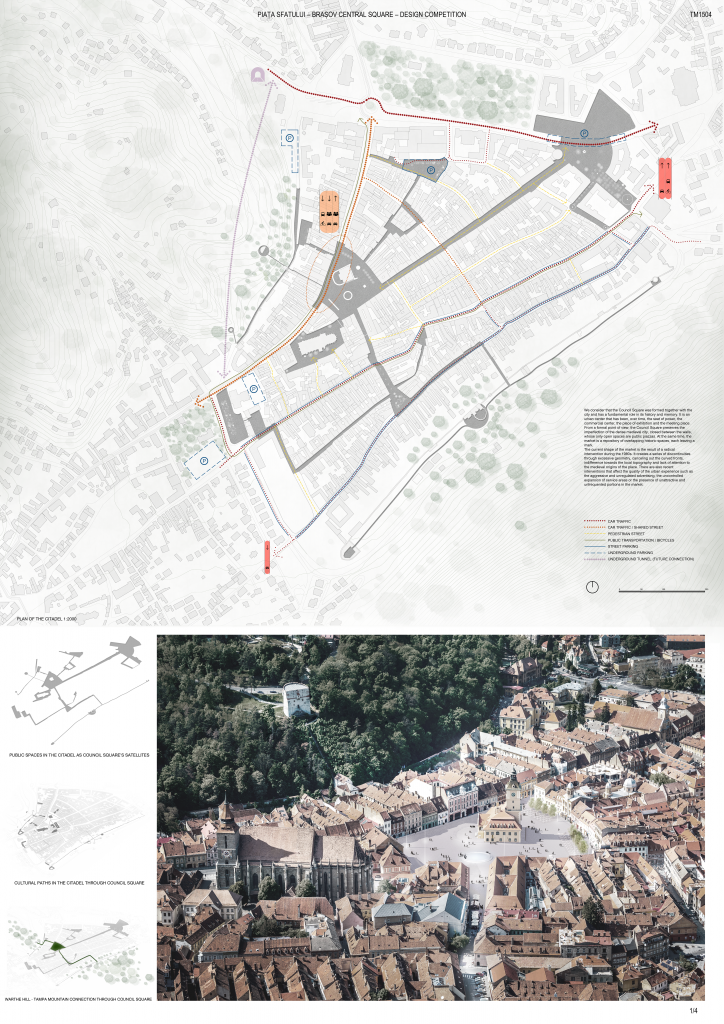
Piata Sfatului: a medieval square with no needs for design
The Old City of Brasov was built around her central square, Piata Sfatului (The Council Square), a place that has a fundamental role in its history and memory. It is, from an affective, symbolical and urbanistic point of view, the centre of the city that has been, over time, the seat of power, the commercial centre, the place of exhibition, of public events and of the social contacts.
From a formal point of view, the Council Square preserves the imperfection and irregularity of the dense medieval city, closed between the walls, whose only open spaces are its public squares. At the same time, the square is a repository of overlapping historic layers of events, each leaving a more visible or faded trace.
The current design of the square is the result of a radical intervention during the 1980s. It creates a series of discontinuities through excessive geometry contradicting its irregular fronts, indifference towards the local topography and lack of sensibility to the medieval origins of this place. There are also recent interventions that affect the quality of the urban experience such as the aggressive and unregulated advertising, the uncontrolled expansion of service areas or the presence of unattractive and unfrequented portions in the square.
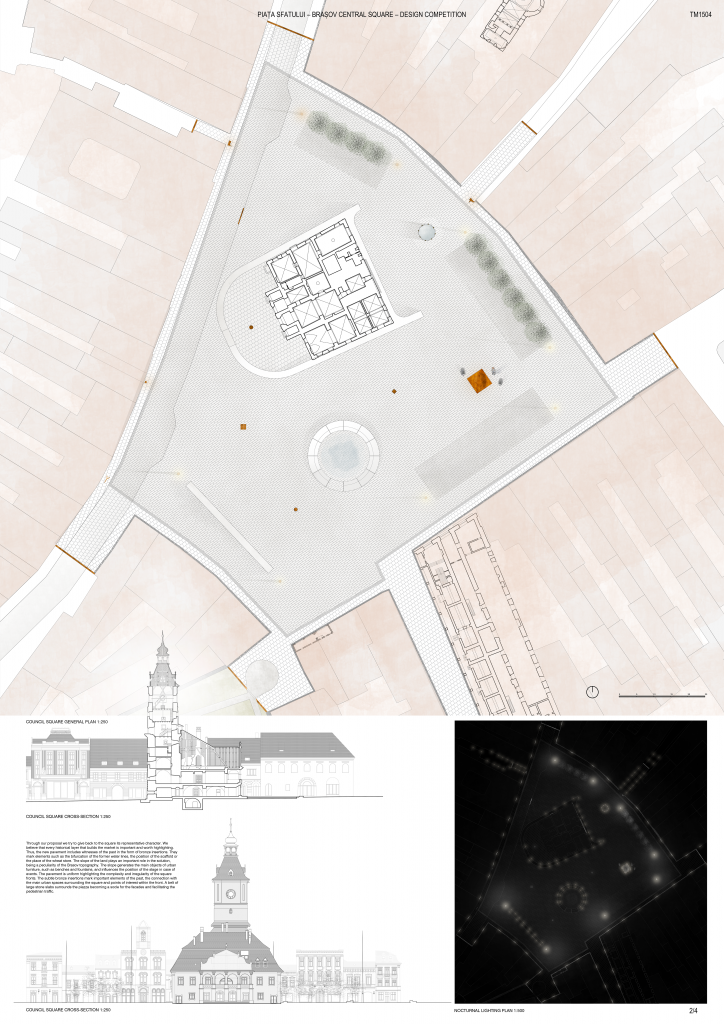
Through our proposal we try to give back to the square its medieval, central and representative character. Also, we believe that every historical layer that builds the square is important and worth highlighting, for a better understanding and affective relation with this place. Thus, the new pavement includes witnesses of the past in the form of bronze insertions. They mark elements such as the bifurcation of the former water lines, the guilds that used to populate each “row” of houses, details about each house of stories of the personalities that lived there.
The natural slope of the land plays an important role in the solution, being a peculiarity of the Brasov topography. The square is now a single main slope which generates also the main objects of urban furniture, such as benches and fountains, and influences the position of the stage in case of events.
The pavement has almost “no design”, highlighting the complexity and irregularity of the square fronts. The subtle bronze insertions mark important elements of the past, the connection with the main urban spaces surrounding the square and points of interest within the rows of buildings.
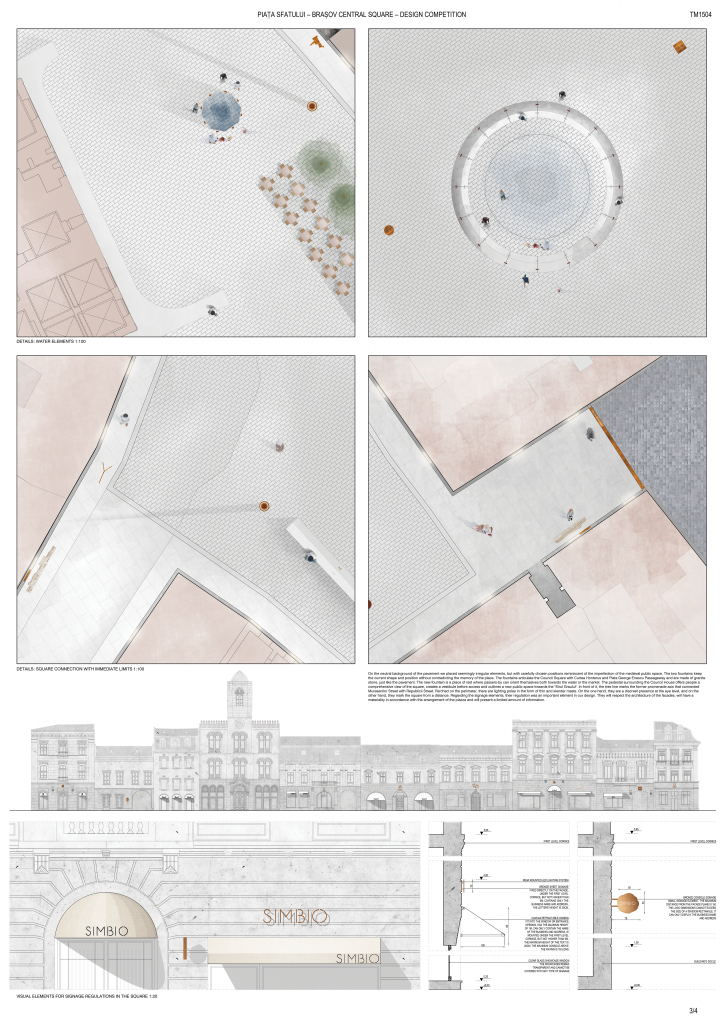
A belt of large stone slabs surrounds the square, becoming a base mark for the facades and facilitating the pedestrian traffic. On the neutral background of the pavement, we placed seemingly irregular elements, but with carefully chosen positions reminiscent of the imperfection of the medieval public space. The same pavement is extended towards the N-V side, the segment of Muresenilor St that enters the square becoming a shared space with pedestrian priority and a limited traffic speed.
The two fountains will keep their current shape and position without contradicting the memory of the place. The fountains articulate the Council Square with Curtea Honterus and Piata George Enescu Passageway and are made of granite stone, just like the pavement. The new fountain is a place of rest where passers-by can orient themselves both towards the water or the square.
The pedestal surrounding the Council House offers people a comprehensive view of the square, creates a vestibule before access and outlines a new public space towards the “Wheat Row”. In front of it, the tree lines mark the former promenade axis that connected Muresenilor Street with Republicii Street.
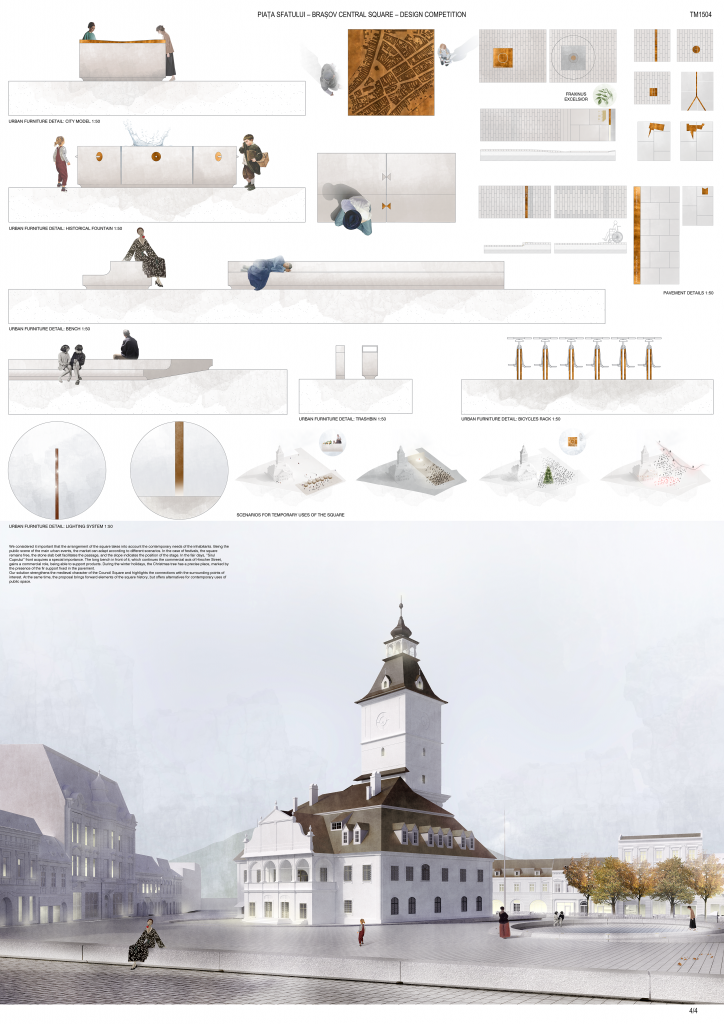
The pedestal and the small entry plaza in front of the Council House, the long bench along the “Copper Row” and the new round fountain are the main urban furniture elements in the square. They mark meeting and gathering places and places that offers you the best views towards the square, the Black Church or the nearby green mountains.
Perched on the perimeter, there are lighting poles in the form of thin and slender masts which integrates inside their simple, shape the urban lighting. On the one hand, they are a discreet presence in the square, having various hights, adapted to the built context, and on the other hand, they mark the square from a distance.
Regarding the signage elements, their regulation was an important element in our design. They will respect the architecture of the facades, will have a materiality in accordance with the arrangement of the square and will present a limited amount of information.
We considered important that the arrangement of the square takes into consideration the contemporary needs of the inhabitants. Being the public scene of the main urban events, the square can adapt according to different scenarios. In the case of festivals, the free square becomes the hall, the stone slab belt facilitates the passage, and the slope indicates the position of the stage. In the fair days, “Copper Row” front acquires a special importance. The long bench in front of it, which continues the commercial axis of Hirscher Street, gains a commercial role, being able to support products. During the winter holidays, the Christmas Tree has a precise position, marked by the presence of the support fixed in the pavement.
Trough the subtle and simple intervention, the proposed solution strengthens the medieval character of the Square, emphasizes the rich architectural heritage of its surrounding buildings, and marks the connections with the surrounding points of interest. At the same time, the proposal brings forward stories from the past and offers opportunities for contemporary and cultural uses of the public space.