





114 – MI3131 – POSTER SRL, REPER ATELIER SRL


Autor principal / Main Author: POSTER SRL & REPER ATELIER SRL
Coautori / Co-authors: Arh. Ștefan Simion, arh. Irina Meliță, arh. Alina Rizescu
Colaboratori arhitectură/ Architectural collaborators: Stud. arh Mirela Ilie, stud. arh. Andrada Moțățăianu, stud. arh. Elena Cercel, stud. arh. Andra Tudor, stud. arh. Maria Simion
Colaboratori specialități / Specialty collaborators: Cross Design SRL, ing. structuri Horia Mihnea, Loisir Landscape Design, peisagist Dan Rusănescu, Muur Atelier35, peisagist Radu Georgescu
The Transformation of the Rulmentul Platform: A Catalyst for Urban Growth
The reimagined Rulmentul platform, anchored by initial investments in a vibrant park and cultural center, is poised to become a pivotal link between the city of Brașov and its rapidly expanding northern satellites, including Hărman, Sânpetru, and Stupini. Our proposal introduces a connective axis (on the southern limit of the site) that can evolve into an extended ring road, facilitating the integration of future urban developments in the region. As the site’s functions expand—particularly through the cultural and commercial repurposing of the historic hangars—Rulmentul will gain strategic importance, transforming from a local center point into a metropolitan hub. This development will act as a vital “seed” for Brașov’s continued urban evolution, fostering growth and connectivity on a regional scale.
Green spaces urban scale
The future park, with its unique feature as a former industrial structure that is in symbiotic relationship with a new, green topography, will become part of a system that will link Rulmentul to Brasov’s natural areas – nearby Triaj Deposits, Lempes Hills and Tampa Mountain.
The green “spine” of the Timis river is strongly connected with Rulmentul trough the green lines between the proposed buildings that “spill” in the green of the new park.
The Future Park: A Fusion of Industry and Nature
The future park, distinguished by its unique integration of former industrial structures with a newly created green topography, will become a vital element of a broader system connecting Rulmentul to Brașov’s other green spaces, such as Tractorul Park and beyond. This evolving network will form a seamless green “spine,” following the course of the Timiș River, creating a blue-green corridor that harmoniously links natural and urban environments.
The green spaces between the proposed buildings will extend into the park, creating fluid connections that reinforce Rulmentul’s integration with the surrounding landscape. These green pathways will act as conduits, allowing nature to “spill” into the urban fabric and further strengthen the park’s role as a cornerstone of Brașov’s ecological and urban development.
Preliminary considerations
- The enfilade of aircraft hangars produces a strong, coherent urban form. The enfilade of the built volumes requires a free space in front so that it can be perceived.
- Maintaining only the essence of the industrial architecture: Strungarie & Hala 6
- The obsessive repetition of a seemingly infinite structure is at the core of the beauty and value of this built heritage.
- Opening the Facades: the problematic aspect of the limits of such a structure. At its absolute state, such a repetitive, infinite field has difficulties in accepting a limit. The Façade can never be the expression of what it holds within. So the facades (and the built add-ons) are to be forgotten.
The project
- A stone base will hold together the enfilade of aircraft hangars. The free space in front of them becomes a noble, mineral plaza – for activities connected with the future functions of the hangars and also unforeseen activities.
- The Grid of Trees
- The Grid of Trees mirrors the grid of pillars. The artificial (12x24m) is doubled by the natural (12x12m). Their rhythms are intertwined, trying to keep up with each other. In the end, the verticality of the tree trunks merges with the one of the columns. The grid is without hierarchy: it can be traveled freely in any wanted way. The ground finishing should be stabilized gravel.
- The heritage is not only about built volumes; it is also about this vast territory. The Grid of Trees is territorial in its unconcealed desire to cover the entire field.
- The Grid of Trees is the natural background of the park. Events, follies, accidents test its strength.
- & the Red Alley
- The Red Alley has the scale of the Grid of Trees, while being its counterweight: it is an oriented path, establishing hierarchy and connecting the most important places of the park.
- The park perceived through the Red Alley offers a series of distinct experiences.
- It is called the Red Alley because its ground finish is red asphalt and it’s being flanked by a series of Norwegian red maples.
Strungarie
- The roof & the idea of vertical limit
- In search of a special light, and given the vast depth of this deep building, the envelope of the roof on the first spans is removed; the beams and metallic structure remain. The façade as horizontal or vertical limit is thus completely blurred.
- To amplify this, two rows of trees grow through the remaining skeleton of the old Strungarie. Nature and Artifice literally blend in.
- a Permeable roof that, while giving shelter from rain and sun, opens up to allow rain to produce a controlled water system that becomes land-art itself by bringing temporary water curtains to the grid of the park.
- Opening up the middle. This structure is removed for significant reasons: creating an urban room when coming into the park from across the 13th of December street; bringing the light inside the territory occupied by Strungarie; creating the premise for the introduction of an event/Follie that could enhance the general experience of the park; taking into account a possible spatial separation during Phase 1 between the park and the industrial hall still used.
- The ground of the Park: removing the concrete. The park needs to breathe, to have a permeable soil which allows plants and certain animals to inhabit this territory. The resulting debris is seen as a resource.
The Mound
- using the so-obtained debris to create a third mound inside the exact core of the project (and so, emphasizing a particular, local typology of natural-artificial forms). It creates a new topography, with an out-of-the-system perspective – to perceive the industrial heritage in various ways as you climb towards the top and from above, to see the repetitive roofs as a pedestal for the mountains
- the landscape resonates and amplifies the Mound, being structured on horizontal layers, from bottom to the top : stabilized gravel, accessible meadow, medium height vegetation and again, on the top of the Mound– walk-on meadow to allow maximum visibility towards the roofs and mountains.
- Phase 1 landscape barrier. The Mound also provides a natural barrier between the first part of the park and the industrial hall maintained for the first ten years.
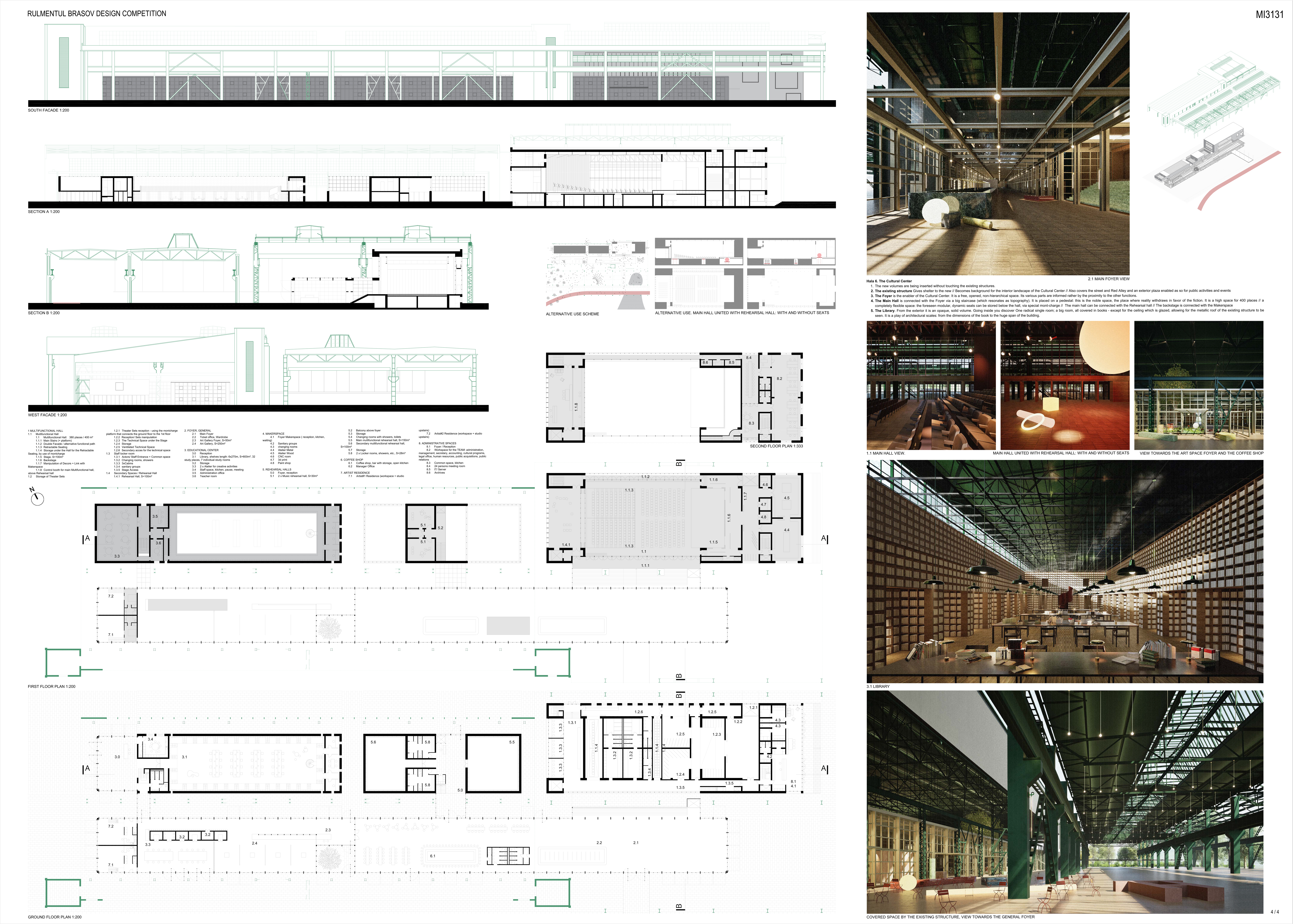
Hala 6. The Cultural Center
- The new volumes are being inserted without touching the existing structures.
- The existing structure:
- Gives shelter to the new
- Becomes background for the interior landscape of the Cultural Center
- Also covers the street and Red Alley and an exterior plaza enabled as so for public activities and events
- The Foyer is the enabler of the Cultural Center. It is a free, opened, non-hierarchical space. Its various parts are informed rather by the proximity to the other functions. It is a visually 360º opened space towards the particular industrial landscape from within the structure. From here you can see everything – and also be seen.
- The Main Hall.
- Connected with the Foyer via a big staircase (which resonates as topography). It is placed on a higher level, on a pedestal: this is the noble space, the place where theater, fiction, movies, or other artistic shows draw the viewer from reality
- A high space for 400 places. Again, the play of architectural scales is at the core of architectural definition.
- Completely flexible space: the foreseen modular, dynamic seats can be stored below the hall, via special montcharge.
- The main hall can be connected with the Rehearsal hall.
- The backstage is connected with the Makerspace
- The Library. From the exterior it is an opaque, solid volume. Going inside you discover One radical single room; a big room, all covered in books – except for the ceiling which is glazed, allowing for the metallic roof of the existing structure to be seen. It is a play of architectural scales: from the dimensions of the book to the huge span of the building. Small, hidden individual study rooms are placed somehow behind the books.