





119 – RR0806 – STUDIO 82 SRL


Autori principali: Octav Silviu OLĂNESCU, Anamaria OLĂNESCU, Andrada MAIER-DRĂGAN, Petrică MAIER-DRĂGAN, Oana Antonia FILIP
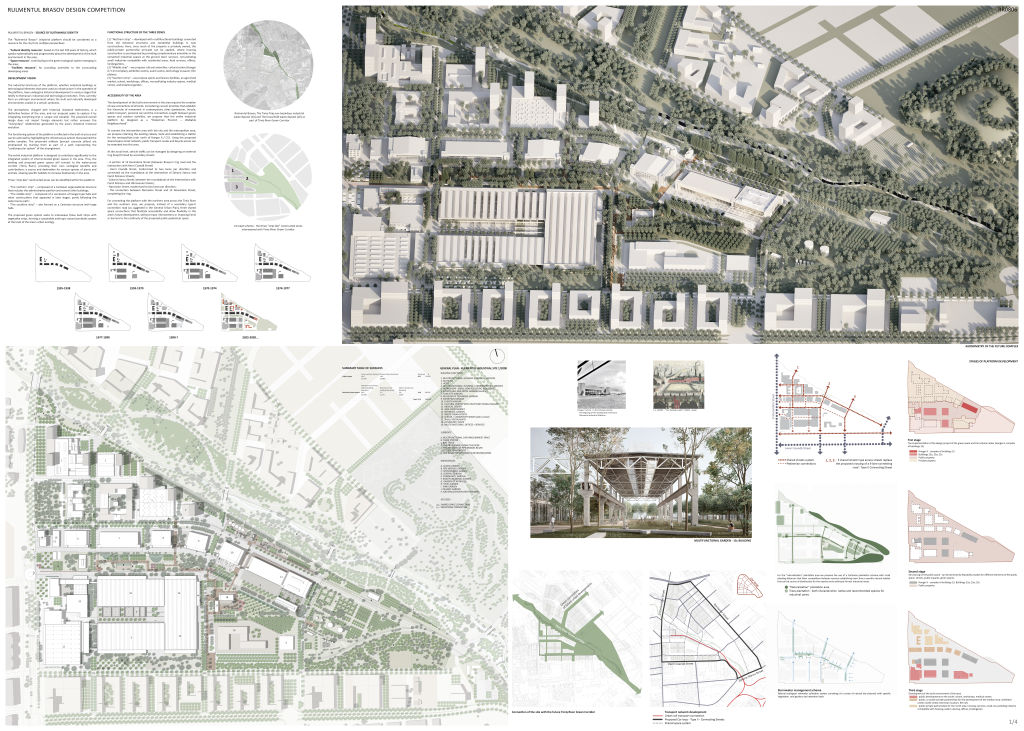
“Propunerea consideră Platforma Rulmentul ca o resursă pentru orașul Brașov, atât în ceea ce privește identitatea culturală, cât și dezvoltarea spațial-ecologică, iar acest lucru este apreciat de juriu, fiind, de asemenea, în conformitate cu tema concursului.”– aprecierea Juriului
RULMENTUL BRAȘOV – SOURCE OF SUSTAINABLE IDENTITY
The “Rulmentul Brașov” industrial platform should be considered as a resource for the city from multiple perspectives:
- “Cultural identity resource”, based on the last 100 years of history, which speaks systematically and progressively about the development of the built environment in the area;
- “Space resource”, contributing to the green ecological system emerging in the area;
- “Facilities resource”, for providing amenities to the surrounding developing areas.
DEVELOPMENT VISION
The industrial structures of the platform, whether industrial buildings or technological elements that were used as infrastructure in the operation of the platform, have undergone historical development in various stages that testify to Romania’s industrial and technological evolution. They currently form an anthropic environment where the built and naturally developed environments coexist in a certain symbiosis.
The atmosphere, charged with historical industrial testimonies, is a distinctive feature of the area, and our proposal seeks to capture it by integrating everything that is unique and valuable. The proposed overall design does not import foreign elements but rather uncovers the “involuntary” relationships generated by the area’s industrial historical evolution.
The functioning system of the platform is reflected in the built structure and can be valorised by highlighting the infrastructure system that powered the entire complex. The preserved artifacts (precast concrete pillars) are emphasized by marking them as part of a path representing the “cardiovascular system” of the arrangement.
The entire industrial platform is designed to contribute significantly to the integrated system of interconnected green spaces in the area. Thus, the existing and proposed green spaces will connect to the watercourse corridor (Timiș River), providing their own ecological benefits and contributions: a source and destination for various species of plants and animals, shaping specific habitats to increase biodiversity in the area.
Three “strip-like” constructed zones can be identified within the platform:
- “The northern strip” – composed of a Cartesian organisational structure that includes the administrative pavilion and several other buildings;
- “The middle strip” – composed of a succession of hangar-type halls and other constructions that appeared in later stages, partly following the watercourse path;
- “The southern strip” – also formed on a Cartesian structure with large halls.
The proposed green system seeks to interweave these built strips with vegetative strips, forming a sustainable anthropic-natural symbiotic system at the level of the area’s urban ecology.
FUNCTIONAL STRUCTURE OF THE THREE ZONES
(1) “Northern strip” – developed with multifunctional buildings converted from old industrial structures and residential buildings in new constructions. Here, since much of the property is privately owned, the public-private partnership principle can be applied, where housing construction is accompanied by providing complementary amenities in the converted industrial spaces at the ground level: services, non-polluting small industries compatible with residential areas, food services, offices, kindergartens.
(2) “Middle strip” – we propose cultural amenities: cultural centre (Hangar 6 / C15 Complex), exhibition centre, event centre, technology museum, film plateau.
(3) “Southern strip” – we propose sports and leisure facilities, an agro-food market, school, workshops, offices, non-polluting industry spaces, medical centre, and botanical garden.
ACCESSIBILITY OF THE AREA
The development of the built environment in the area requires the creation of new connections of all kinds. Considering current priorities that establish the hierarchy of movement in contemporary cities (pedestrian, bicycle, public transport, personal car) and the connections sought between green spaces and outdoor activities, we propose that the entire industrial platform be designed as a “Pedestrian Precinct – Walkable Neighbourhood”.
To connect the intervention area with the city and the metropolitan area, we propose retaining the existing railway route and establishing a station for the metropolitan train north of Hangar 6 / C15. Using the proposed shared space street network, public transport routes and bicycle access can be extended into this area.
At the zonal level, vehicle traffic can be managed by designing an external ring (loop) formed by secondary streets:
- A portion of 13 Decembrie Street (between Brașov’s ring road and the intersection with Henri Coandă Street)
- Henri Coandă Street, modernised to two lanes per direction and connected via the roundabout at the intersection of Zaharia Stancu and Camil Petrescu Streets;
- Zaharia Stancu Street, between the roundabouts at the intersections with Camil Petrescu and Hărmanului Streets;
- Narciselor Street, modernised to two lanes per direction;
- The connection between Narciselor Street and 13 Decembrie Street, completing the ring.
For connecting the platform with the northern area across the Timiș River and the southern area, we propose, instead of a secondary type-II connection road (as suggested in the General Urban Plan), three shared space connections that facilitate accessibility and allow flexibility in the area’s future development, without major interventions or imposing limits or barriers to the continuity of the proposed public pedestrian space.
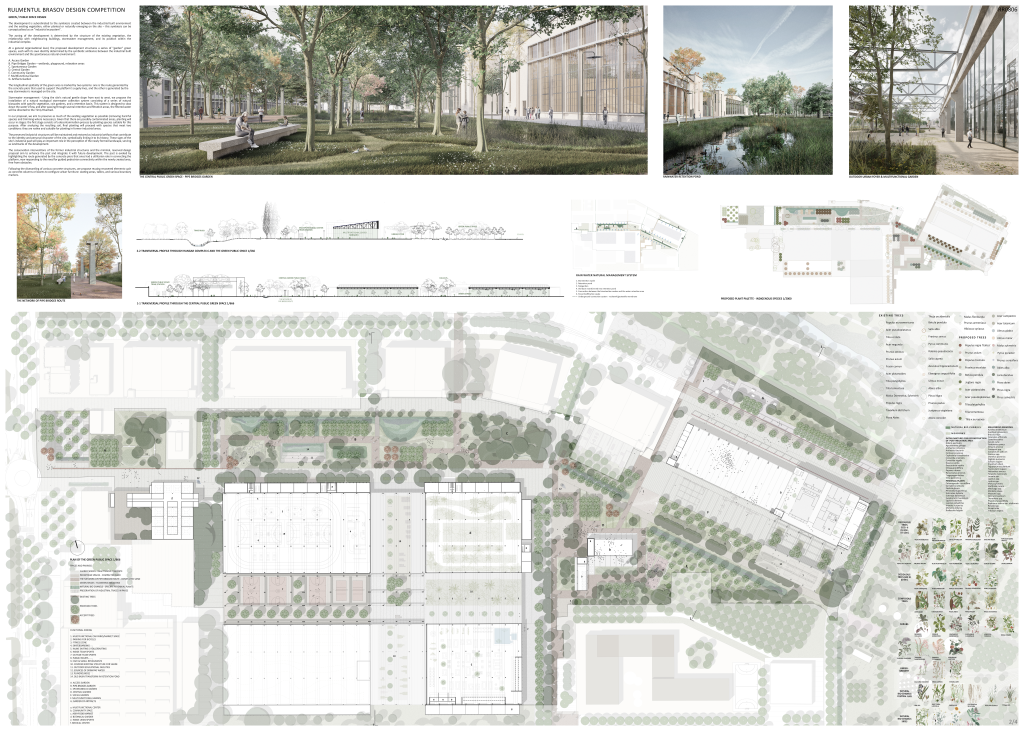
GREEN / PUBLIC SPACE DESIGN
The development is subordinated to the symbiosis created between the industrial built environment and the existing vegetation, either planted or naturally emerging on the site – this symbiosis can be conceptualised as an “industrial ecosystem”.
The zoning of the development is determined by the structure of the existing vegetation, the relationship with neighbouring buildings, stormwater management, and its position within the industrial complex.
At a general organisational level, the proposed development structures a series of “garden” green spaces, each with its own identity determined by the symbiotic ambiance between the industrial built environment and the spontaneous natural environment:
A. Access Garden
B. “Pipe Bridges Garden” – wetlands, playground, relaxation areas
C. Spontaneous Garden
D. Central Garden
E. Social Garden
F. Multifunctional Garden
G. Artifacts Garden
The longitudinal spatiality of the green area is marked by two systems: one is the route generated by the concrete piers that used to support the platform’s supply lines, and the other is generated by the way stormwater is managed on the site.
Stormwater management – Using the site’s natural gentle slope from east to west, we propose the installation of a natural ecological stormwater collection system consisting of a series of natural bioswales with specific vegetation, rain gardens, and a retention basin. This system is designed to slow down the water’s flow, and after passing through several retention and filtration areas, the filtered water will be directed to the Timiș Riverbed.
In our proposal, we aim to preserve as much of the existing vegetation as possible (removing harmful species and trimming where necessary).
Given that there are possibly contaminated areas, planting will occur in stages: the first stage consists of a decontamination process by planting species suitable for this purpose. After analysing the resulting soil, final planting will proceed with species that meet two conditions: they are native and suitable for planting in former industrial areas.
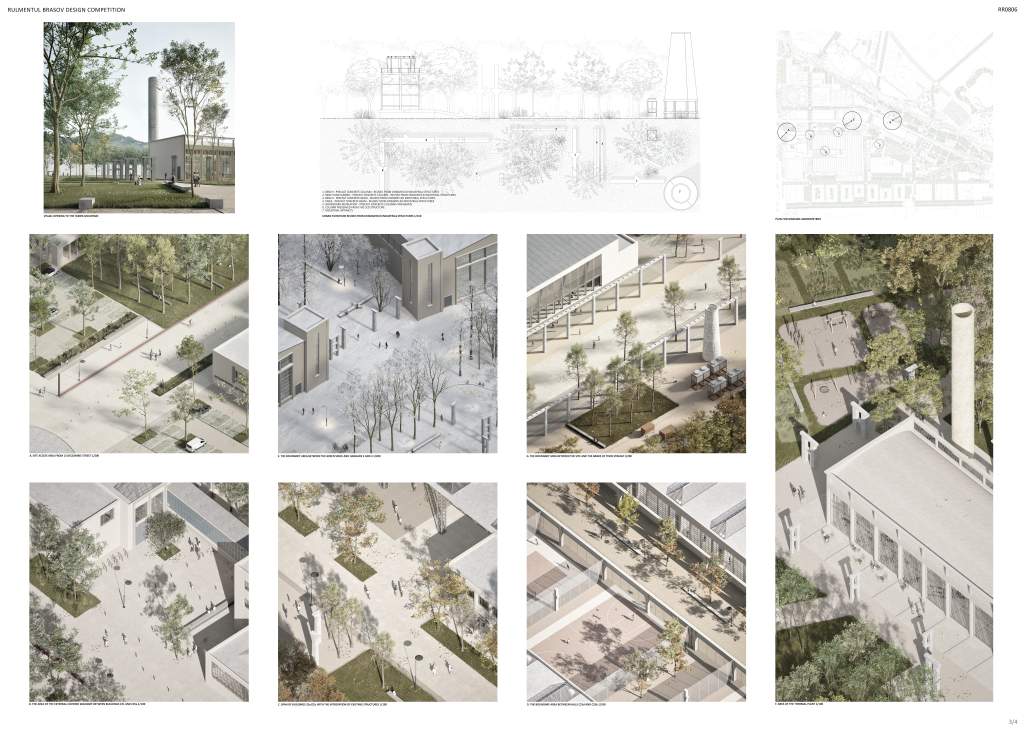
The preserved industrial structures will be maintained and restored as industrial artifacts that contribute to the identity and personal character of the site, symbolically linking it to its history. These signs of the site’s industrial past will play an important role in the perception of the newly formed landscape, serving as landmarks of the development.
The conservation interventions of the former industrial structures and the minimal, reserved design proposal aim to enhance the past and integrate it with future development. The past is evoked by highlighting the route generated by the concrete piers that once had a utilitarian role in connecting the platform, now responding to the need for guided pedestrian connectivity within the newly created area, free from obstacles.
Following the dismantling of various concrete structures, we propose reusing recovered elements such as concrete columns or beams to configure urban furniture: seating areas, tables, and various boundary markers.
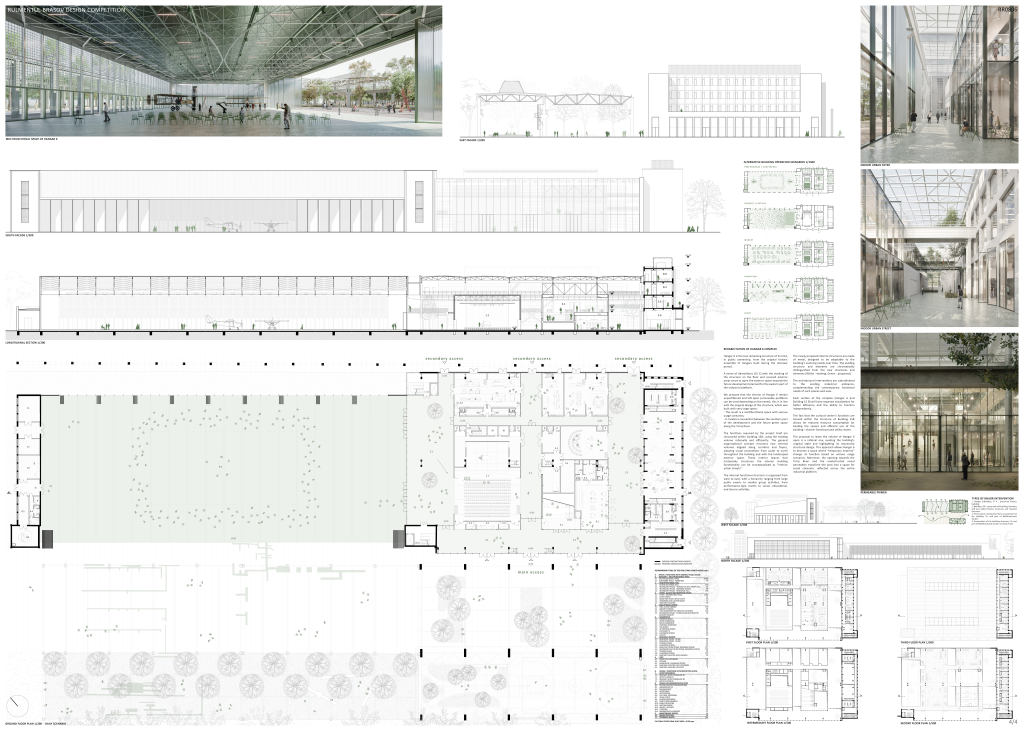
REHABILITATION OF HANGAR 6 COMPLEX
Hangar 6 is the last remaining structure of its kind, in public ownership, from the original historic ensemble of hangars built during the interwar period.
A series of demolitions (15 C) with the marking of the structure on the floor and covered exterior areas serve to open the exterior space towards the future development planned for the eastern part of the industrial platform.
We propose that the interior of Hangar 6 remain unpartitioned and left open (removable partitions can be used depending on the event); this is in line with the original design of the structure, which was built with very large spans:
- The result is a multifunctional space with various usage scenarios;
- It creates a connection between the southern part of the development and the future green space along the Timiș River.
The functions required by the project brief are structured within building 15B, using the existing volume rationally and efficiently. The general organisational concept envisions two internal volumes aligned along corridors and foyers, allowing visual connections from south to north throughout the building and with the landscaped exterior space. These interior spaces that Cartesianly structures the interior building functionality can be conceptualised as “interior urban streets”.
The internal functional structure is organised from west to east, with a hierarchy ranging from large public events to smaller group activities, from performance-type events to social, educational, and leisure activities.
The newly proposed interior structures are made of metal, designed to be adaptable to the building’s evolving needs over time. The existing structure and elements are chromatically distinguished from the new structures and elements (White – existing, Green – proposed).
The architectural interventions are subordinated to the existing industrial ambiance, complementing the contemporary functional needs of such spaces and uses.
Each section of the complex (Hangar 6 and Building 15 B) will have separate installations for better efficiency and the ability to function independently.
The fact that the cultural centre’s functions are housed within the structure of Building 15B allows for reduced resource consumption for heating the spaces and efficient use of the building—shorter functional and utility routes.
The proposal to leave the volume of Hangar 6 open is a rational one, evoking the building’s original state and highlighting its impressive structural design. This approach allows Hangar 6 to become a space where “temporary imprints” change its function based on various usage scenarios. Moreover, the opening towards the Timiș River and the unobstructed visual perception transform the area into a space for social cohesion, reflected across the entire industrial platform.