





116 – AX1243 – KXL STUDIO SRL


Main author: arh. Nistor Andrei-Lucian
Co-author: arh. Alexandru Grindeanu
Architecture collaborators: arh. Andreea Netejoru, arh. Andreea Cojocia, arh. Cristina Ungureanu, arh. Oana Fofircă-Iacob, arh. Mihai, Țucă, arh. Teodor Tibar, arh. Tudor Rusu, arh. Oana Tutu-Grindeanu, arh. Stefan Tanase
Speciality collaborators: Urbanism: Urb. Vlad-Andrei Nour; Jurist Andreea Jişcanu
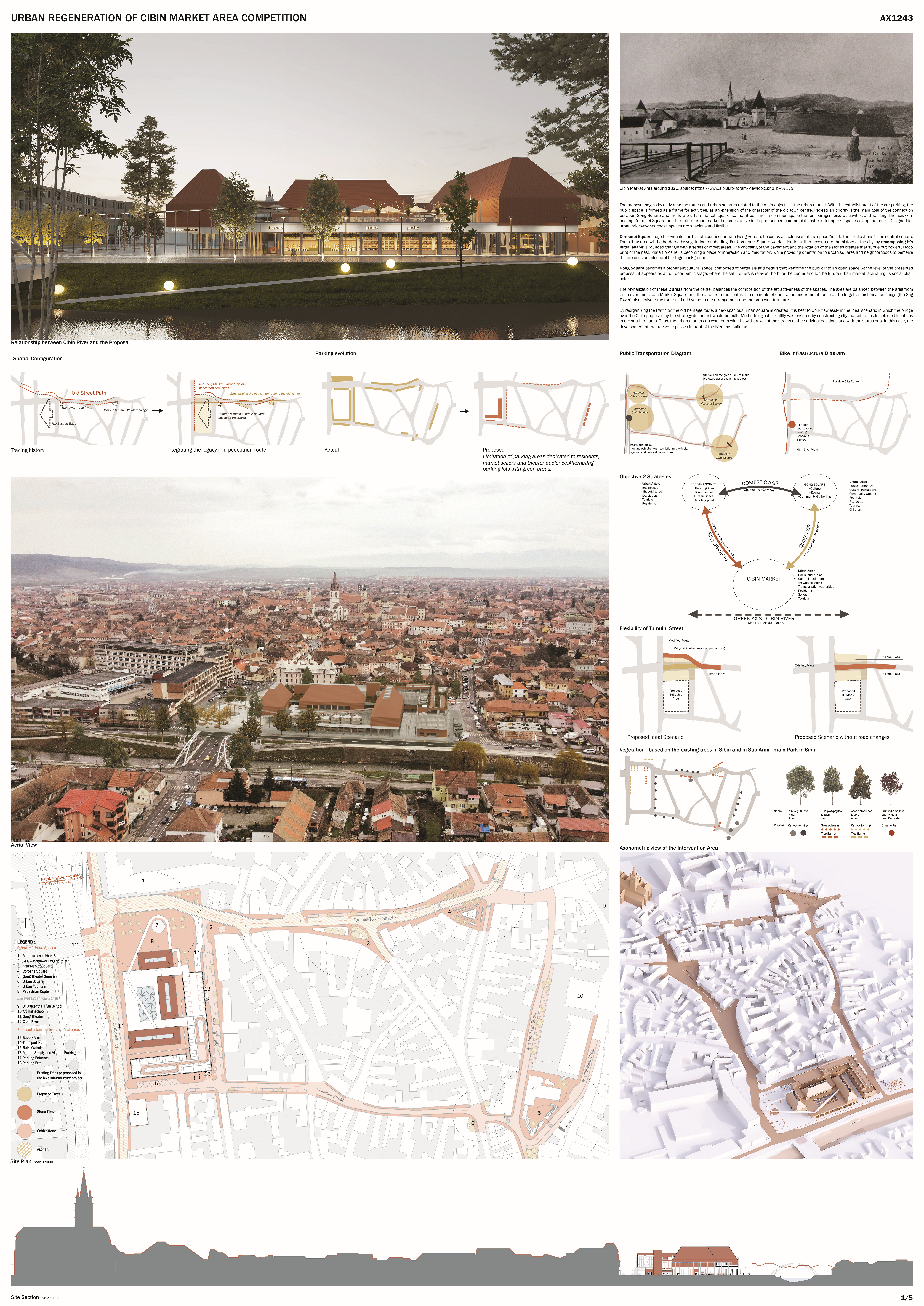
The proposal begins by activating the routes and urban squares related to the main objective – the urban market. With the establishment of the car parking, the public space is formed as a frame for activities, as an extension of the character of the old town centre. Pedestrian priority is the main goal of the connection between Gong Square and the future urban market square, so that it becomes a common space that encourages leisure activities and walking. The axis connecting Coroanei Square and the future urban market becomes active in its pronounced commercial bustle, offering rest spaces along the route. Designed for urban micro-events, these spaces are spacious and flexible.
Coroanei Square, together with its north-south connection with Gong Square, becomes an extension of the space “inside the fortifications” – the central square. The sitting area will be bordered by vegetation for shading. For Coroanei Square we decided to further accentuate the history of the city, by recomposing it’s initial shape: a rounded triangle with a series of offset areas. The choosing of the pavement and the rotation of the stones creates that subtle but powerful footprint of the past. Piata Coroanei is becoming a place of interaction and meditation, while providing orientation to urban squares and neighborhoods to perceive the precious architectural heritage background.
Gong Square becomes a prominent cultural space, composed of materials and details that welcome the public into an open space. At the level of the presented proposal, it appears as an outdoor public stage, where the set it offers is relevant both for the center and for the future urban market, activating its social character.
The revitalization of these 2 areas from the center balances the composition of the attractiveness of the spaces. The axes are balanced between the area from Cibin river and Urban Market Square and the area from the center. The elements of orientation and remembrance of the forgotten historical buildings (the Sag Tower) also activate the route and add value to the arrangement and the proposed furniture.
By reorganizing the traffic on the old heritage route, a new spacious urban square is created. It is best to work flawlessly in the ideal scenario in which the bridge over the Cibin proposed by the strategy document would be built. Methodological flexibility was ensured by constructing city market tables in selected locations in the southern area. Thus, the urban market can work both with the withdrawal of the streets to their original positions and with the status quo. In this case, the development of the free zone passes in front of the Siemens building.
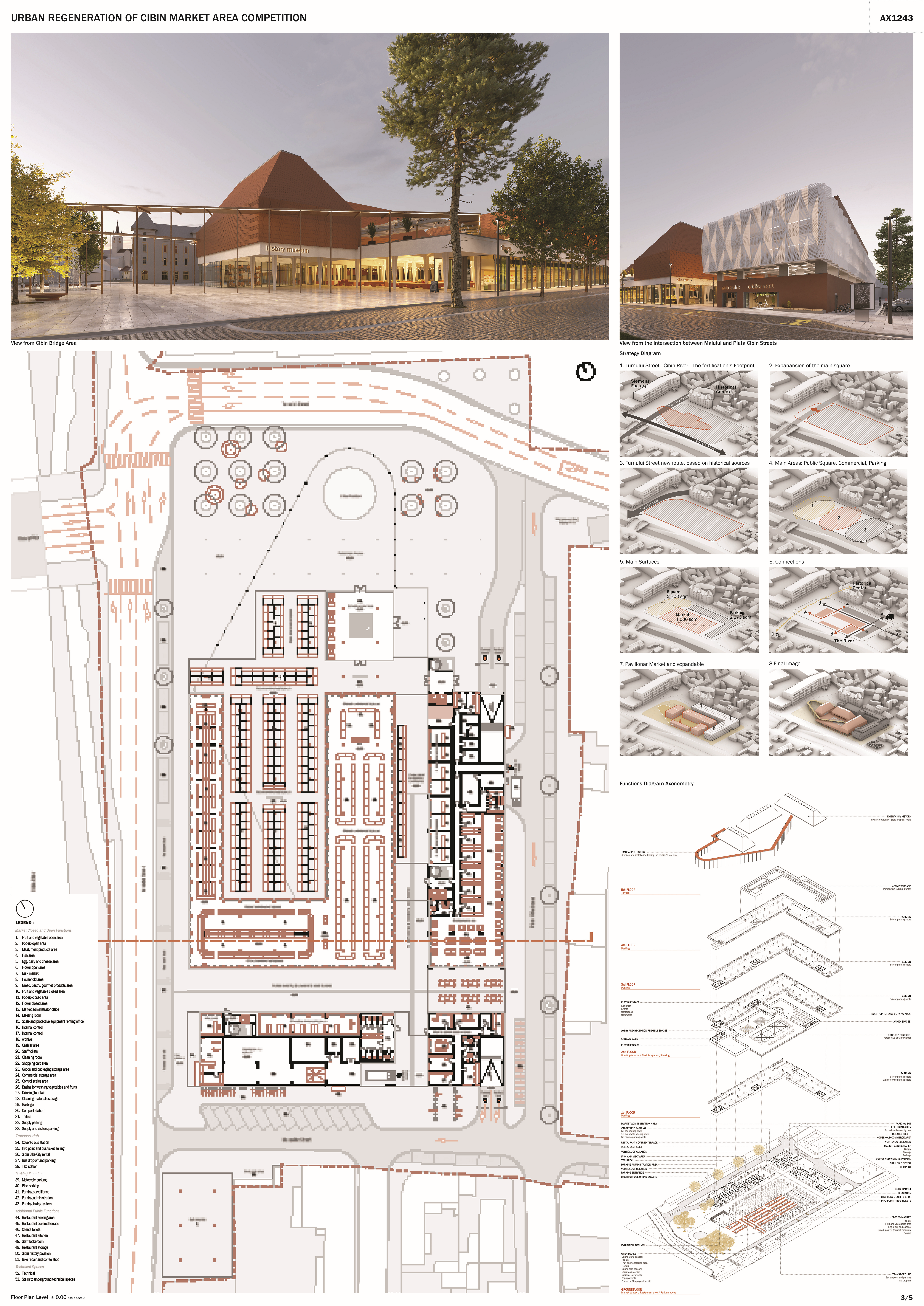
By diverting the route of the Tower Street, we have obtained a large site to recreate the atmosphere of the space between the bastion square. The project presents three main areas: the entrance space to the old city, the food market, and the parking area, which visually encloses the site but, through its permeability, creates connections with the urban fabric. To further enhance permeability, the overall complex highlights two commercial axes that together form the street grid of a “commercial village.”
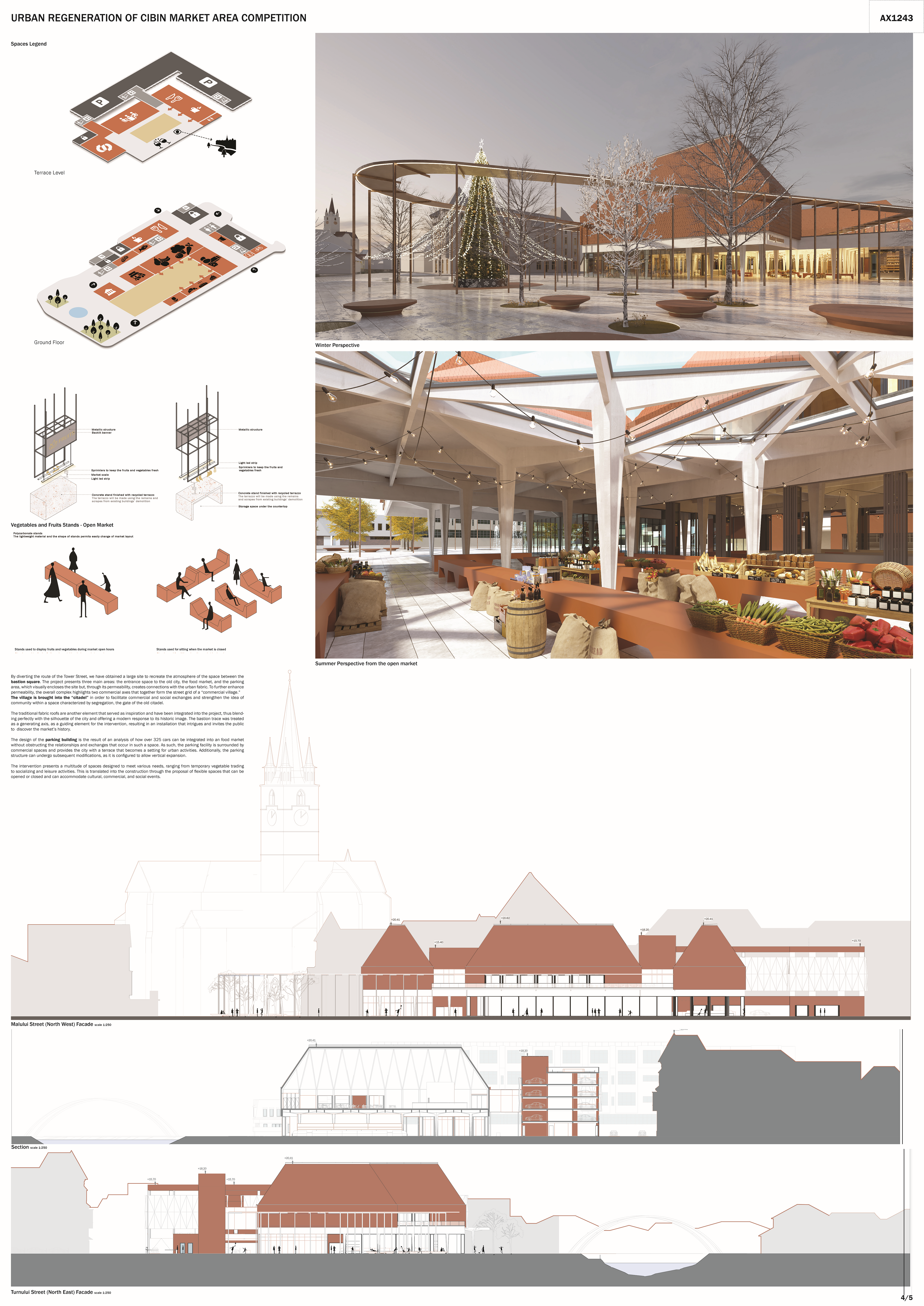
The village is brought into the “citadel” in order to facilitate commercial and social exchanges and strengthen the idea of community within a space characterized by segregation, the gate of the old citadel.
The traditional fabric roofs are another element that served as inspiration and have been integrated into the project, thus blending perfectly with the silhouette of the city and offering a modern response to its historic image. The bastion trace was treated as a generating axis, as a guiding element for the intervention, resulting in an installation that intrigues and invites the public to discover the market’s history.
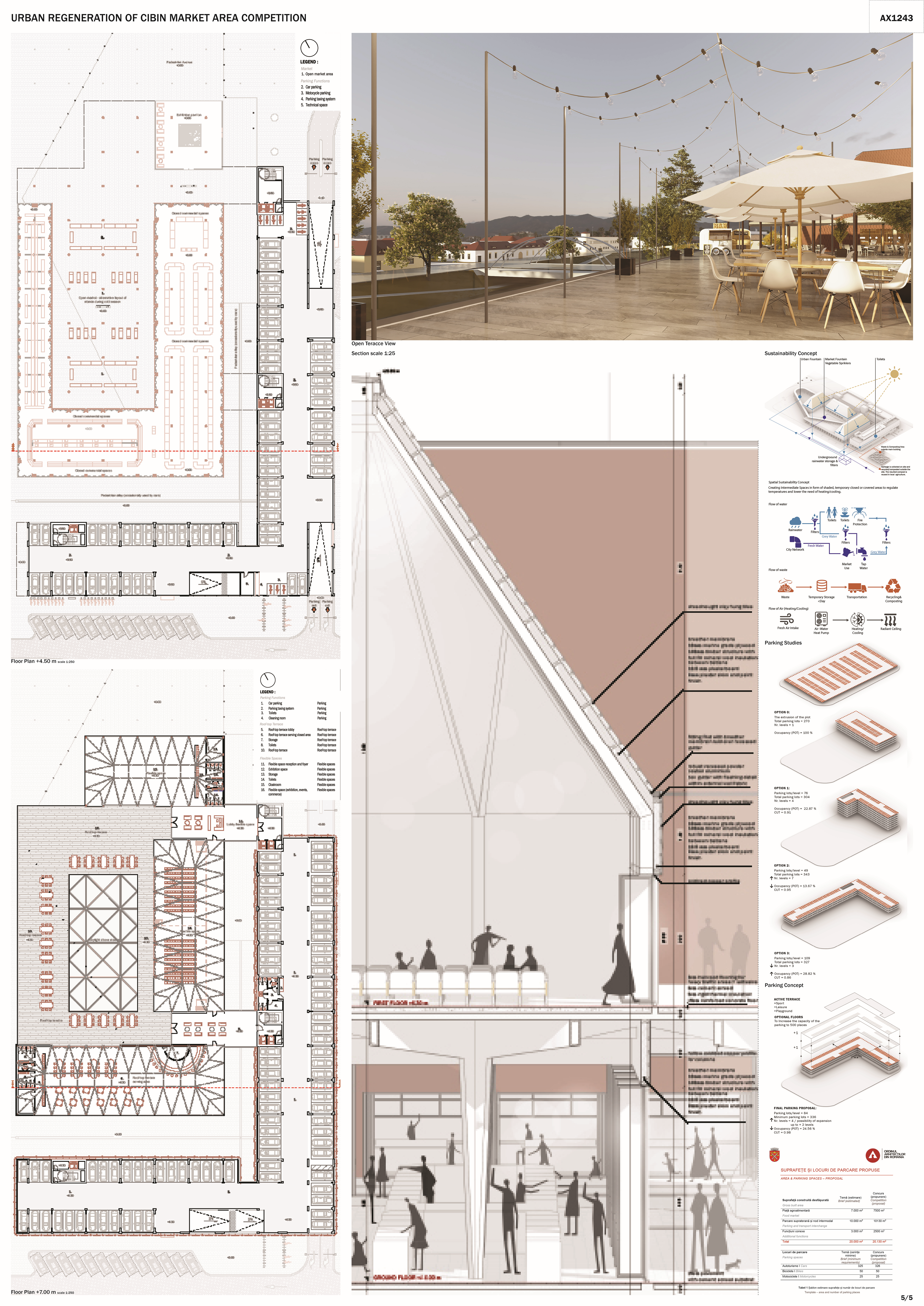
The design of the parking building is the result of an analysis of how over 325 cars can be integrated into an food market without obstructing the relationships and exchanges that occur in such a space. As such, the parking facility is surrounded by commercial spaces and provides the city with a terrace that becomes a setting for urban activities. Additionally, the parking structure can undergo subsequent modifications, as it is configured to allow vertical expansion.
The intervention presents a multitude of spaces designed to meet various needs, ranging from temporary vegetable trading to socializing and leisure activities. This is translated into the construction through the proposal of flexible spaces that can be opened or closed and can accommodate cultural, commercial, and social events.