





122 – II1234 – ERIO DESIGN


Autor principal: Emily Jane Richards
Coautori: Juliana Rojas Navarro, Adrienn Nagy
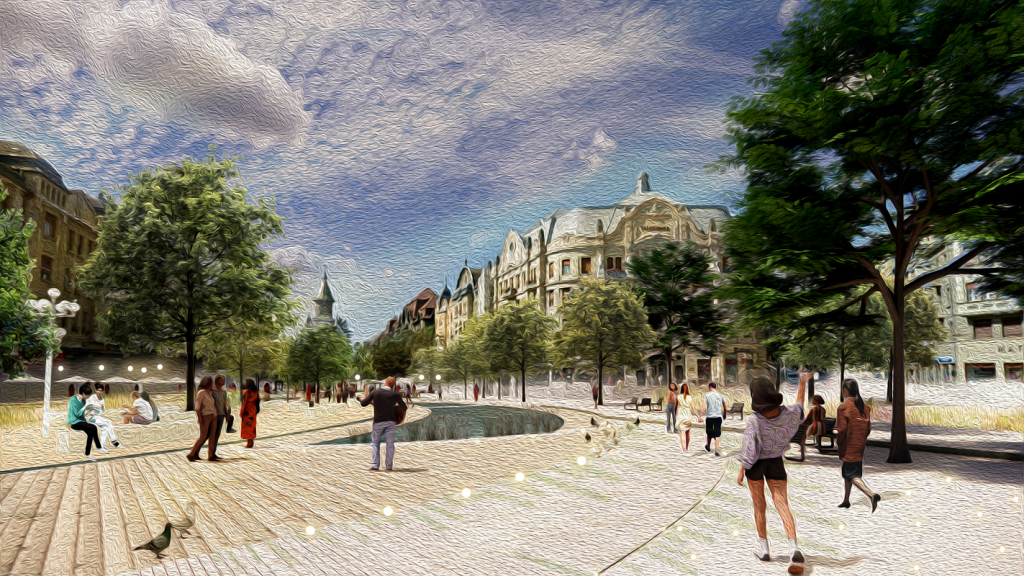
Timisoara has historically been a city embedded in the landscape. As historic maps indicate, until the beginning of 18th century the inner city and castle sat in the landscape organically. The local ecology only started to alter with the channelization of river bega and timis and later with the expansion of the city. Today padurea verde (the green forest) and padurea bistra are the closest remnant of the original flora and fauna, the green lungs of timisoara.
These areas are also important stops for migratory birds. Looking further out to the landscape, timisoara sits along the second largest bird migratory route in europe, the via pontica. Therefore green areas, corridors and habitats within the city are extremely important.
Piata victoriei, the competition site itself has the potential to be a starting point in recreating a city wide green network. Sitting close to river bega, an already existing green route and stretching in to the historic inner city is a unique position to move the city forward into a green future, expand and reconnect existing green-blue networks and detached patches. Therefore, our landscape proposal builds on the concept: the flight of the birds.
Birds symbolising music in romanian and also globally freedom, harmony and peace. A break in the rigid layout as it is now and a response to the natural flows. The conceptual flight path provides a mechanism for interweaving pedestrian flows and the migratory routes of humans with ecology. The layout also provides series of opportunities for new squares, nodes and intimate gatherings set in garden backdrop. Opportunity to showcase the elegance and beauty, soft and free soul of the city.
Lighting is designed to be a feature of the renewed piața victoriei. Inspired by the existing lighting features, it is used to symbolise the movement of the birds and densified around gathering spaces – specifically in front of the cathedral and opera, and also in other important nodes.
There are four lighting levels proposed:
All lighting across the urban renewal area is proposed to use low consuming led lights, supplied from renewable energy sources.
The northern section of the esplanade of piața victoriei, the area in front of the opera house is designed to be a functional meeting point, but also a major attraction, and huniade square as a gateway to the city center.
The free flow of the landscape is superimposed by the tree strategy. The formal base grid, complementing the existing trees structure are proposed to be typical, resilient urban street trees as species of acer, tilia, fraxinus, pyrus, ginkgo. The formal, grid based arrangement of these allows for framing views and the built heritage, especially the opera house.
Underneath, the layer of organic landscape elements – meadows, and gardens – blend into the urban hard landscape with gradual variation of joint widths meeting the attenuation pools. The natural pools along the flight path of the birds are proposed to be stormwater attenuation elements, as well as attractive cooling features during heatwaves & in themselves works of art.
The design provides space for contemplation and respect of the built heritage, however looks for the real needs of our days in an urban environment – provides a liveable green urban environment, threading various uses in and around each other to encourage social interaction and chance meetings.
From a perspective of sustainability and functionality we believe that the underpass in its current form is not a required element of the square. However, we also do not propose to recreate an underground built form that requires significant engineering work. Given the spatial qualities and extent of the square, the
The ecology strategy is highly inspired by the remnant landscapes in and around timișoara – pădurea verde and pădurea bistrei. The riverine oak woodlands once present in the area offer a great atmosphere to merge in and a number of highly resilient and attractive species to introduce once again in the urban landscape. These would also provide a good base for local fauna. A second layer of tree species complement the grid of street trees and form denser woodland areas and light copses – quercus robur, alnus glutinosa, fraxinus angustifolia, carpinus betulus.
Complemented by attractive garden species and evergreens, a characteristic contemporary and naturalistic planting design scheme creates a resilient ecology strategy.
The southern section of the esplanade in front of the cathedral is designed as a counterpart of piața victoriei. A hard plaza that offers flexible space for gatherings, markets, events, religious or historic contemplation. A space that organically flows from a hard, functional urban landscape to the soft more natural areas of the esplanade & allows for smaller community activities .
It is proposed to re-use as much material on site as possible, feature paving where possible can be reused and relaid with wide joints to allow permeability. Where paving is damaged or not suitable aesthetically it can be reused to fill gabion basket seating and subbase fill where required and suitable.
The paving strategy is to maintain light colours with an ethereal quality to complement the material palette around the opera house. The contrasting gravel and plant filled joints that widen towards the natural attenuation pools will add articulation, draw the eye to the natural pools and alluding to their function. The shimmering quality of the stone next to the clean natural pools gives a continuity between hard and soft.
The proposals suggest to keep the pigeon clock and she wolf statue in their current locations. The pigeon clock can maintain its function as a meeting point to the main plaza. The she wolf is now surrounded by woodland. It is proposed to move the fish fountain near the castle entrance to create a marked gateway to the linked plazas, give the fish fountain space to breath in its own right & remove it from the overall drainage site strategy. It is proposed to move the crucifix closer to the cathedral and rotate it parallel to it to allow the fall of its shadow onto the shared surface & create permeability at the welcome plaza.