





116 – CA7339 – SC PLANWERK ARHITECTURĂ ȘI URBANISM SRL


Main authors: SC PLANWERK ARHITECTURĂ ȘI URBANISM SRL
Coauthors: Tiberiu Ciolacu, Diana Cosman, Alexandra Crișan-Man, Benjamin Kohl, Iulia Miclea, Tudor Pănescu, Lucian Șuvaina
Architecture collaborators: Andra Hrenciuc, Cristina Moldovan
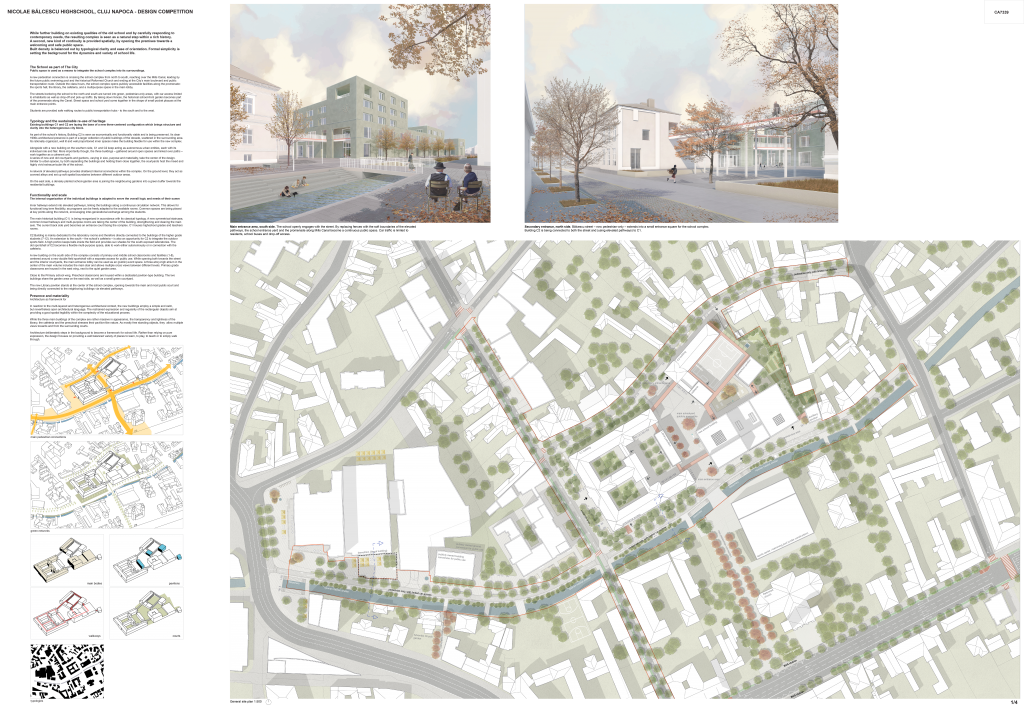
While further building on existing qualities of the old school and by carefully responding to contemporary needs, the resulting complex is seen as a natural step within a rich history. A second, new kind of continuity is provided spatially, by opening the premises towards a welcoming and safe public space.
Built density is balanced out by typological clarity and ease of orientation. Formal simplicity is setting the background for the dynamics and variety of school life.
The School as part of The City
Public space is used as a means to integrate the school complex into its surroundings.
A new pedestrian connection is crossing the school complex from north to south, reaching over the Mills Canal, leading by the future public swimming pool and the historical Reformed Church and ending at the City’s main boulevard and public transportation route. Outside the class hours, the school complex opens publicly accessible facilities along the promenade: the sports hall, the library, the cafeteria, and a multipurpose space in the main lobby.
The streets bordering the school to the north and south are turned into green, pedestrian-only areas, with car access limited to inhabitants as well as drop-off and pick-up traffic. By taking down fences, the historical school-front garden becomes part of the promenade along the Canal. Street space and school yard come together in the shape of small pocket plazzas at the main entrance points.
Students are provided safe walking routes to public transportation hubs – to the south and to the west.
Typology and the sustainable re-use of heritage
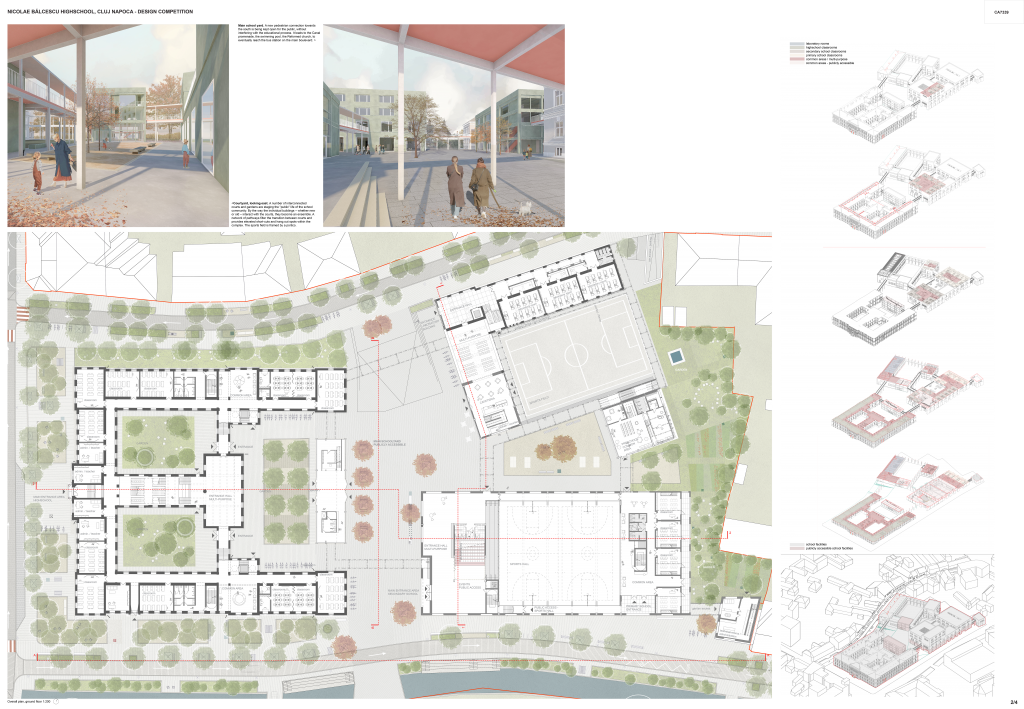
Existing buildings C1 and C2 are laying the base of a new three-centered configuration which brings structure and clarity into the heterogeneous city block.
As part of the school’s history, Building C2 is still economically and functionally viable. Its clear 1930s architectural presence is part of a larger collection of public buildings of the decade, scattered in the surrounding area. Its rationally organized, well lit and well proportioned inner spaces make the building flexible for use within the new complex.
Alongside with a new building on the southern side, C1 and C2 keep acting as autonomous urban entities, each with its individual role and flair. More importantly though, the three buildings – gathered around open spaces and linked over paths – work together as a coherent unit.
A series of new and old courtyards and gardens, varying in size, purpose and materiality, take the center of the design. Similar to urban spaces, by both separating the buildings and holding them close together, the courtyards host the mixed and highly vivid extracurricular life of the school.
A network of elevated pathways provides sheltered internal connections within the complex. On the ground level, they act as covered alleys and set up soft spatial boundaries between different outdoor areas.
On the east side, a densely planted school-garden area is joining the neighbouring gardens into a green buffer towards the residential buildings.
Functionality and scale
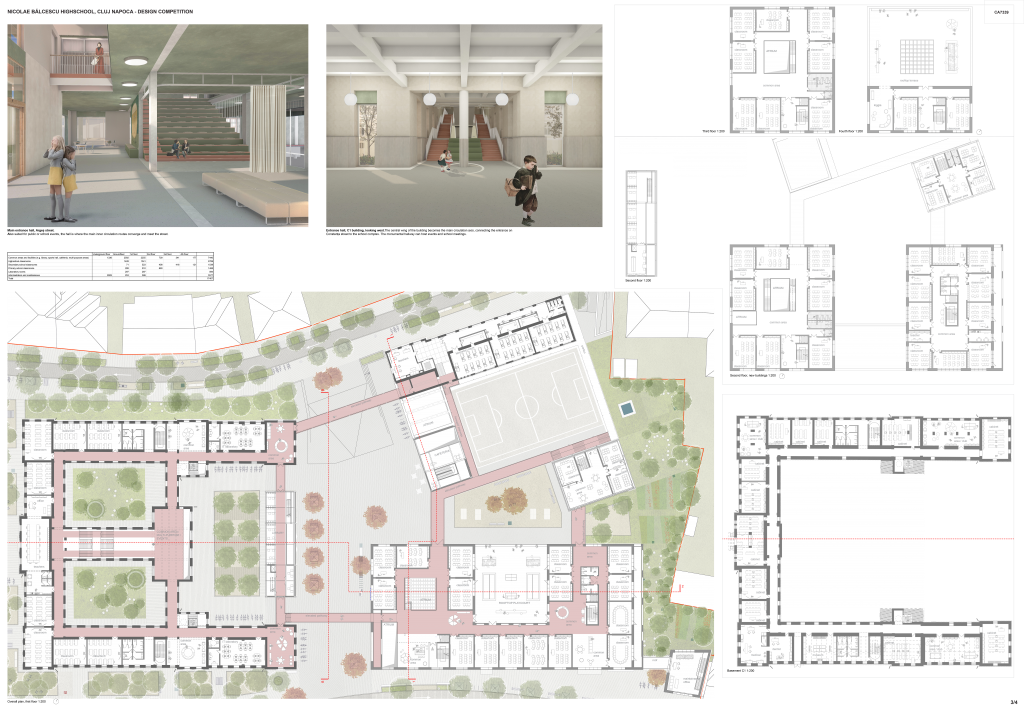
The internal organization of the individual buildings is adapted to serve the overall logic and needs of their summ.
Inner hallways extend into elevated pathways, linking the buildings along a continuous circulation network. This allows for functional long term flexibility, as programs can be freely adapted to the available rooms. Common spaces are being placed at key points along the network, encouraging inter-generational exchange among the students.
The main historical building (C1) is being reorganized in accordance with its classical typology. A new symmetrical staircase, common broad hallways and multi-purpose rooms are taking the center of the building, strengthening and clearing the main axis. The current back side yard becomes an entrance court facing the complex. C1 houses highschool grades and teachers rooms.
C2 Building is mainly dedicated to the laboratory rooms and therefore directly connected to the buildings of the higher grade students (7-12). An extension to the south – the school’s cafeteria – is also an opportunity for C2 to integrate the outdoor sports field. A high portico keeps balls inside the field and provides sun shades for the south exposed laboratories. The old sportshall of C2 becomes a flexible multi-purpose space, able to work either autonomously or in connection with the cafeteria.
A new building on the south side of the complex consists of primary and middle school classrooms and facilities (1-8), centered around a new double field sportshall with a separate access for public use. While opening both towards the street and the interior courtyards, the main entrance lobby can be used as an (public) event space. A three-story-high atrium in the center of the main volume includes the main stair and allows multiple cross views between different levels. Primary grade classrooms are housed in the east wing, next to the quiet garden area.
Close to the Primary school wing, Preschool classrooms are housed within a dedicated pavilion-type building. The two buildings share the garden area on the east side, as well as a small green courtyard.
The new Library pavilion stands at the center of the school complex, opening towards the main and most public court and being directly connected to the neighboring buildings via elevated pathways.
Presence and materiality
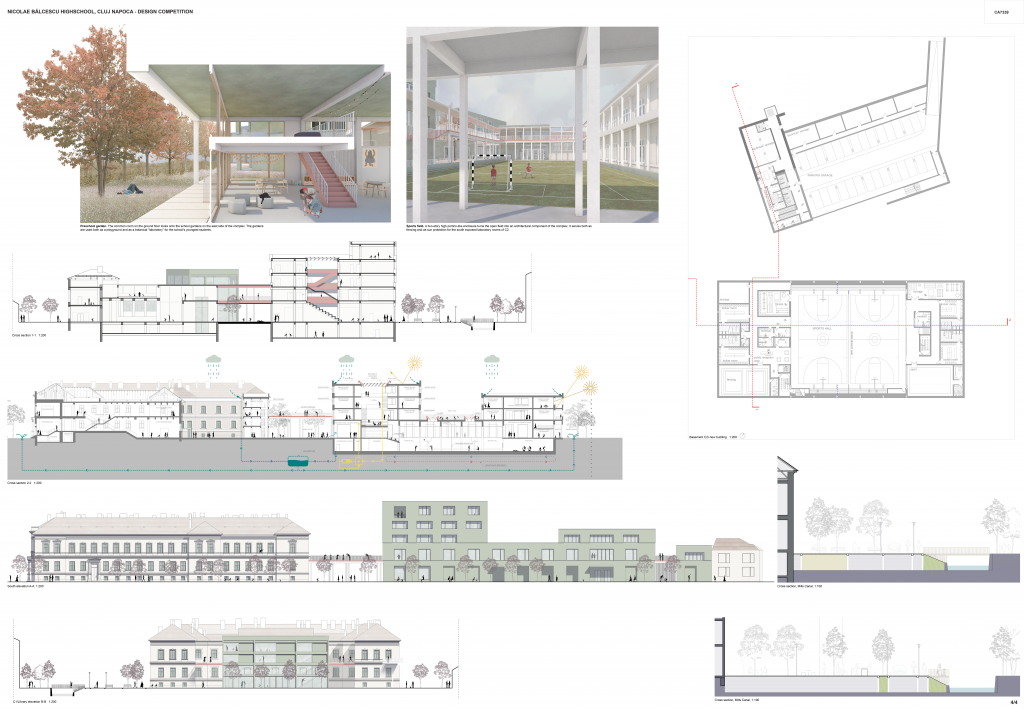
In reaction to the multi-layered and heterogenous architectural context, the new buildings employ a simple and calm, but nevertheless open architectural language. The restrained expression and regularity of the rectangular objects aim at providing a good spatial legibility within the complexity of the educational process.
While the three main buildings of the complex are rather massive in appearance, the transparency and lightness of the library, the cafeteria and the preschool stresses their pavilion-like nature. As mostly free standing objects, they allow multiple views towards and from the surrounding courts.
Architecture deliberately steps in the background to become a framework for school life. Rather than relying on pure expression, the design focuses on providing a well balanced variety of places to learn, to play, to teach or to simply walk through.