





GM1234 – S.C. CRIBA PROIECT S.R.L. & S.C. MASLAEV CONSULTING S.R.L. – Missed submission deadline


Main author: Arh. Cristina-Olga GOCIMAN
Coauthors: urb. Andreea Simion, arh. urb. Cristian Iosif Moscu, st. arh. Andrei Gramoiu
Architecture collaborators: urb. Alfred Toader, arh. Alexandru Iftimie, arh. Didier Chifan, arh. Cristina Soparleanu, arh. Luana Vultur, arh. Ioana Patrut, arh. Andreea Augustin, st. arh. Bogdan Span
Specialty collaborators: ing. Andrei Maslaev, ing. Stefan Lichwar, ing. Florin Iordache, ing. George Vanatoru, ing. Ioan Silviu Dobosi, ing. Eugen Ionescu, ing. Cristina Gardeanu, ec. Monica Ene, ref. Andreea Maslaev
Joint venture:
- S.C. CRIBA PROIECT S.R.L. – 60%
- S.C. MASLAEV CONSULTING S.R.L. – 40%
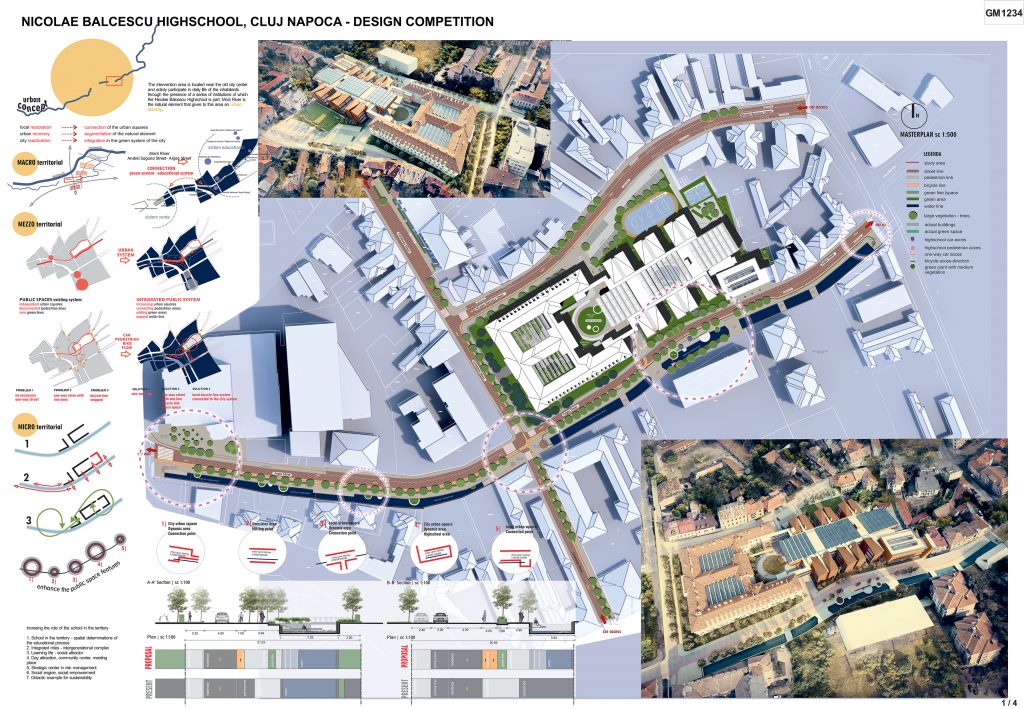
Objectives of the project
A. Increasing the benefits of education
Adaptation of the educational offer to:
- The current economic context
- Promoting culture by improving personal skills
- Promoting innovation, performance
- Participatory management
School in support of society
- Ensuring the quality of all school processes
- The cultural identity of the school
- School as a community coagulant
- Development of creative activities
- Equal opportunities
- Emotional security
School in the service of the child
- Finding a place in society
- Functional literacy – access to information
- Establishing value and cultural landmarks, ethical principles
- Ensuring personal development, initiation
- Ensuring physical development
School and family connection
- Fundamental role in education – family – community
- Extra curricular activities in support of the family
- Parent’s cooperation with the school
- Efficient and inclusive atmosphere
- Active learning – role play, research school projects
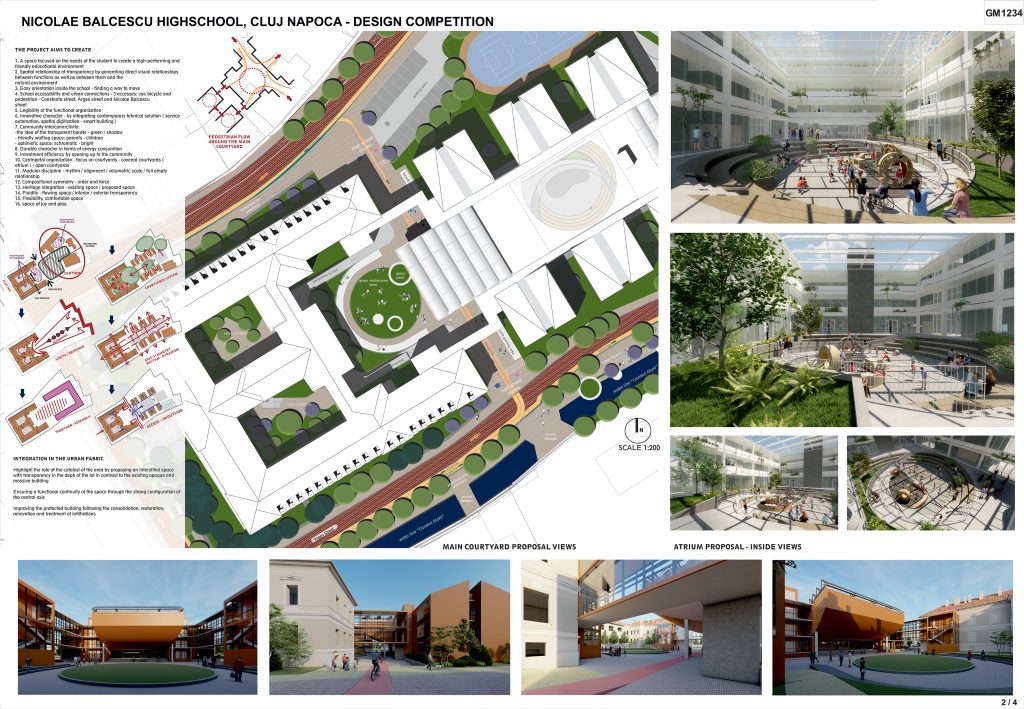
B. School – Model building – anthropological role in shaping the child’s personality
The main factor of development is the quality of the space
Well-being – satisfaction, joy, children’s pleasure
Spatial conformation:
- Expressing the qualities of an educational act
- Symmetry/ axis: increase direction, force
- Rhythm/ mode: increase order, logic
- Modulation: increase scalar readability
- Central space/ atrium: increase co gathering, globality
- Old/ new relationship: intergenerational relationship
C. Increasing the role of the school in the territory
- School in the territory – spatial determinations of the educational process.
- Integrated roles – intergenerational complex
- Life learning – social attractor
- Daytime attraction, community center, meeting place
- Strategic center in risk management
- Social engine, social empowerment
- Didactic example for sustainability
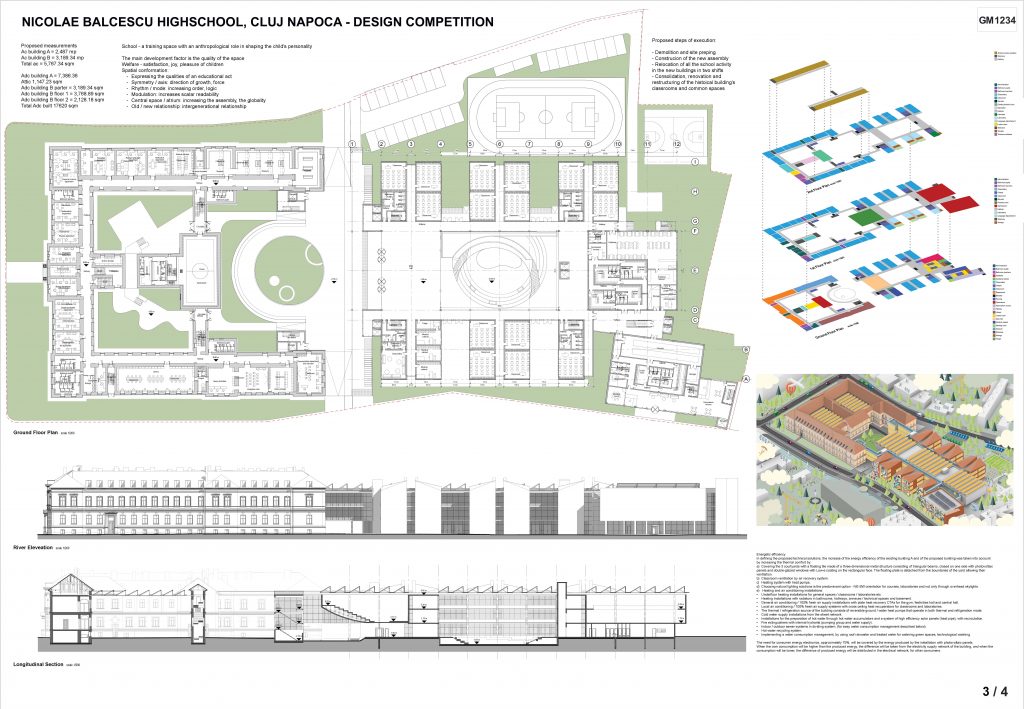
Concept
The project aims to create:
- A space focused on the needs of the student in order to enhance a high-performing and friendly educational environment.
- Spatial relationship through transparency by generating direct visual relationships between functions as well as between them and the natural environment.
- Easy orientation inside the school – way finding.
- School accessibility and connections – 3 accesses: car, bicycle and pedestrian – Constanța street, Argeș street and Nicolae Bălcescu street
- Readability of the functional organization.
- Innovative character – by integrating contemporary technical solutions (service automation, spatial digitization – smart building).
- Community interconnectivity:
- the idea of the transparent border – green / shade
- friendly waiting space: – parents – children
- optimistic space – chromatic – bright
- Sustainable character regarding energy consumption.
- Investment efficiency through openness to the community.
- Centripetal organization – focus on courtyards – covered courtyards (atrium)/open courtyards.
- Modular discipline – alignment rhythm and full-empty volumetric scale.
- Compositional symmetry – order and force.
- Heritage integration – existing space – proposed space.
- Fluidity – the space flowing inside – outside, transparent.
- Flexibility, comfortable space.
- Space of joy and play.
Integration into the urban fabric
– Highlighting the role of catalyst of the area by proposing an interstitial space with transparency in the depth of the lot in contrast to the existing opaque and massive building;
– Ensuring a functional space continuity through the strong configuration of the central axis;
– Enhancement of the protected building following the consolidation, restoration, refurbishment and treatment of infiltrations.
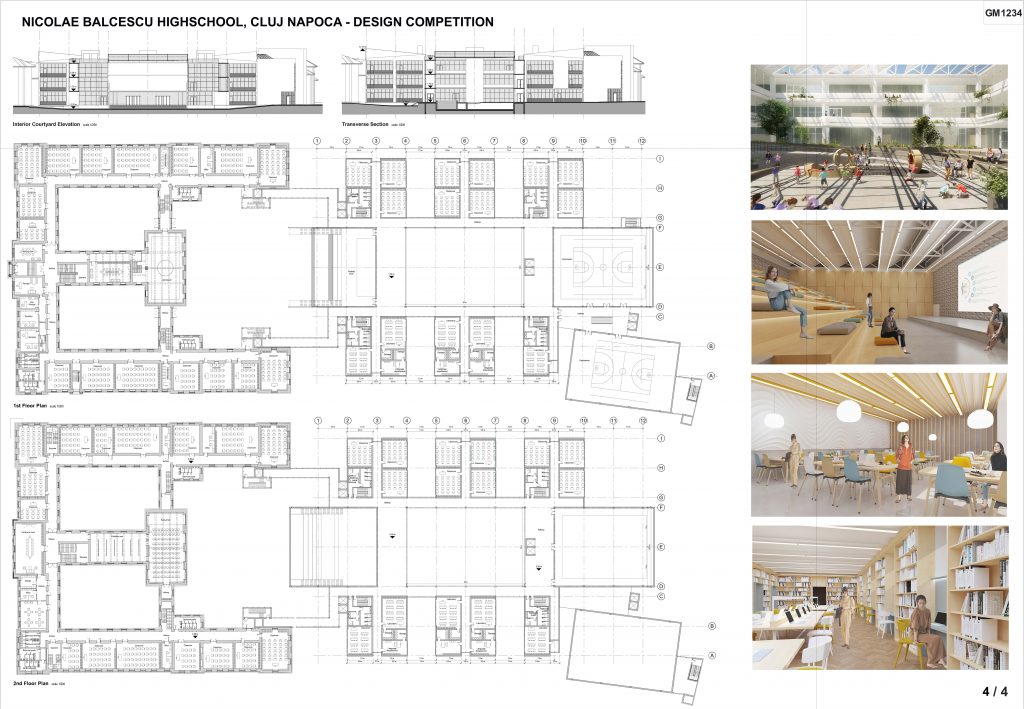
Energetic efficiency
In defining the proposed technical solutions, it was considered to increase the energy efficiency of the existing building A regarding the increase of thermal comfort by:
- Covering the 3 courtyards of light with a floating floor consisting of a three-dimensional metal structure consisting of triangular beams, closed rectangles on one side with photovoltaic panels and double-glazed glass with Low-e coating on the rectangular face. The floating slab is detached from the boundaries of the yard allowing their ventilation.
- Classroom ventilation through recovery air recycling system.
- Heating system with heat pumps.
- The choice of natural lighting solutions is the predominant option – NE-SW orientation for classes, laboratories and more for zenithal skylights.
- Energy modeling to check if the spring energy consumption is <69 kwh / sqm / cm.
- heating and air conditioning installations:
- Underfloor heating installations for general spaces / classrooms / laboratories etc
- Heating installations with radiators in bathrooms, hallways, annex / technical spaces and basement
- General air conditioning installations / 100% fresh air supply with CTAs with plate heat recovery for the gym, festivities hall and central hall
- Local air conditioning systems / 100% fresh air supply with cross-ceiling ceiling heat recuperators for classrooms
- Thermal / refrigeration source of the building consisting of reversible ground / water heat pumps operating in both thermal and refrigeration
- Cold water supply installations from the street network
- Hot water preparation installations by means of hot water accumulators and a system of high efficiency solar panels (heat pipe), with recirculation.
- Fire extinguishers with internal hydrants (pumping group and water supply)
- Indoor / outdoor sewerage systems in dividing system, (for easy management of water consumption described below).
The project will aim to:
- To reduce the consumption of hot water, it will be recirculated to the last consumer.
- A management of water consumption will be implemented, by using roof rainwater and treated water for watering green spaces, technological washing
Electrical installation
Thus, a part of the energy needed by consumers, approximately 75%, will be covered by the energy produced by the installation with photovoltaic panels.
When the own consumption is higher than the produced energy, the difference will be taken from the electric supply network of the building, and when the consumption is lower, the difference of produced energy will be distributed in the electric network, for other consumers.
Benchmarking
| Existing | Proposed |
| Lack of connection between buildings – access through the yard | Interconnection of existing and proposed building through the ground floor and first floor walkways. |
| Lack of social spaces | Creating new social spaces, 3 covered atriums and a new space for festivities. |
| Lack of school spaces. Education in 2 shifts, morning and afternoon. | Providing educational spaces in a morning shift |
| Lack of storage space for students | Organization of storage of students’ things in each class, laboratory, office through specific furniture |
| Insufficient sports facilities 1 building space 2 – 160 sqm 1 play space building 1 – 136 sqm 4 classes simultaneously in the same sports space | Proposal of two new gyms and an inter-related service room as accesses and services that can be used jointly and separately, keeping the gym in building A, which is equipped with other locker rooms in the basement of the central building. Sizing required sports spaces: – primary education 27 classes x 2h / week = 54 h / week – gymnasium education 27 classes x 2h / week = 54 h / week – high school 13 classes x 1h / week + 3 classes x 2h / week = 19 h / week Total – 127h / week Hours / week / gym space – 5 days x 6.5 hours / day = 39 hours / week / space 4 gym space x 39 h / week / gym space = 156 h / week |
| Rehabilitation of sports fields (outdoor) | Reconfiguration of sports fields on another location: – Mini football field with running track included – Basketball / volleyball / handball court |
| Insufficient space for the existing library – 25,000 volumes with new specific materials – 85 sqm | Library development in a basement wing S = 340 mp. Reading room, Bookcase, Media library, Desk, Book storage, Information center |
| Insufficient spaces for existing extra-curricular activities: Projects: – “I know music too”; – “Happiness / Love / Freedom between myth and reality”; Summer camps;Clubs: – robotics club; – photo club; – theatre club; Art contests / shows;Charity fairs;Photography, painting exhibitions; Book launches;Partnerships; Programs: Erasmus Grant – TWIN (The Wise Network) teacher-student-parent collaboration network | Proposal for carrying out extra-curricular activities Festivities halls – building A, B Attic cabinets building A |
| Insufficient toilets Normative | Normative – 1 toilet / 40 boys 1 urinal / 20 boys 1 wc / 15 girls Sanitary facilities required 1776 students / 2 = 888 boys / girls 888/40 = 22 toilets / boys urinals 888/15 = 59 girlswc Proposal of separate sanitary groups: – boys: 24 toilets – girls: 60 toilets – proposal groups on the same vertical in building A. |
| Dining hall organized in the basement (with infiltrations) with odour spread in the undersized building S = 78.04 sqm | Larger dining hall S = 130 sqm with office annexes located at the NE end of the enclosure with exit to the courtyard NE with office and annexes |
| Teacher room – in building A floor 1 insufficiently dimensioned Lack of kitchenette, storage, bathrooms for teachers | Teachers’ rooms – high school education – storage room hall 1st floor – building A and extension annexes – gymnasium education – ground floor – building A – primary education – basement building B |
| Insufficient laboratories in large oversized rooms – 70 sqm / 98 sqm, superimposed over high school classes | Integral reorganization of laboratories by specialties in building B in 50 sqm rooms with 20 sqm annexes |
| Giving up cabinets and transforming them into spaces for hybrid learning – 10 cabinets | Creating spare spaces in the new building near laboratories Building B: – 6 cabinets (1-2 floors) Building A:– ground floor – 1 cabinet attic – 4 cabinet |
| Unmaintained green spaces Lack of recreational furniture | Maximize indoor and outdoor green spaces, green terraces. Furniture with seating and playgrounds. |
| Infiltrations in building A in the basement | Proposal for infiltration treatment solutions – waterproofing of the basement plate – foundation drains – wall ventilation |
| Old installations heat, water, ventilation | – ensuring energy independence – introduction of photovoltaic systems – for obtaining current – thermal installations – heat pump and gas boiler – ventilation installations – with heat recovery cross ventilation system – air conditioning installations – CTA |
| Consolidation Technical requirements: – overall coherence – rehabilitation of valuable built fund – expertise degradations to: – structuring elements; – for interior and exterior finishes. Causes of degradation: – material aging; – infiltrations; – deficiency in taking over the shear forces. – consolidation of buildings to bring it from RSII to RSIV according to the regulations in force | Proposal Creating rigid cores with diaphragms connected by scraping creating concrete floor over ground floor and first floor 1 Wooden frame replacement with metal to create the attic existing wooden frame replacement in areas that are kept as a control Replacement of ceramic coverings Restoration of decorative elementsFinishing repairs |
| Existing measurements Building A – Ac =2,487 square m – Ad = 7,386.35 square m – D + P + 1E | Proposed measurements Ac building A = 2,487 square m Ac building B Total Ac Adcbuilding A = 7,386.36 + attic Adcbuilding B Total Adc |
| Adctheme measurements 9.5 mp / student x 1776 students = 16.872 square m | Realized 17620 square m |