





113 – AB3416 – ARCSETT SRL


Main author: arch. Andrei Gelu Mihăilescu
Co-authors: arch. Bogdan Selin, arch. Camil Isacov, arch. Daniel Berindeanu, arch. urb. Andreea Constantinescu, arch. Oana Mihăilescu
The cultural stimulus – element/elements of sensitive analysis
These elements are related to the intangible values of the Dobrogea region and respond to the sensory perception of it and enrich the response to the need to identify with the environment, thus considering them as influencing factors, as an analysis tool for the design of the future urban park.
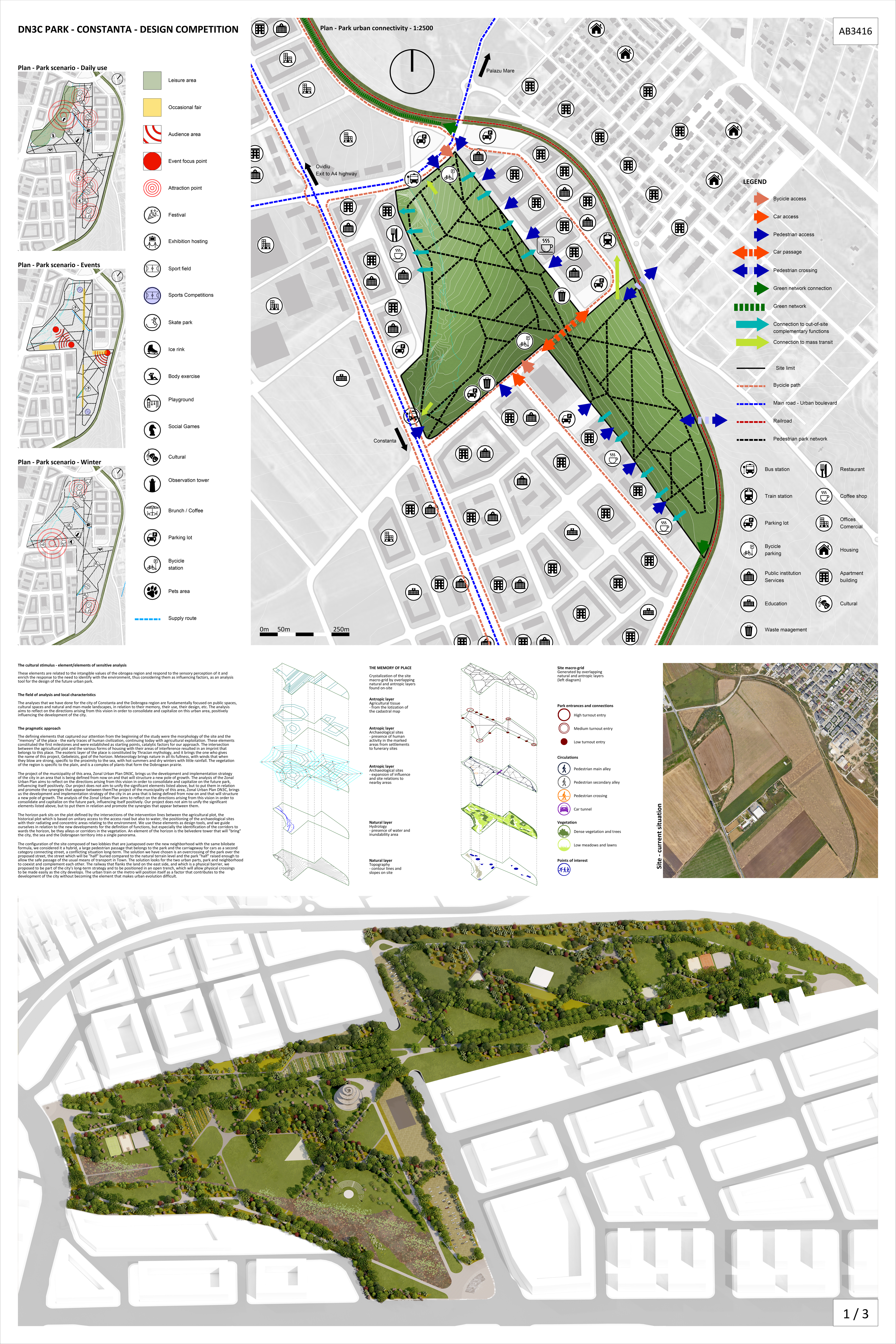
The field of analysis and local characteristics – The analyzes that we have done for the city of Constanta and the Dobrogea region are fundamentally focused on public spaces, cultural spaces and natural and man-made landscapes, in relation to their memory, their use, their design, etc. The analysis aims to reflect on the directions arising from this vision in order to consolidate and capitalize on this urban area, positively influencing the development of the city.
The pragmatic approach – The defining elements that captured our attention from the beginning of the study were the morphology of the site and the “memory” of the place – the early traces of human civilization, continuing today with agricultural exploitation. These elements constituted the first milestones and were established as starting points, catalytic factors for our approach. The intersection between the agricultural plot and the various forms of housing with their areas of interference resulted in an imprint that belongs to this place. The esoteric layer of the place is constituted by Thracian mythology, and it brings the one who gives the name of this project, Gebeleizis, God of the horizon. Meteorology brings nature in all its fullness, with winds that when they blow are strong, specific to the proximity to the sea, with hot summers and dry winters with little rainfall. The vegetation of the region is specific to the plain, and is a complex of plants that form the Dobrogean prairie.
The project of the municipality of this area, Zonal Urban Plan DN3C, brings us the development and implementation strategy of the city in an area that is being defined from now on and that will structure a new pole of growth. The analysis of the Zonal Urban Plan aims to reflect on the directions arising from this vision in order to consolidate and capitalize on the future park, influencing itself positively. Our project does not aim to unify the significant elements listed above, but to put them in relation and promote the synergies that appear between them.
The horizon park sits on the plot defined by the intersections of the intervention lines between the agricultural plot, the historical plot which is based on unitary access to the access road but also to water, the positioning of the archaeological sites with their radiating and concentric areas relating to the environment. We use these elements as design tools, and we guide ourselves in relation to the new developments for the definition of functions, but especially the identification of the corridors towards the horizon, be they alleys or corridors in the vegetation. An element of the horizon is the belvedere tower that will “bring” the city, the sea and the Dobrogean territory into a single panorama.
The configuration of the site composed of two lobbies that are juxtaposed over the new neighborhood with the same bilobate formula, we considered it a hybrid, a large pedestrian passage that belongs to the park and the carriageway for cars as a second category connecting street, a conflicting situation long-term. The solution we have chosen is an overcrossing of the park over the proposed street, the street which will be “half” buried compared to the natural terrain level and the park “half” raised enough to allow the safe passage of the usual means of transport in Town.
The solution looks for the two urban parts, park and neighborhood to coexist and complement each other. The railway that flanks the land on the east side, and which is a physical barrier, we proposed to be part of the city’s long-term strategy and to be positioned in an open trench, which will allow physical crossings to be made easily as the city develops. The urban train or the metro will position itself as a factor that contributes to the development of the city without becoming the element that makes urban evolution difficult.