





115 – UV7319 – UMBRELA VERDE STUDIO SRL


Main authors: dr. ing. peis. Vladimir-Ionuț BOC, drd. ing. peis. Ana VIȚA, ing. peis. Daniela-Ioana GUJU, ing. peis. Gabor-Giovani LUCA, ing. peis. Anca-Roxana STRUGARIU
Co-authors: drd. ing. peis. Luciana ZECA
Architecture collaborators: arch. Vlad-Andrei MALI
Concept: ECO-Link
Concept. The proposed solution for the development of the DN3C park proposes the transformation of the site into a representative space for the region of Dobrogea and a central pole for the local community in the northwest of the city of Constanța by reproducing some emblematic landscapes for the local natural heritage. The aim of the project consists of creating a new ecological core that can be interconnected with green-blue corridors, which would ensure the development of the green space system in the north of Constanța. At the same time, the concept proposes a multifunctional and inclusive urban park, which can be used throughout the year.
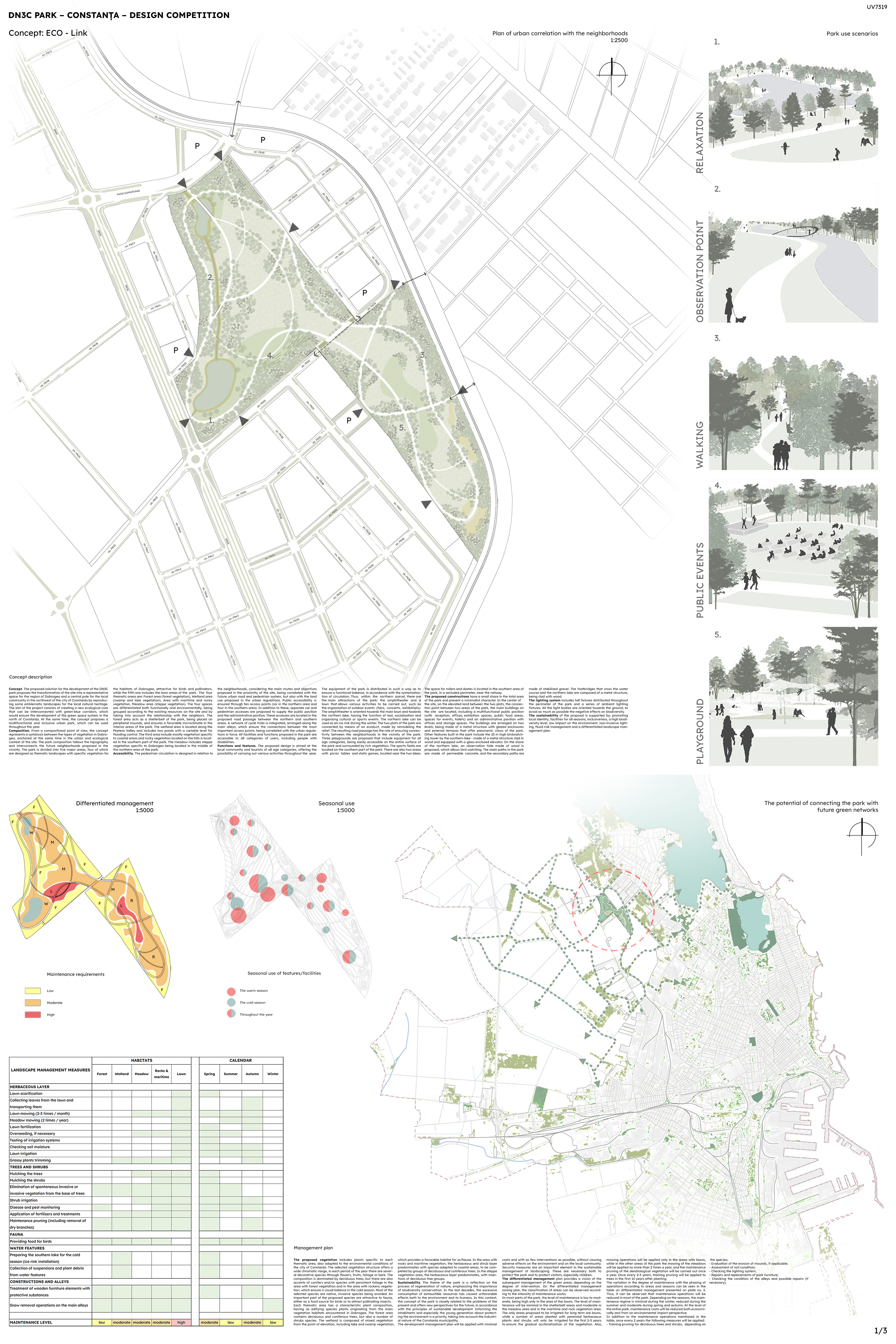
Composition. From a compositional point of view, the concept represents a symbiosis between the types of vegetation in Dobrogea, anchored at the same time in the urban and ecological context of the site. The park composition follows the topography and interconnects the future neighborhoods proposed in the vicinity. The park is divided into five major areas, four of which are designed as thematic landscapes with specific vegetation for the habitats of Dobrogea, attractive for birds and pollinators, while the fifth one includes lawn areas. The four thematic areas are: Forest area (forest vegetation), Wetland area ( swamp and lake vegetation), Area with maritime and rocky vegetation, Meadow area (steppe vegetation). The four spaces are differentiated both functionally and environmentally, being grouped according to the existing resources on the site and by taking into account the relationship with the neighbors.
The forest area acts as a shelterbelt of the park, being placed on peripheral mounds, and ensures a favorable microclimate in the interior areas of the park. The wetland area is located along the Peștera Valley and includes two ponds with a variable level for flooding control. The third area include mostly vegetation specific to coastal areas and rocky vegetation located on the hills is located in the southern part of the park. The meadow includes steppe vegetation specific to Dobrogea being located in the middle of the northern area of the park.
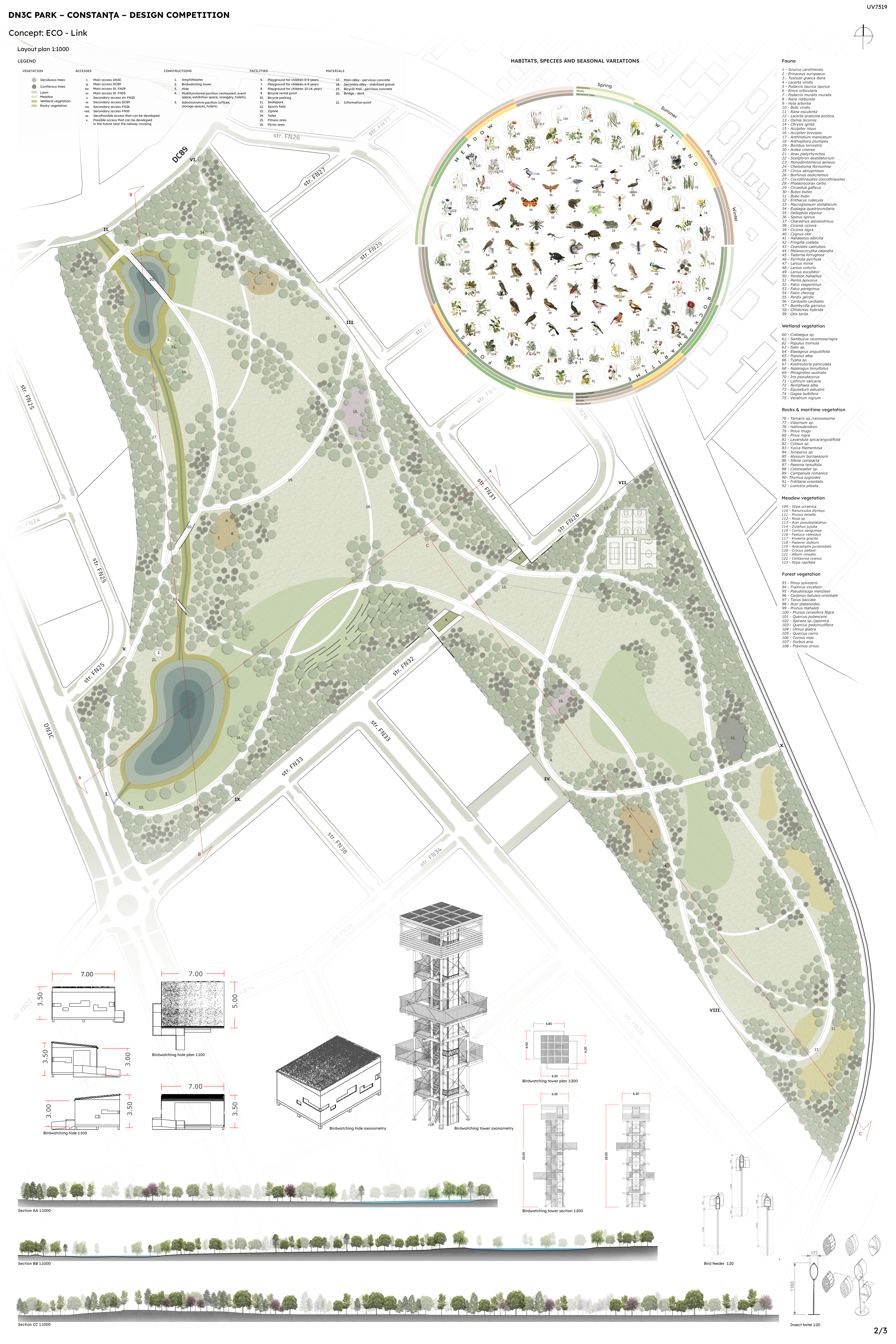
Accessibility. The pedestrian circulation is designed in relation to the neighborhoods, considering the main routes and objectives proposed in the proximity of the site, being correlated with the future urban road and pedestrian system, but also with the land use proposed in the urban regulations. Public accessibility is ensured through ten access points (six in the northern area and four in the southern area). In addition to these, separate car and pedestrian accesses are proposed to supply the public pavilion and the administrative pavilion. These accesses are located in the proposed road passage between the northern and southern areas. A network of cycle trails is integrated, arranged along the main alleys, which ensure the connections between the most important access points, being correlated with the urban regulations in force. All facilities and functions proposed in the park are accessible to all categories of users, including people with disabilities.
Functions and features. The proposed design is aimed at the local community and tourists of all age categories, offering the possibility of carrying out various activities throughout the year. The equipment of the park is distributed in such a way as to ensure a functional balance, in accordance with the systematization of circulation. Thus, within the northern parcel, there are the main attractions of the park: the amphitheater and a lawn that allows various activities to be carried out, such as the organization of outdoor events (fairs, concerts, exhibitions). The amphitheater is oriented towards the main lawn and towards the northern lake, having the function of rest, socialization and organizing cultural or sports events. The northern lake can be used as an ice rink during the winter.
The two plots of the park are connected by means of an ecoduct, made by remodeling the relief. The resulting road passage has the role of ensuring connectivity between the neighborhoods in the vicinity of the park. Three playgrounds are proposed that include equipment for all age categories, being easily accessible on the entire surface of the park and surrounded by rich vegetation. The sports fields are located on the southern part of the park. There are also two areas with picnic tables and static games, located near the two lakes. The space for rollers and skates is located in the southern area of the park, in a secluded perimeter, near the railway.
The proposed constructions have a small share in the total area of the park and present a minimalist character. In the center of the site, on the elevated land between the two plots, the connection point between two areas of the park, the main buildings on the site are located, including a multifunctional public pavilion (with reception, offices, exhibition spaces, public food areas, spaces for events, toilets) and an administrative pavilion with offices and storage spaces. The buildings are arranged on two levels, being made of a metal structure with glazed enclosures and external terraces that offer panoramic views of the park.
Other features built in the park include the 23 m high birdwatching tower by the southern lake – made of a metal structure clad in wood and equipped with a glass-enclosed elevator. On the shore of the northern lake, an observation hide made of wood is proposed, which allows bird watching. The main paths in the park are made of permeable concrete, and the secondary paths are made of stabilized gravel. The footbridges that cross the water course and the northern lake are composed of a metal structure, being clad with wood.
The lighting system includes tall fixtures distributed throughout the perimeter of the park and a series of ambient lighting fixtures. All the light bodies are oriented towards the ground, to avoid as much as possible the negative effects on the biodiversity.
The sustainability of the proposal is supported by: promoting local identity, facilities for all seasons, inclusiveness, a high biodiversity level, low impact on the environment, non-invasive lighting, flood risk management and a differentiated landscape management plan.