





107 – BP4033 – TEQUI POINTEAU ARCHITECTES, 5-CINQ ARCHITECTURE, ARIA CONCEPT ARCHITECTURE SRL


Autor principal: TEQUI POINTEAU ARCHITECTES
Coautori: 5-CINQ ARCHITECTURE, ARIA CONCEPT ARCHITECTURE
Colaboratori arhitectură: Adriana Saab, Antoine Saab, Cynthia Saab, Radeck Beraneck, Jad Bou Raad, Axel Isabel, Sarah Ascenso, Didier Fevre, Irina Panait, Cosmina Adascalitei, Alexandra Tancau-Petrea, Lucia, Abdulea, Denisa Stoica, Nazanin Shalbaf-Tabar
Colaboratori specialități: urbanisti/peisagisti: Britta Voegeli, Roxana Marculescu
ingineri rezistenta: Radu Trandafirescu, Adrian Trandafirescu Expert Scenotehnica: Silviu Scrob
Masterplan
Our project seeks to regenerate the Rulmentul industrial site in Brașov, blending sustainability, historical preservation, and modern urban functions. The goal is to unite the site’s industrial and aviation heritage with contemporary design, offering cultural, recreational, and economic opportunities for Brașov’s residents and visitors. By preserving key historical structures, we connect the site’s past with its future.
The masterplan is divided into four zones: Sports and leisure area (east), Cultural core (center), Botanical Garden and technology hub (south), Mixed-use development (west).
These zones are linked by green spaces and an urban passageway, creating a cohesive connection between historical and modern urban living. The central park serves as the green backbone, connecting cultural and recreational areas.
Our design draws on the site’s rich history:
- Industrial heritage: Preserving superstructures like tanks and rails as focal points.
- Aviation legacy: Design elements evoke aircraft shapes, reflecting the site’s WWII aviation history.
- Natural reclamation: Incorporating vegetation that overtook the site after industrial use.
- Water and Timiș River: Water features cool public spaces and visually link the site to the surrounding environment.
- Circular forms: Rounded shapes, referencing the site’s past as “Rulmentul,” symbolize continuity and regeneration.
Our project focuses on sustainability and heritage preservation. Using green energy, local materials, and extensive green spaces minimizes environmental impact. Adaptive reuse of buildings reduces waste, while pedestrian paths and green corridors promote eco-friendly mobility.
The project involves collaboration between public and private actors. The municipality manages infrastructure, while private developers and cultural institutions oversee specific areas, including the cultural center. Public transport authorities ensure sustainable mobility systems.
The botanical garden in the south supports ecological restoration using native and phytoremediation plant species. Green corridors connect the garden to the site, creating a continuous natural flow.
The masterplan balances recreational, cultural, residential, and commercial functions:
- Sports and leisure zone (east) offers facilities for physical activities.
- Cultural core (center) houses a theater, library, and exhibition spaces.
- Mixed-use development (west) blends housing, offices, and commercial spaces with a Data Center and a Fab-Lab.
The road system prioritizes pedestrian movement, with bike lanes and tramway stops for efficient access. A main road connects the site to northern and southern Brașov. Public transport integrates tramway stops, while parking is placed at the periphery to reduce congestion. A pedestrian bridge ensures uninterrupted movement across the site.
Located in the former industrial hall, the cultural center includes a theater, library, and exhibition spaces. Designed to foster social engagement, the center integrates artistic installations into the landscape, creating a vibrant atmosphere for public events.
Development Phases
- Phase 1: Construction of the cultural center, botanical garden, urban park, and key road connections.
- Phase 2: Development of the data center and mixed-use buildings, including residential units and a Fab-Lab.
- Phase 3: Construction of a university, medical center, and additional housing for students and seniors.
Each phase builds on the previous, ensuring sustainable growth. Initial investment in the cultural center and botanical garden is expected to attract investors, while the data center will act as a technological hub, driving economic growth.
Green Space
The urban park and botanical garden form the heart of the site’s green infrastructure, connecting cultural, sports, and mixed-use zones while offering ecological and recreational benefits. The park features green lawns, pedestrian paths, and seating areas that encourage social interaction. The botanical garden, located in Strungărie Hall, showcases local plant species, reinforcing the site’s ecological sustainability goals.
Water features, such as the reflective water mirror, visually link the park with the Timiș River, blending historical structures with modern design. The existing vegetation, which reclaimed the site post-industrial use, is integrated into the new landscaping, enhancing the visitor experience. The garden also plays a role in ecological restoration, using local and phytoremediation plants, and is connected by pedestrian paths, bike lanes, and Brașov’s tramway system, encouraging sustainable movement.
The garden, symbolizing renewal, merges the site’s industrial heritage with nature. Repurposing Strungărie Hall into a green space supports ecological sustainability, offering areas for relaxation, education, and community engagement.
The integration of green spaces with the built environment is central to the project. The plaza at 13 Decembrie Street connects the urban park to the cultural center, while a pedestrian bridge between Buildings C21 and C25a provides scenic views and enhances connectivity.
The green space between Buildings 25a and 25c blends historical structures with new landscaping, creating a cohesive site aesthetic. The interface between Hangar 6 and adjacent green spaces ensures smooth transitions between indoor and outdoor areas, maintaining a functional connection to the natural surroundings.
Preserving industrial remnants while incorporating modern public space elements fosters a harmonious blend of history and nature. Key structures like cisterns and old frameworks are preserved, maintaining the site’s historical identity. Views of Tampa Mountain are designed to link the landscape with the development, and water features enhance environmental quality and provide cooling effects in summer.
Cultural Center
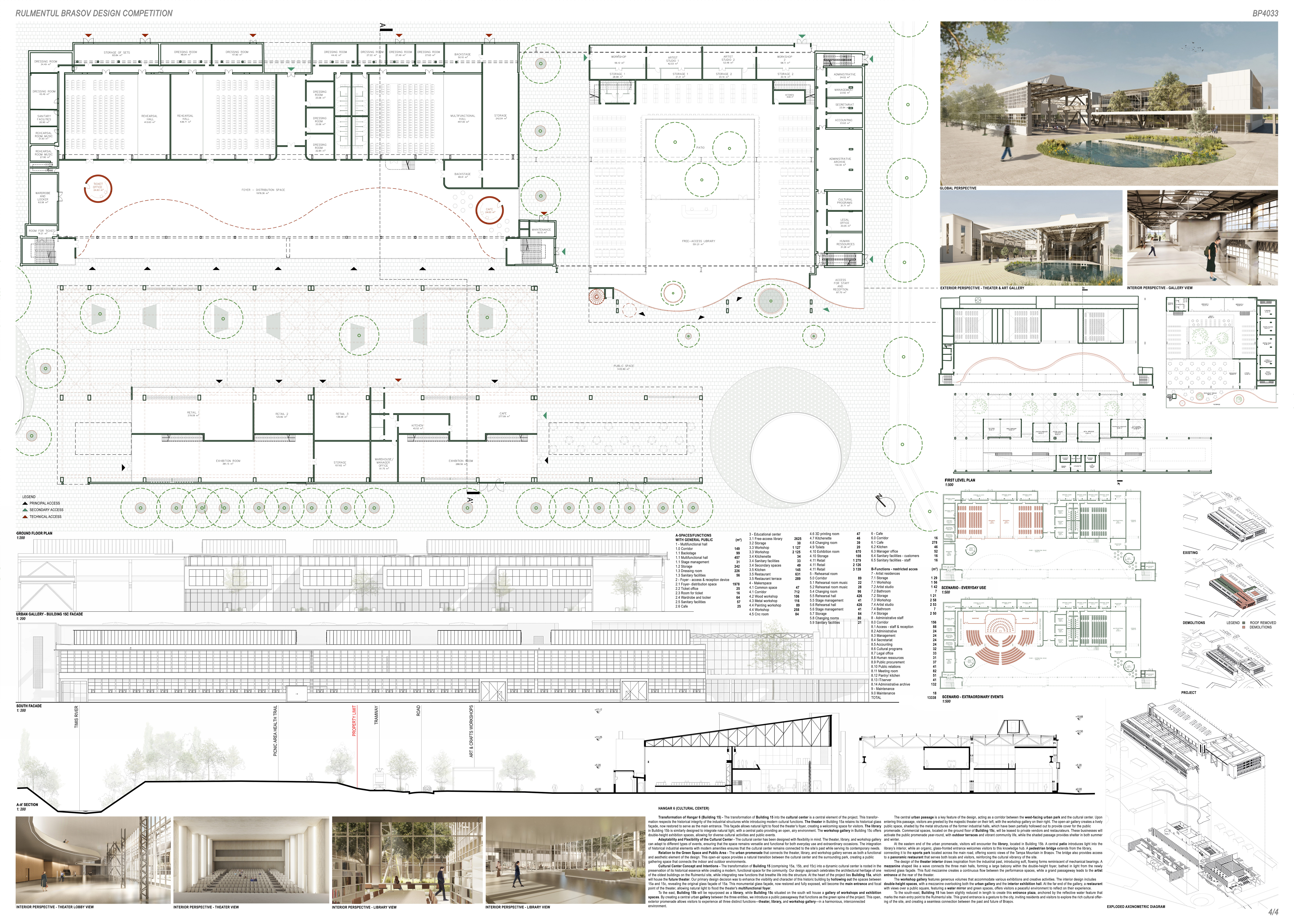
The transformation of Building 15 into a cultural center is central to the project, preserving its industrial heritage while introducing modern functions. The theater in Building 15a retains its historical glass façade, now restored as the main entrance, flooding the foyer with natural light. Building 15b will be repurposed as a library, featuring a central patio that brings in light, while Building 15c will house a workshop gallery with double-height spaces for exhibitions and events.
The urban promenade linking the theater, library, and workshop gallery is a key design element. This open-air passage, shaded by metal structures of the former industrial halls, provides a lively public space and connects the cultural center to the surrounding urban park.
Commercial spaces on the ground floor of Building 15c will be leased to vendors, activating the promenade year-round with outdoor terraces. At the eastern end of the passage, the library in Building 15b features a light-filled interior and a glass-fronted entrance. A pedestrian bridge from the library connects to the sports park, offering views of Tampa Mountain and access to a panoramic restaurant.
The interior of the theater is inspired by the industrial past, with a mezzanine shaped like a wave that connects the three performance halls. The workshop gallery includes double-height spaces, and at the far end, a restaurant overlooks a public square with a water mirror and green spaces.
To the southeast, Building 15 has been slightly shortened to create an entrance plaza, anchored by the reflective water feature that marks the main entry to the Rulmentul site, creating a seamless connection between the past and future of Brașov.