




52 – CL1950 – S.C. ONE ARCHITECTS S.R.L.


Autori principali: arh. Florin Radac, arh. Bogdan Chioran
Coautori: arh. Dan Andrei Pintea, arh. Alexandru Blânaru, arh. Andreea Emilia Ardelean, arh. Alexandru Marius Hăprian, arh. Ileana Dan
Colaboratori specialități: Peisagistica: arh. Mykolas Šečkus
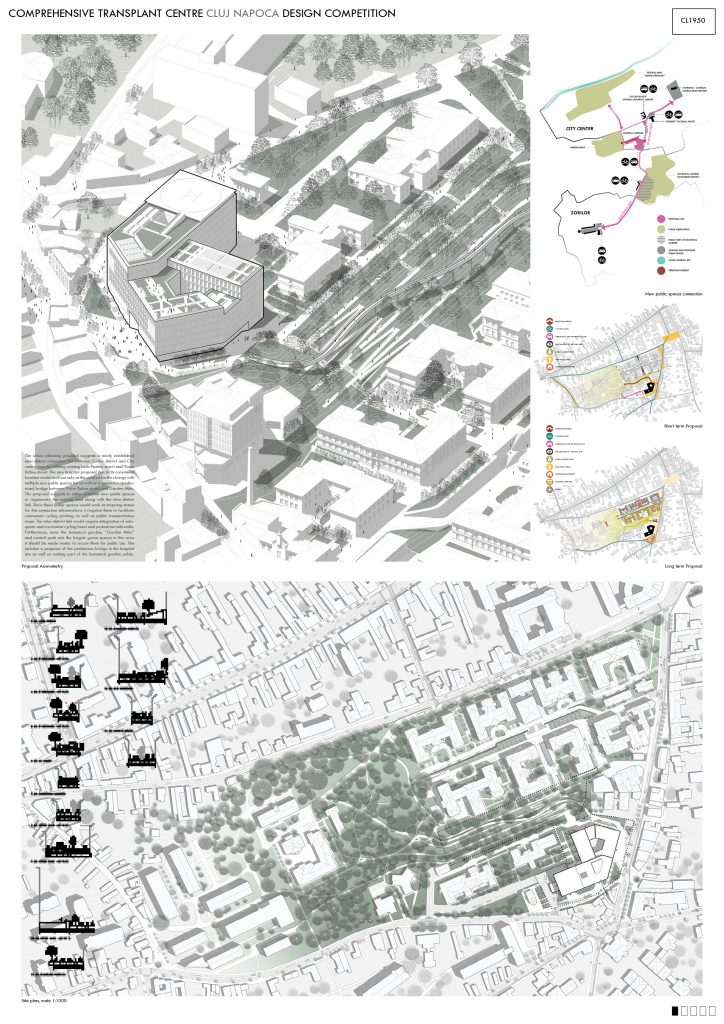
The urban planning proposal suggests a newly established inter-district connection link between Zorilor district and City centre area by utilising existing Louis Pasteur street and Victor Babes street. The new hospital proposal due to its convenient location would work not only as the catalyst for the change with multiple new public spaces but as well as a connection (pedestrian) bridge between Victor Babes street and Garden Miko. The proposal suggests to either establish new public spaces or regenerate the existing ones along with the inter-district link. Since these public spaces would work as stepping stones for this connection infrastructure it requires them to facilitate convenient cycling parking as well as public transportation stops. The inter-district link would require integration of adequate and convenient cycling lanes and pedestrian sidewalks. Furthermore, since the botanical garden, ‘‘Garden Miko’’ and central park are the largest green spaces in the area it should be made easier to access them for public use. This includes a proposal of the pedestrian bridge in the hospital site as well as making part of the botanical garden public.
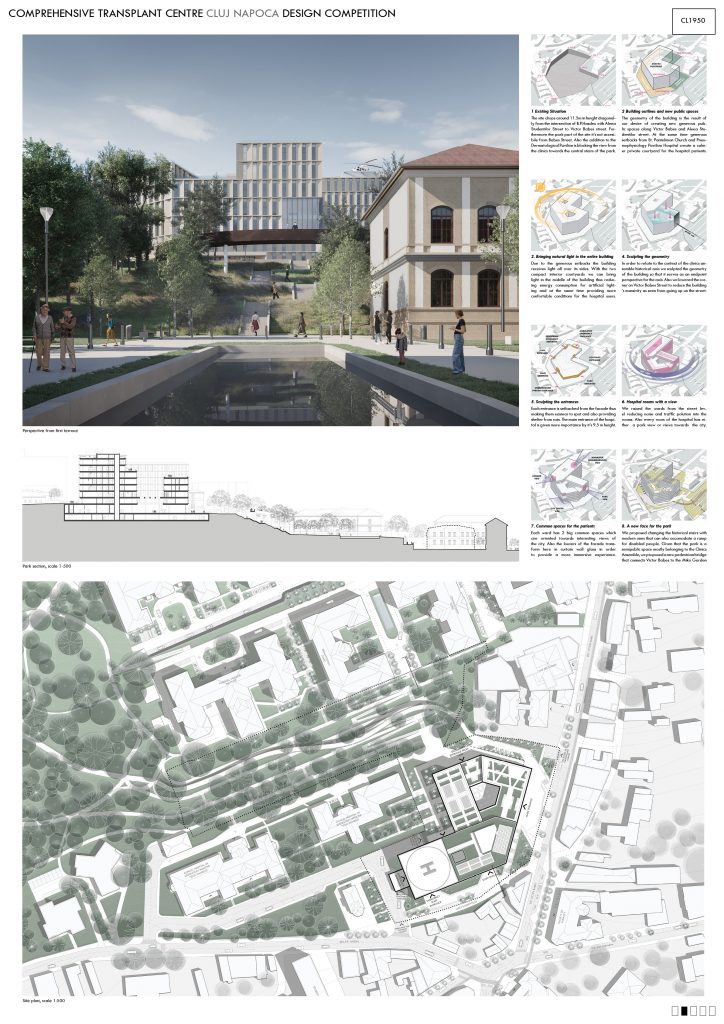
1. EXISTING SITUATION
The site drops around 11.5m in height diagonally from the intersection of B.P.Hasdeu with Aleea Studentilor Street to Victor Babes street. Furthermore the park part of the site it’s not accesibile from Babes Street. Also the addition to the
Dermatological Pavilion is blocking the view from the clinics towards the central stairs of the park.
2. BUILDING OUTLINES AND NEW PUBLIC SPACES
The geometry of the building is the result of our desire of creating new generous public spaces along Victor Babes and Aleea Studentilor street. At the same time generous setbacks from St. Pantelimon Church and Pneumophysiology Pavilion Hospital create a calmer private courtyard for the hospital patients.
3. BRINGING NATURAL LIGHT IN THE ENTIRE BUILDING
Due to the generous setbacks the building receives light all over its sides. With the two compact interior courtyards we can bring light in the middle of the building thus reducing energy consumption for artificial lighting and at the same time providing more confortable conditions for the hospital users.
4. SCULPTING THE GEOMETRY
In order to relate to the context of the clinics ansemble historical axis we sculpted the geometry of the building so that it serves as an endpoint perspective for the axis. Also we lowered the corner on Victor Babes Street to reduce the building ‘s massivity as seen from going up on the street.
5. SCULPTING THE ENTRANCES
Each entrance is setbacked from the facade thus making them easiear to spot and also providing shelter from rain. The main entrance of the hospital is given more importance by it’s 9.5 m height.
6. HOSPITAL ROOMS WITH A VIEW
We raised the wards from the street level reducing noise and traffic polution into the rooms. Also every room of the hospital has either a park view or views towards the city.
7. COMMON SPACES FOR THE PATIENTS
Each ward has 2 big common spaces which are oriented towards interesting views of the city. Also the louvers of the facade transform here in curtain wall glass in order to provide a more immersive experience.
8. A NEW FACE FOR THE PARK
We proposed changing the historical stairs with modern ones that can also accomodate a ramp for disabled people. Given that the park is a semipublic space mostly belonging to the Clinics Ansemble, we proposed a new pedestrian bridge that connects Victor Babes to the Miko Garden
Key Features:
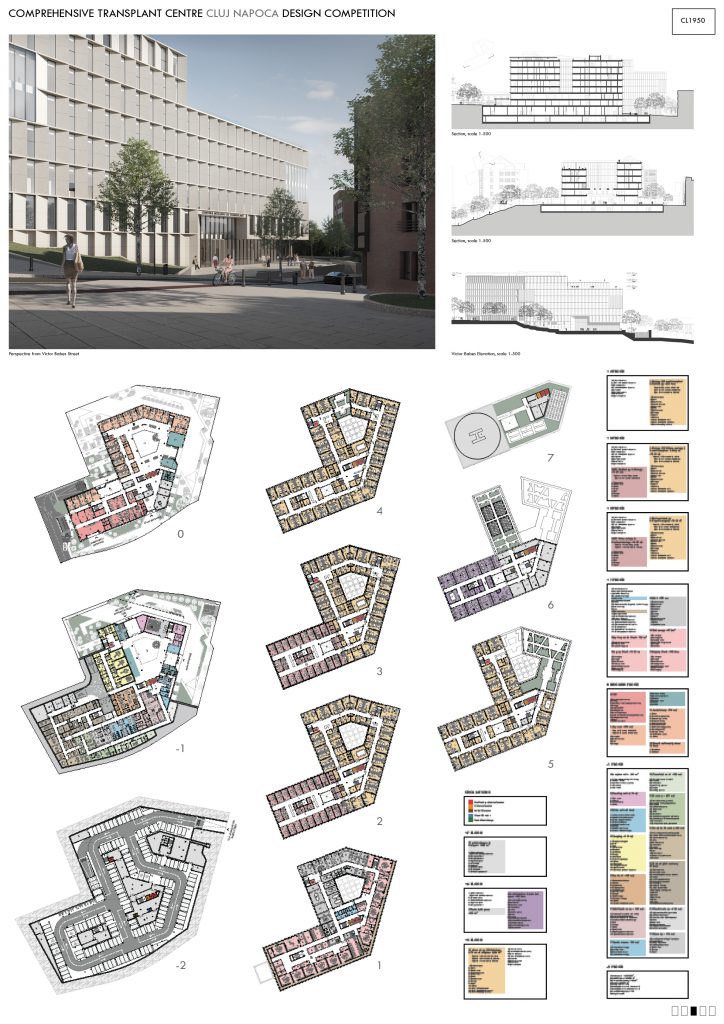
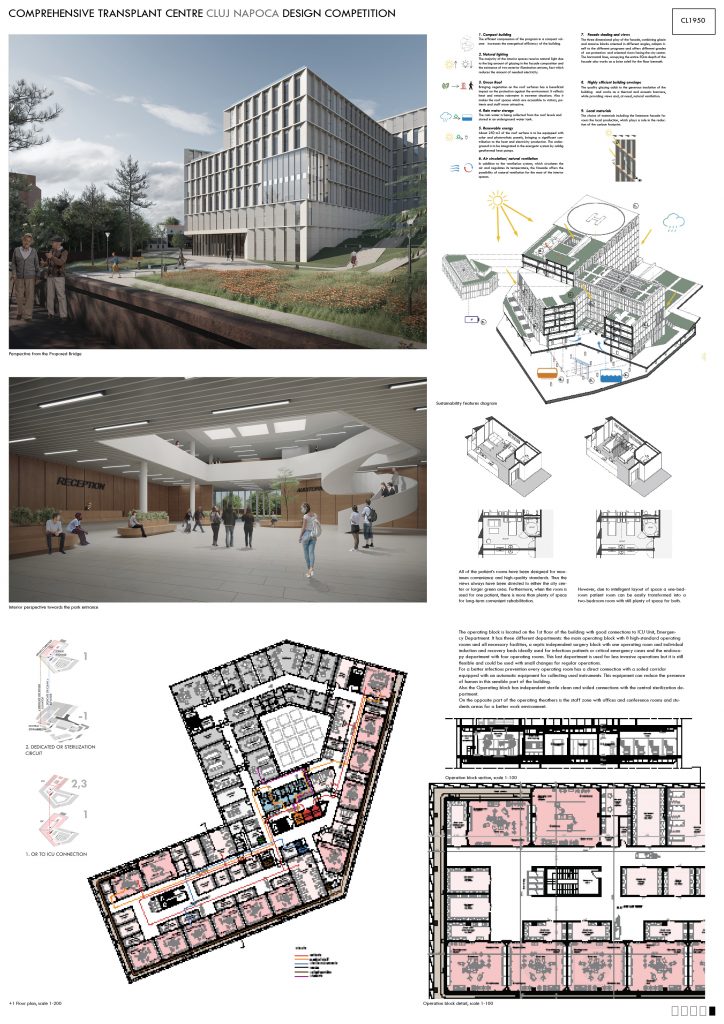
All of the patient’s rooms have been designed for maximum convenience and high-quality standards. Thus the views always have been directed to either the city center or larger green area. Furthermore, when the room is used for one patient, there is more than plenty of space for long-term convenient rehabilitation.
However, due to intelligent layout of space a one-bedroom patient room can be easily transformed into a two-bedroom room with still plenty of space for both.
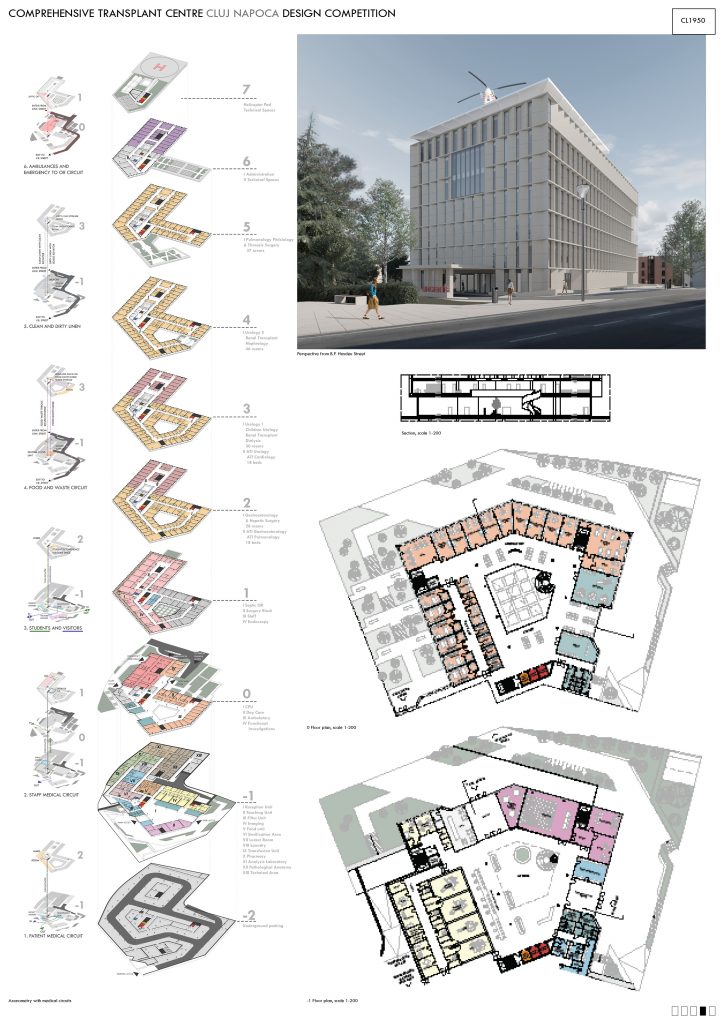
The operating block is located on the 1st floor of the building with good connections to ICU Unit, Emergency Department. It has three different departments: the main operating block with 8 high- standard operating rooms and all necessary facilities, a septic independent surgery block with one operating room and individual induction and recovery beds ideally used for infectious patients or critical emergency cases and the endoscopy department with four operating rooms. This last department is used for less invasive operations but it is still flexible and could be used with small changes for regular operations.
For a better infectious prevention every operating room has a direct connection with a soiled corridor equipped with an automatic equipment for collecting used instruments. This equipment can reduce the presence of human in this sensible part of the building.
Also the Operating block has independent sterile clean and soiled connections with the central sterilization department.
On the opposite part of the operating theathers is the staff zone with offices and conference rooms and students areas for a better work