





115 – TM0303 – TERA DESIGN STUDIO SRL


Autor principal: arh. Tamara Roseti, arh. Tamara – Maria Popovici, arh. Andrada Eftime, arh. Traianus Popovici, arh. Amalia Anastasia Gîscă – Chițac, peis. Gabriela Vlăsceanu, peis. Cristina Irimia, peis. Ruxandra – Maria Stănescu, peis. Elena – Delia Rusu, arh. Iulia Popescu, ec. Daniela Măuță, arh. Alex Pavel
1 INTRODUCTION
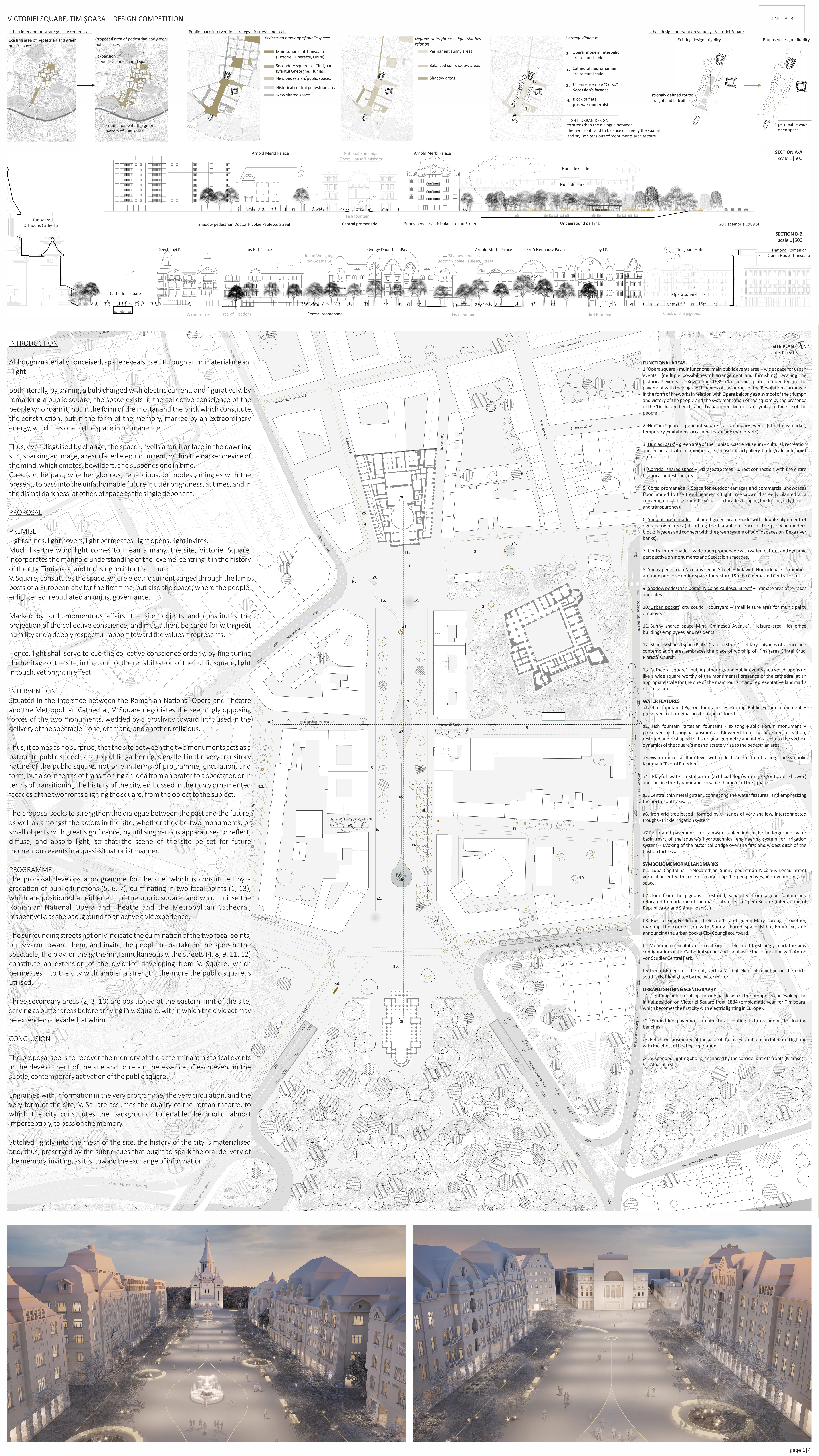
Although materially conceived, space reveals itself through an immaterial mean, – light.
Both literally, by shining a bulb charged with electric current, and figuratively, by remarking a public square, the space exists in the collective conscience of the people who roam it, not in the form of the mortar and the brick which constitute the construction, but in the form of the memory, marked by an extraordinary energy, which ties one to the space in permanence.
Thus, even disguised by change, the space unveils a familiar face in the dawning sun, sparking an image, a resurfaced electric current, within the darker crevice of the mind, which emotes, bewilders, and suspends one in time.
Cued so, the past, whether glorious, tenebrious, or modest, mingles with the present, to pass into the unfathomable future in utter brightness, at times, and in the dismal darkness, at other, of space as the single deponent.
2 PROPOSAL
a PREMISE
Light shines, light hovers, light permeates, light opens, light invites.
Much like the word light comes to mean a many, the site, Victoriei Square, incorporates the manifold understanding of the lexeme, centring it in the history of the city, Timișoara, and focusing on it for the future.
V. Square, constitutes the space, where electric current surged through the lamp posts of a European city for the first time, but also the space, where the people, enlightened, repudiated an unjust governance.
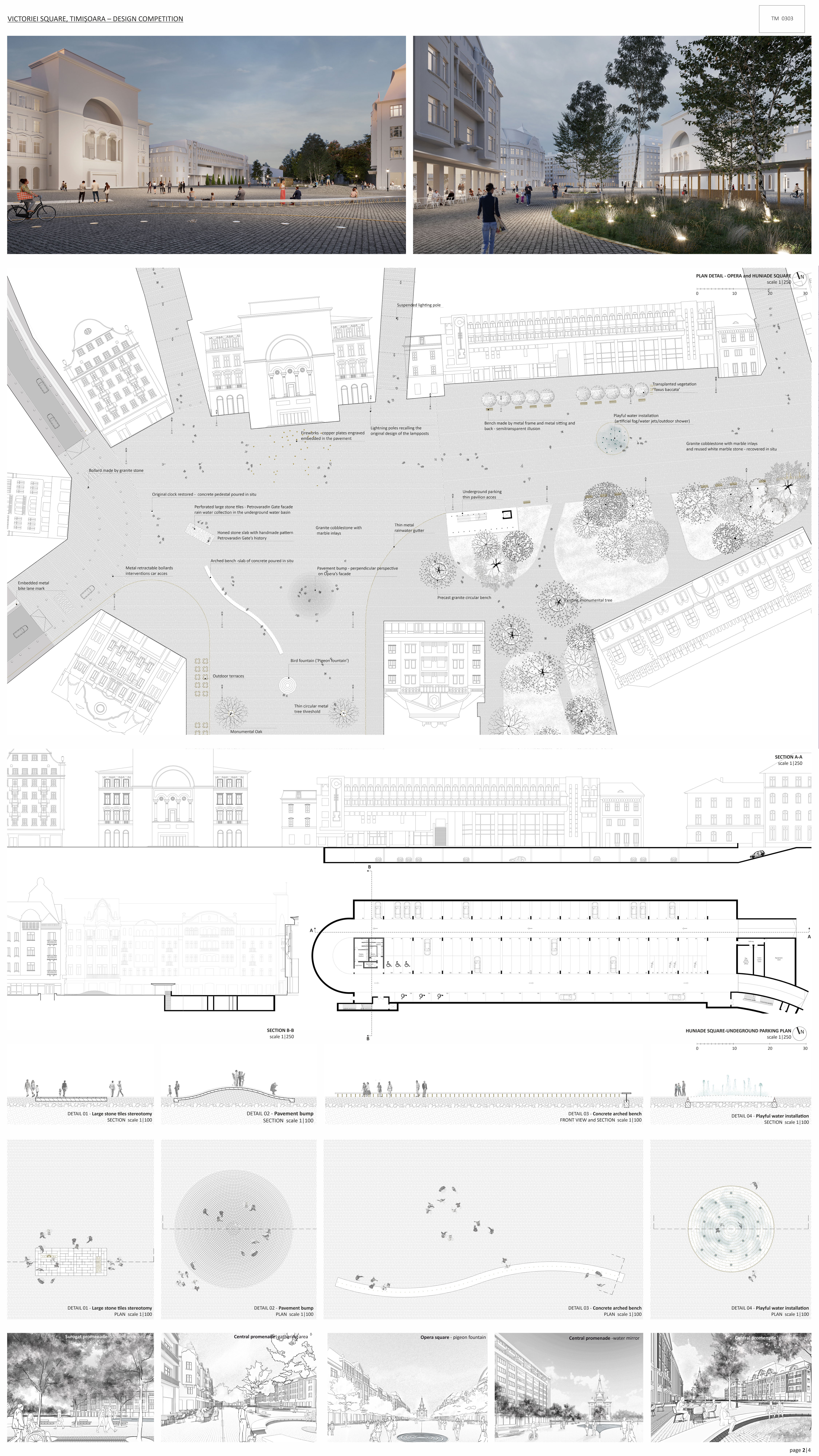
Marked by such momentous affairs, the site projects and constitutes the projection of the collective conscience, and must, then, be cared for with great humility and a deeply respectful rapport toward the values it represents.
Hence, light shall serve to cue the collective conscience orderly, by fine tuning the heritage of the site, in the form of the rehabilitation of the public square, light in touch, yet bright in effect.
b INTERVENTION
Situated in the interstice between the Romanian National Opera and Theatre and the Metropolitan Cathedral, V. Square negotiates the seemingly opposing forces of the two monuments, wedded by a proclivity toward light used in the delivery of the spectacle – one, dramatic, and another, religious.
Thus, it comes as no surprise, that the site between the two monuments acts as a patron to public speech and to public gathering, signalled in the very transitory nature of the public square, not only in terms of programme, circulation, and form, but also in terms of transitioning an idea from an orator to a spectator, or in terms of transitioning the history of the city, embossed in the richly ornamented façades of the two fronts aligning the square, from the object to the subject.
The proposal seeks to strengthen the dialogue between the past and the future, as well as amongst the actors in the site, whether they be two monuments, or small objects with great significance, by utilising various apparatuses to reflect, diffuse, and absorb light, so that the scene of the site be set for future momentous events in a quasi-situationist manner.
I. PROGRAMME
The proposal develops a programme for the site, which is constituted by a gradation of public functions (5, 6, 7), culminating in two focal points (1, 13), which are positioned at either end of the public square, and which utilise the Romanian National Opera and Theatre and the Metropolitan Cathedral, respectively, as the background to an active civic experience.
The surrounding streets not only indicate the culmination of the two focal points, but swarm toward them, and invite the people to partake in the speech, the spectacle, the play, or the gathering. Simultaneously, the streets (4, 8, 9, 11, 12) constitute an extension of the civic life developing from V. Square, which permeates into the city with ampler a strength, the more the public square is utilised.
Three secondary areas (2, 3, 10) are positioned at the eastern limit of the site, serving as buffer areas before arriving in V. Square, within which the civic act may be extended or evaded, at whim.
II. CIRCULATION
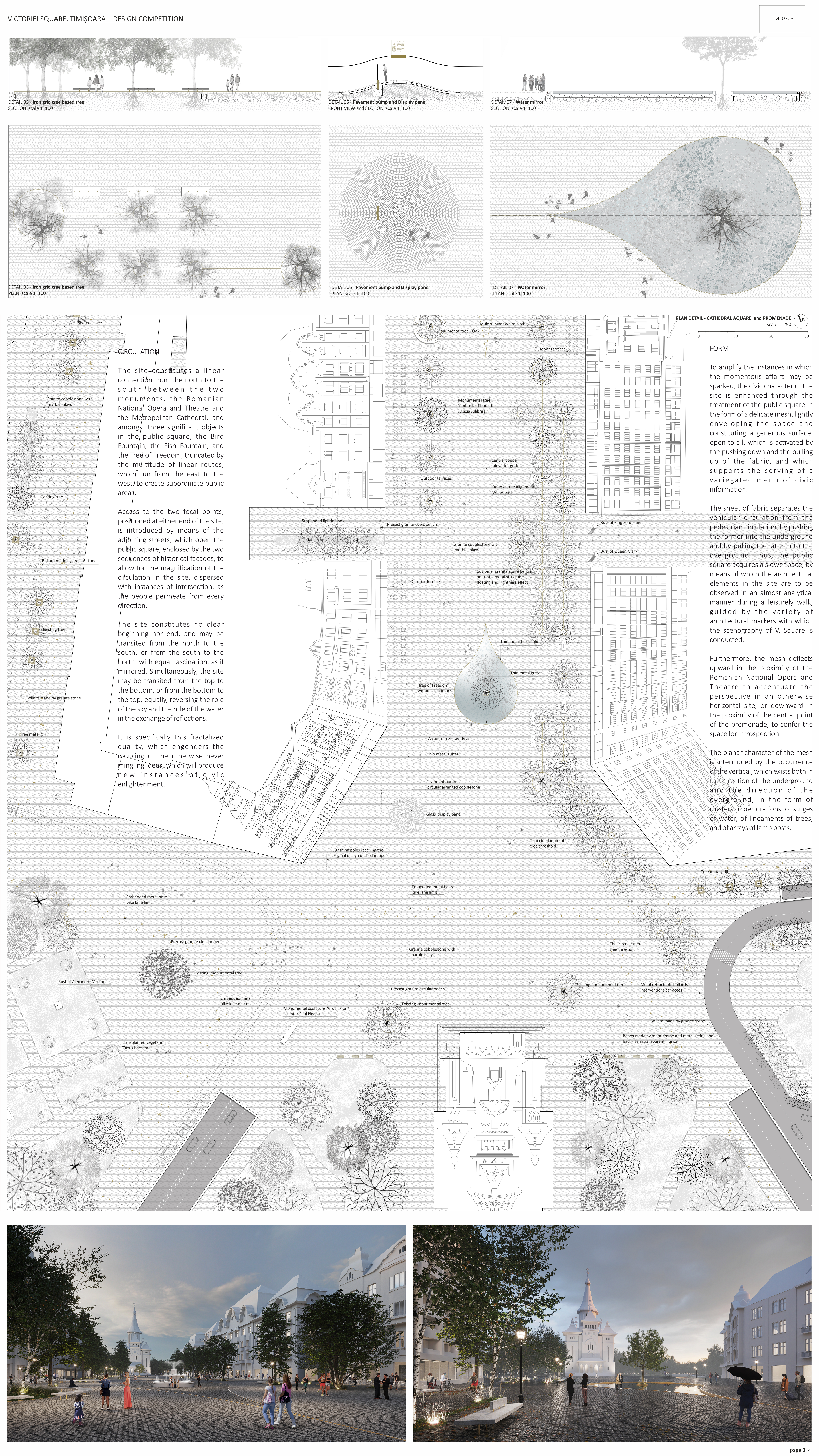
The site constitutes a linear connection from the north to the south between the two monuments, the Romanian National Opera and Theatre and the Metropolitan Cathedral, and amongst three significant objects in the public square, the Bird Fountain, the Fish Fountain, and the Tree of Freedom, truncated by the multitude of linear routes, which run from the east to the west, to create subordinate public areas.
Access to the two focal points, positioned at either end of the site, is introduced by means of the adjoining streets, which open the public square, enclosed by the two sequences of historical façades, to allow for the magnification of the circulation in the site, dispersed with instances of intersection, as the people permeate from every direction.
The site constitutes no clear beginning nor end, and may be transited from the north to the south, or from the south to the north, with equal fascination, as if mirrored. Simultaneously, the site may be transited from the top to the bottom, or from the bottom to the top, equally, reversing the role of the sky and the role of the water in the exchange of reflections.
It is specifically this fractalized quality, which engenders the coupling of the otherwise never mingling ideas, which will produce new instances of civic enlightenment.
III. FORM
To amplify the instances in which the momentous affairs may be sparked, the civic character of the site is enhanced through the treatment of the public square in the form of a delicate mesh, lightly enveloping the space and constituting a generous surface, open to all, which is activated by the pushing down and the pulling up of the fabric, and which supports the serving of a variegated menu of civic information.
The sheet of fabric separates the vehicular circulation from the pedestrian circulation, by pushing the former into the underground and by pulling the latter into the overground. Thus, the public square acquires a slower pace, by means of which the architectural elements in the site are to be observed in an almost analytical manner during a leisurely walk, guided by the variety of architectural markers with which the scenography of V. Square is conducted.
Furthermore, the mesh deflects upward in the proximity of the Romanian National Opera and Theatre to accentuate the perspective in an otherwise horizontal site, or downward in the proximity of the central point of the promenade, to confer the space for introspection.
The planar character of the mesh is interrupted by the occurrence of the vertical, which exists both in the direction of the underground and the direction of the overground, in the form of clusters of perforations, of surges of water, of lineaments of trees, and of arrays of lamp posts.
3 CONCLUSION
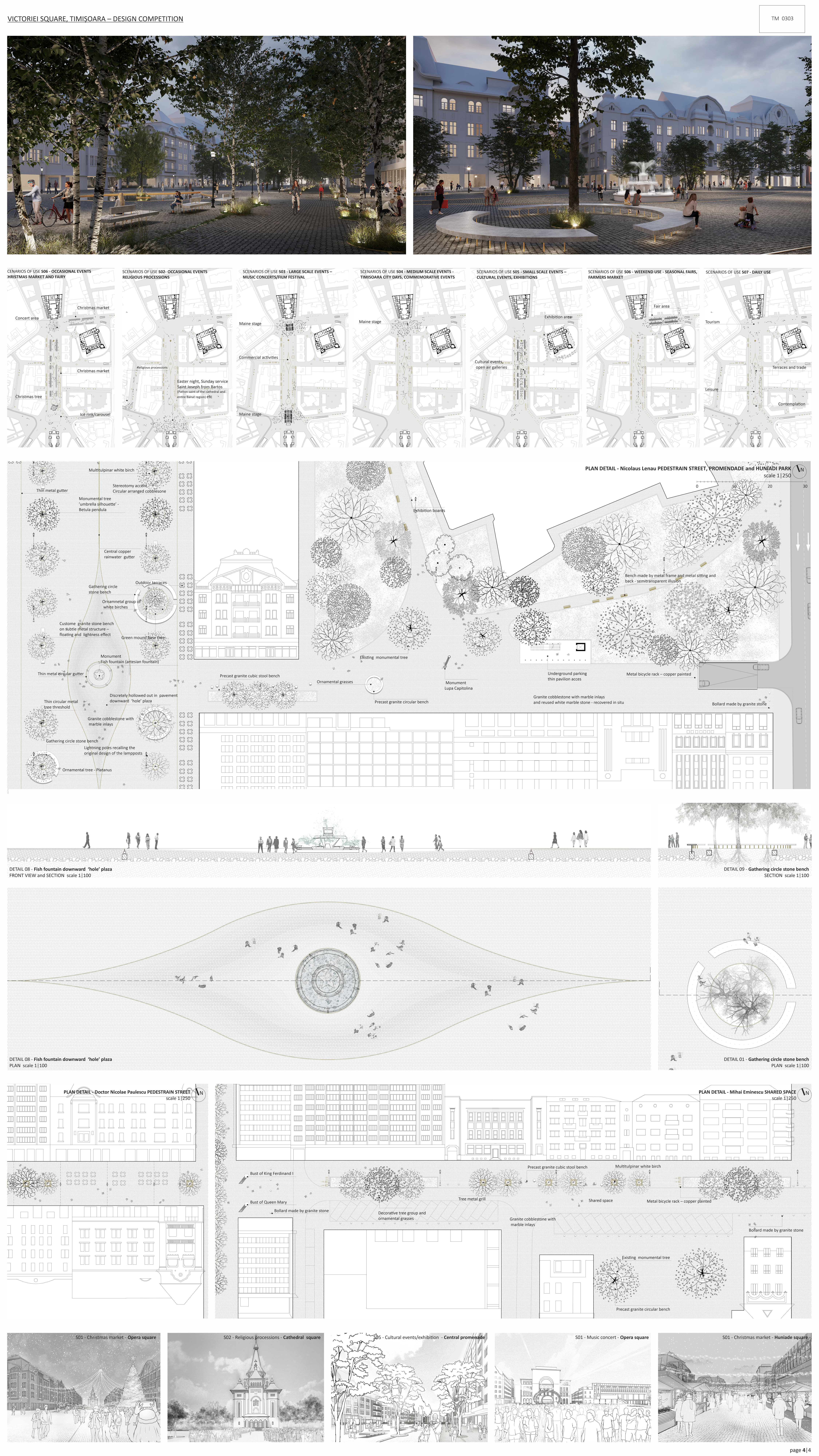
The proposal seeks to recover the memory of the determinant historical events in the development of the site and to retain the essence of each event in the subtle, contemporary activation of the public square.
Engrained with information in the very programme, the very circulation, and the very form of the site, V. Square assumes the quality of the roman theatre, to which the city constitutes the background, to enable the public, almost imperceptibly, to pass on the memory.
Stitched lightly into the mesh of the site, the history of the city is materialised and, thus, preserved by the subtle cues that ought to spark the oral delivery of the memory, inviting, as it is, toward the exchange of information.