





130 – AZ4891 – ATELIER OLIMPIA ONCI SRL


Autori principali: Marius Stelian Găman, Ana-Maria Branea, Olimpia Onci-Isopescu
Colaboratori arhitectură: David-Alexandru Dumitrescu, Evelina Ursatii, Bogdan Liviu Isopescu, Miruna Trașcă
Colaboratori Specialități: Alexandru Ciobotă
“ Propunerea se bazează pe conceptul de “palimpsest”, considerând situl ca fiind o stratificare complexă a istoriei industriale și a naturii. Ea pledează pentru recuperarea sa fizică și funcțională în vederea definirii unui nou peisaj urban hibrid. Încadrat ca cea mai nordică completare a axei urbane principale nord-sud a Brașovului, Platforma Rulmentul oferă autorilor o șansă de a dezvolta un mediu construit contemporan dincolo de centrul istoric al orașului și de extinderea modernistă a Platformei Tractorul. Juriul găsește acest lucru în mod special în conformitate cu tema de concurs. ”– aprecierea Juriului
Natural reclaimed palimpsest
Like medieval scrolls, erased and rewritten, the urban space is also reshaped, sometimes erasing certain fragments, other times filling in, resulting in several overlapping layers. Thus a co-presence character emerges, where traces of the past and previous interventions can be read, albeit necessitating an initiated viewer of its (con)text for understanding.
A palimpsest, layer upon layer of forgotten history, the proposal builds on this site’s identity, enhancing it, by carefully curating which layers are preserved, how much of each, and what is added as a new and definitely not the last layer of this urban tissue. This collage generates a new hybrid urban landscape, a vague terrain.
Modernist industrial buildings became a symbol of their period, of social changes, a new lifestyle, thus making their architecture part of that period’s memory, giving significance to a place.
Tabula rasa projects, characteristic to the modernist and afterwards socialist periods, erased a site’s past, the collective memory, identity, rebuilding from scratch. Museification has not proven to be much better. We reject these premises, having a vision of accumulated history, preserved identity and reused industrial heritage.
The context analysis was carried out on three components: identity, structure and significance. Considering individuality, re-cognoscibility and site specificity, entire buildings, structures or footprints were preserved for identity. Analyzing structure as the spatial relation between viewer and surrounding objects, the context, new additions and pavilions were proposed. The site’s significance was tackled through the emotional connection between the viewer and place, establishing a new city center, distinct yet complementary to the existing network.
The Timis and Ghimbasel rivers together with the Timis canal are to become linear parks, blue-green corridors. Combined with the wooded hills, existing parks, and the ones proposed in Brasov’s PUG, they form a green belt, the Rulmentul site being a major component of it with its own park, and the landscaped hills nearby. Designed as an urban forest, the site and its two adjacent hills act as a counterbalance to the hills near the old historical center.
No major roads are to cut through the site, dividing it. Pedestrian and cycling routes ensure the site’s accessibility complemented by limited car access for loading and unloading goods and produce for the shops and galleries within. A new railway station is proposed to cover mobility needs over the entire development pole and shift traffic patterns. Its placement ensures accessibility coverage for nearby neighborhoods as well. Unused rail lines are transformed to trails, maintained as components of the site’s memory. A raised pedestrian pathway, built on top of the trestles, frames and connects the main buildings on the site.
Joining Brasov’s other two centers, the historical one in the South and the modernist one in the middle, the proposed third, the green one, Rulmentul, completes the Nort-South urban axis through an artifacts and landmarks speckled route. The axis formed by the New Centre, the railway station, Tractorul Park at its back, the square dotted Coresi pedestrian route and the mall with its mineral access area is carried on by a green pedestrian route connecting the cultural and exhibition centers to the city. A 74m high building acts as the focal point of the eye level visual connection to the city while an artistic landmark, the balloon aised 300m above the cultural centre, surpassing the 28m CET tower, is a visual landmark for the entire city, and abstract representation of the site’s aviation past.
The project was structured to adhere to the Reduce-Reuse-Recycle sustainability principle. Flexible, mixed-use, infill development well connected, physically and psychologically, to adjoining neighbourhoods, natural features and the city centre reduces car dependency as housing, production, commercial and leisure opportunities converge. A dense urban environment with reliable local and regional transportation and good accessibility to public transit, inviting walking and cycling achieves resource-efficient land use. The Tabula plena toolkit is a recipe for building Reuse. The project proposal focuses on the first two Rs, Reduce and Reuse, as material recycling of demolished buildings is the easiest, most common approach. The lack of accessibility to the river needs to be remedied to ensure its function as a living corridor throughout the city.
By accommodating a variety of businesses and services, both blue and white collar, the area is neither unilaterally dependent on one industry nor caters to a single demographic thus reducing its vulnerability to cyclical fluctuations and structural changes. Providing numerous housing typologies and viable live-work opportunities ensures a diversity of future residents, income, lifestyle, age and background wise, contributing to social cohesion and an inclusive, integrated, equitable neighbourhood.
The intervention staging covers both phytoremediation and maintaining the active area till the services’ infrastructure and new housing demand makes their relocation financially viable, mixing public and private funds to ease implementation. The liniar park, cultural centre & access square form the catalyst for the areas redevelopment, filled-in in later stages by the airshed reuse and riverfront redesign allowing for private and PPP projects to complete the proposal.
Tabula Plena – The potential of industrial buildings is given precedence for living and working developments. Rejecting the typical tabula rasa approach to industrial/brownfield urban renewal or beautification we propose a Tabula plena form of urban preservation. We propose a reuse intervention catalog of 5 alternative approaches to architectural form to be used on a plot-by-plot case based on site, building, development and function mix particularities. Each variant is accompanied by a schematic evaluation of its development, maintained identity, investment cost and attained density to better inform private owners on their options.
The approaches range from a conventional repartition and re-functionalization, pruning of secondary or damaged buildings or reskinning to various forms of extending and enhancing, to even a stripping to the structural skeleton to give a physical definition to new open spaces. Employed in similar conditions Adding and Top up differ from the previous two and each other in the value they place on the existing buildings or urban space, maintaining the building intact and reshaping the space they define through new insertions, in the case of Adding, or vertically expanding the buildings to maintain the urban space for Top up. Given the large scale of the buildings Substraction would be the most impactful intervention to ensure building reuse. The intervention catalogue proposes four architectural element interventions, foundation, facade, structure and roof, as elements to be preserved, combined with six subtraction types single or multiple courtyards, perimeter, exterior pockets, corridors and their numerous combinations.
Economic and aesthetic valuations would dictate the most suitable approach.
To further adhere to the Reduce-Reuse-Recycle sustainability principle all interventions within the existing buildings are proposed to be easily dismantlable, CLT or metal structures, complementing the large scale of the buildings themselves and their ease of adaptability and reuse. Pavilion structures form a continuous hybrid landscape both in and outdoor while multifunctional public, sometimes covered, spaces house various events.
For almost a millennia, after the fall of the Roman Empire, Rome was recycled both physically, as ancient ruins became building materials or were reused or built upon in a parasitic symbiosis, and psychologically, as they became accent elements in 17-18th century landscape paintings later on inspiring real life English landscape design. A place’s identity is thus preserved through traces still felt in today’s city, a palimpsest of overlapping layers, mining the old city and building on top of it, generating a new hybrid urban landscape.
A similar approach is proposed for Rulmentul as well, a layered palimpsest using as much as possible of the existing buildings in a continuous landscape. Borders are intentionally blurred between interior and exterior space, building and nature, a collage in which nature invades, reclaims, the site and the new reused buildings open up or even migrate into nature themselves. A vague landscape is thus generated open to the viewer’s interpretation, a mystery to be explored again and again.
Hybrid Landscape
Three types of relations are proposed between the buildings and the surrounding nature: adjacency; overlapping – through climbing plants, green facades and roofs; fusion – interlacing elements, breaking limits/facades and inviting nature in, while some built elements are displaced in the natural environment; or hybridization – using all types to create a continuous landscape where the line between built and unbuilt space is permanently, intentionally, blurred.
To achieve this continuous landscape the first stage is a pruning of annexes, an evaluation and interventions on valuable buildings to clear dangerous building materials or pollutants and plant based decontamination of the terrain.Phytomining, through hyper accumulating plants can initiate the process, ensuring some resources are recuperated. Added clean humus topsoil and later on trees with a high capacity for phytoremediation mark the transition process. Paved surfaces or opened up building’s ground floor are demolished and grafted with a dense lattice of trees and shrubs for bioremediation. Phytofiltration is proposed through ecological banks for the river and water features – ponds, basins, throughout the site.
The proposed landscape consists of several distinct areas stitched together by pedestrian and cycling routes and a raised pedestrian pathway built on top of the existing trestles. Green avenues lined by trees and perennial plants frame the site along with the riparian zone. The arboretum, building upon the existing native and imported plantations, unites all areas. Hedge biotopes surround the educational areas and penetrate the opened up courtyard of the exhibition center. The community garden gives character to the future mixed-use area while the wildflower field connects Rulmentul to the future residential redevelopment of the Bilka site. The botanical garden and grass field preceding it act as the embodiment of the proposal’s concept, a palimpsest reclaimed by nature. The adjacent hills are transformed into urban forests.
A water retention network is proposed, composed of bioswales, rainwater ponds, water squares, permeable paving and the brown/green terraces to delay its discharge and lead it to the river. Shaded public spaces, together with the green roofs and facades contribute both to mitigating heat island effects while providing habitats for animals. Former oil storage tanks and water basins are transformed into filtration ponds while water is used as a guiding element connecting Coresi neighbourhood to the river.
Traces of the former public space design were brought back to life in a collage of histories, rails became trails, planes adorn and commemorate the reused airsheds, new pavilions speckled over the landscape create activity nodes and focus points, combining past and present, generating a framework for the future.
For a nature inclusive design, a holistic vision to combine architecture with the landscape, buildings as part of the urban ecosystem was proposed. Each building can assume the role of a cliff, wooded hill, field or even forest depending on its height of type or facade. Diversity in use, maintenance and materials can impact flora and fauna diversity as well. Not all spaces need to be catering to humans, permanently and perfectly manicured, built to our scale and preferences. Some areas can remain wild, some we could share with our non-human neighbors forming a living city.
The multifunctional pavilions and bicycle parking are designed in an industrial style, sometimes reusing the disassembled building elements of the existing buildings. Similarly the proposed urban furniture are reused beams, pillars, any building element uncontaminated and transformed into seating, lighting features, planters or amphitheater steps and even part of the proposed porous pavement.
The riverfront, after its phytofiltration stage is only sparsely redesigned, maintaining its wild character. Stairs, ramps, and a continuous pedestrian and cycling route can be used to increase accessibility. Tree alignments, ecological banks help create the green corridor while fishing facilities, art installations, expo or cultural pavilions, and bridges punctuate the route with activity nodes.
Cultural Center
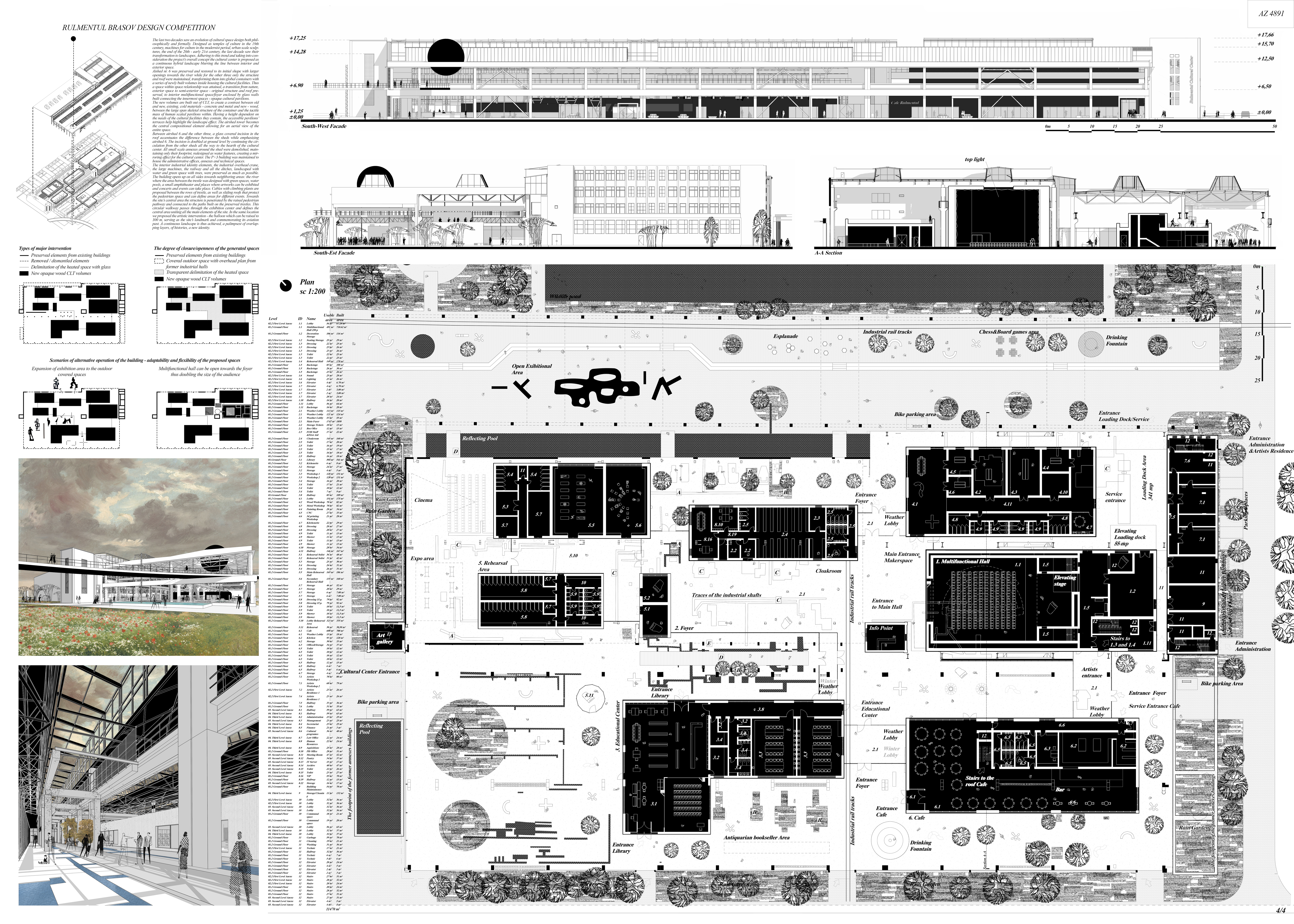
The last two decades saw an evolution of cultural space design both philosophically and formally. Designed as temples of culture in the 19th century, machines for culture in the modernist period, urban scale sculptures, the end of the 20th – early 21st century, the last decade saw their transformation to landscapes. Adhering to this trend and taking into consideration the project’s overall concept the cultural center is proposed as a continuous hybrid landscape blurring the line between interior and exterior space.
Airshed nr. 6 was preserved and restored to its initial shape with larger openings towards the river while for the other three only the structure and roof were maintained, transforming them into global containers with a series of newly built volumes inside housing the cultural facilities. Thus a space within space relationship was attained, a transition from nature, exterior space to semi-exterior space – original structure and roof preserved, to interior multifunctional space/foyer enclosed by glass walls built connecting the innermost spaces – opaque cultural pavilions. The new volumes are built out of CLT, to create a contrast between old and new, existing, cold materials – concrete and metal and new – wood, between the large span skeletal structure of the container and the tactile mass of human scaled pavilions within. Having a height dependent on the needs of the cultural facilities they contain, the accessible pavilions’ terraces help highlight the landscape effect. The airshed tower becomes the central compositional element allowing for an aerial view of the entire space.
Between airshed 6 and the other three, a glass covered incision in the roof accentuates the difference between the sheds while emphasizing airshed 6. The incision is doubled at ground level by continuing the circulation from the other sheds all the way to the hearth of the cultural center. All small scale annexes around the shed were demolished, maintaining only their footprint, redesigned as water features, creating a mirroring effect for the cultural center. The P+3 building was maintained to house the administrative offices, annexes and technical spaces.
The interior industrial identity elements, the industrial overhead crane, the large machines, the railway and all the ditches, landscaped with water and green space with trees, were preserved as much as possible. The building opens up on all sides towards neighboring areas: the river where the area between the trestle was designed with green spaces, water pools, a small amphitheater and places where artworks can be exhibited and concerts and events can take place.
Cables with climbing plants are proposed between the rows of trestle, as well as sliding roofs that protect the pedestrian space and can define areas for different events. Towards the site’s central area the structure is penetrated by the raised pedestrian pathway and connected to the paths built on the preserved trestles. This circular walkway passes through the exhibition center and defines the central area uniting all the main elements of the site. In the same location we proposed the artistic intervention – the balloon which can be raised to 300 m, serving as the site’s landmark and commemorating its aviation past. A continuous landscape is thus achieved, a palimpsest of overlapping layers, of histories, a new identity.