





116 – SF1986 – S.C. SFERA ARHITECTURA S.R.L.


Autori principali: arh. BUCIN ADRIAN-OVIDIU, arh. SABĂU ALEXANDRU, arh. BORȘ SILVIU-CLAUDIU, arh. SABĂU IOANA-ANDREEA, stud. arh. JINGA TEODORA MARIA, stud. arh. SIMEDRU PATRICIA SABINA
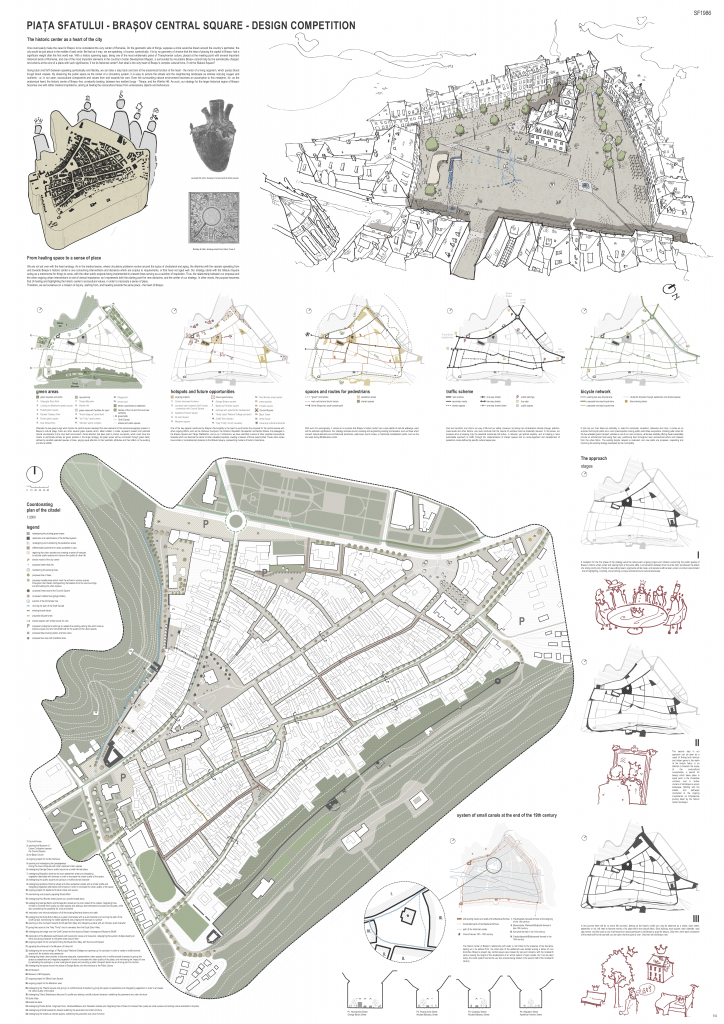
The historic center as a heart of the city
One could easily make the case for Brașov to be considered the very center of Romania. On the geometric side of things, suppose a circle would be drawn around the country’s perimeter, the city would be just about in the middle of said circle. Be that as it may, we are speaking, of course, symbolically. It is by no geometry of chance that the idea of placing the capital in Brașov had a significant weight after the first world war. With a history spanning ages, being one of the most emblematic poles of Transylvanian culture, placed at the meeting point with several important historical lands of Romania, and one of the most important elements in the country’s Center Development Region, a surrounded by mountains Brașov cannot help but be semiotically charged. And what is at the core of a place with such significance, if not its historical center? And what is the very heart of Brașov’s complex cultural force, if not the Sfatului Square?
Going back and forth between speaking symbolically and literally, we can take a step back and look at the anatomical function of the heart – the motor of a living organism, which pumps blood trough blood vessels. By observing the public space as the center of a circulatory system, it is easy to picture the streets and the neighbouring landscape as arteries carrying oxygen and nutrients – or, in our case, sociocultural components and values from and towards the core. Even the surrounding natural environment becomes an accomplice to this metaphor, for, as the anatomical heart, the historic center of Brașov lies, constantly beating, between two resilient lungs – Tâmpa and the Warthe Hill. As such, our strategy for the larger historical region of Brașov becomes one with rather medical inspirations, aiming at healing the sociocultural tissue from unnecessary objects and behaviours.
From healing space to a sense of place
We are not yet over with the heart analogy. As in the medical sense, where circulatory problems revolve around the topics of cholesterol and aging, the dilemma with the vessels spreading from and towards Brașov’s historic center is one concerning interventions and decisions which are surplus to requirements, or that have not aged well. Our strategy starts with the Sfatului Square acting as a metronome for things to come, with the other public projects being implemented in present times serving as a cauldron of inspiration. Thus, the relationship between our proposal and the other ongoing urban interventions is one of utmost importance, as it represents both the starting point for new decisions, and the center of our strategy. In other words, the purpose becomes that of healing and highlighting the historic center’s sociocultural values, in order to (re)create a sense of place.
Therefore, we set ourselves on a mission of inquiry, starting from, and heading towards the same place – the heart of Brașov.
Hotspots and future opportunities
One of the key aspects mentioned by Brașov’s Municipality is the need to synchronize the proposal for the central square with other ongoing efforts, such as the Honterus Courtyard, the Hirscher, Republicii, Mureșenilor and Barițiu Streets, the passages to the Enescu Square and Târgul Căldărarilor, and so on. Furthermore, we have identified a series of other potential sociocultural hotspots which can become the center of other valuable proposals, creating a network of future opportunities. These urban nodes have similar or complementary features to the Sfatului Square, representing markers of historic importance.
Green areas
Whereas the two green lungs which border the central square represent the main elements of the natural scenography present in Brașov’s cultural stage, there are other several green spaces which, albeit smaller in scale, represent present and potential natural counterparts to the city’s built environment. Close attention has been paid to interior courtyards, which could have the means to participate actively as green pockets in the larger strategy. All green areas will be connected through green belts, defined by carefully selected species of trees, paying equal attention to their aesthetic attributes and their effect on the existing and future wildlife.
Scenic promenades
With such rich scenography, it comes as no surprise that Brașov’s historic center has a vast palette of cultural walkways, each with its particular significance. Our strategy revolves around unveiling and augmenting existing promenades, such as those which connect natural elements and architectural landmarks, well-known tourist routes, or traditional manifestation paths, such as the one used during Sărbătoarea Junilor.
Cars, shared spaces, and pedestrian routes
Cars are important, and vital to our way of life and our safety. However, by taking into consideration climate change, pollution, noise levels and other factors, one must conclude that the volume of vehicles must be drastically reduced. In this sense, our proposal aims at keeping only the essential autoroutes still active, in reduced, yet optimal capacity, and at creating a more sustainable approach to traffic through the implementation of shared spaces and an encouragement and development of pedestrian routes defined by specific cultural sequences.
Bicycles
If cars are out, then bikes are definitely in. Used for commutes, recreation, deliveries and more, it comes as no surprise that bicycle paths are a main preoccupation among public authorities everywhere. Creating safe routes for the two-wheeled green transport vehicles is one of our main concerns, while also carefully offering these sustainable circuits an architectural treat along their way, positioning them throughout main sociocultural actors and hotspots from the urban fabric. The existing bicycle network is extended, and new paths are proposed, respecting and improving the existing strategy developed by the municipality.
The approach
Stage I
A metaphor for the first phase of the strategy would be taking each ongoing project and initiative concerning the public spaces of Brașov’s historic urban center and placing them at the same table. A conversation between them must be held, as between the elders of a strong community. Points of view will be heard, arguments will be made, and decisions will be taken under a common denominator – that of highlighting, unveiling, and enriching a unique architectural and cultural landscape.
Stage II
The second step in our approach can be seen as a quest of finding both obvious and hidden gems in the realm of the historic fabric, in an attempt to broaden the scope of the sociocultural conversation, a search for beauty which takes place in equal parts in the immediate vicinities, and in further corners of old Brașov’s scenic landscape. Starting with the streets and pathways connected to the ongoing investments, an introspective journey taken by the historic center has begun.
Stage III
In this journey there will be no stone left unturned. Seeing as the historic center can only be observed as a whole, each street, pedestrian or not, will need to become worthy of its place within the cultural fabric. Each building, each square, each sidewalk, road sign, bench, and tree (and so on) must become an equal participant in old Brașov’s quest for beauty. Only then, when each constituent of the whole will find its best self, can we claim that the quest is over. Only then will old Brașov rest.
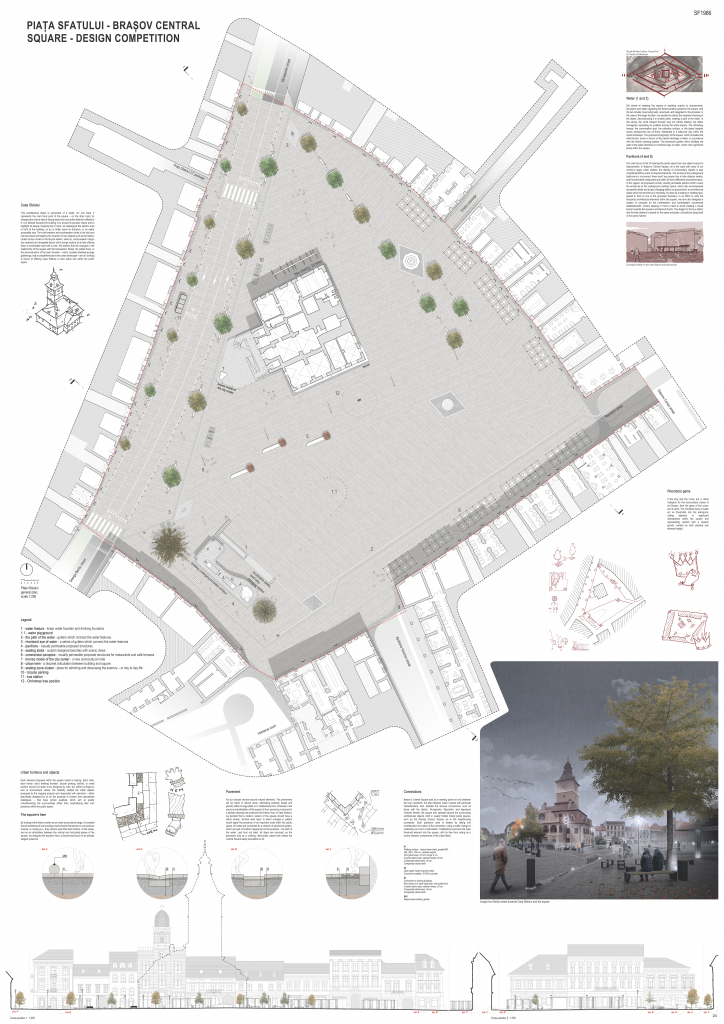
SFATULUI SQUARE
Pavement
All our choices revolve around natural elements. The pavements will be made of natural stone, alternating between basalt and granite, either in large slabs or in cobblestone form. Whereas in the previous manifestation of the square its floor served as a canvas for a stylized drawing that continued the interior floor of Casa Sfatului, we decided that a modern version of the square should have a rather simple, minimal outer layer, in which changes in pattern would signal the presence of an important node within the public space. All nodes are connected by a network of stonework gutters, which are part of another integral part of the proposal – the path of the water. Last bust not least, all steps are removed, as the pavement acts as a unifying, democratic carpet that makes the Central Square easily accessible to all.
Water
As we said, we aimed at cleaning the square of anything surplus to requirements. Decisions were taken regarding the three fountains present in the square, with the two smaller ones being kept, revamped, and integrated in the proposal. In the case of the larger fountain, we decided to extract the essential meaning of the object, deconstructing it in smaller parts, creating a path of the water. In this sense, the circle shaped fountain was not merely deleted, but rather reimagined, spreading its qualities among the entire square. The refreshing breeze, the conversation spot, the reflective surface, or the signal towards scenic perspectives are all there, distributed in a balanced way within the urban landscape. The proposed topography of the square, which emulates the initial terrain, works in favour of the natural drainage of water, in accordance with the historic draining system. The stonework gutters which facilitate the path of the water intertwine in rhomboid eyes of water, which mark significant areas within the square.
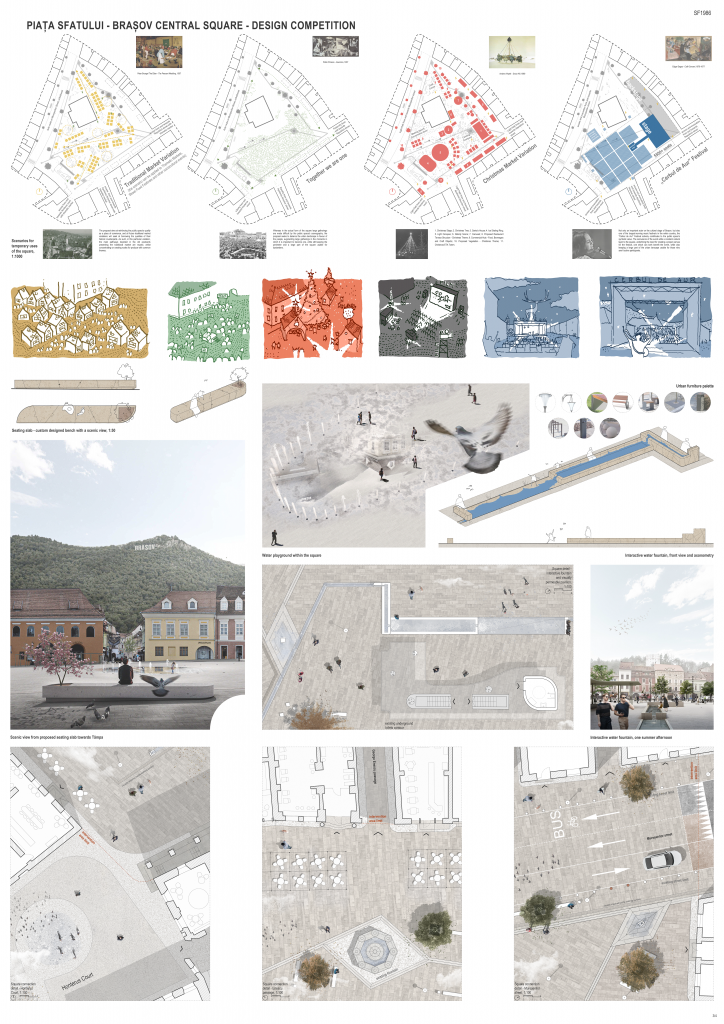
Urban furniture and objects
Each element proposed within the square needs to belong. Each chair, each bench, each drinking fountain, bicycle parking, bollard, or small pavilion should not seem to be designed by man, bur rather by Brașov’s sum of sociocultural values. We carefully studied the urban objects proposed by the ongoing projects and responded with elements – either specifically designed by us for the proposal or chosen from specialized catalogues – that have similar qualities, which aim at quietly complementing the surroundings rather than emphasizing their own presence within the public space.
Vegetation
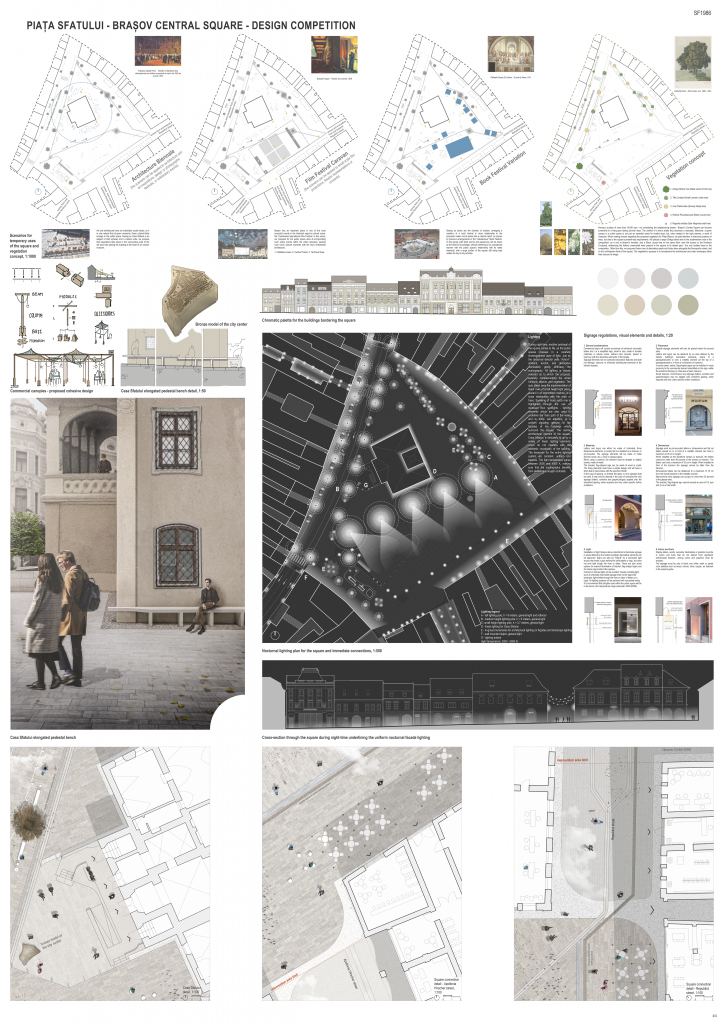
Having a surface of more than 10.000 sqm – not considering the neighbouring streets – Brașov’s Central Square can become somewhat of a frying pan during summer days. The comfort of a tree’s shade thus becomes a necessity. Moreover, a green canopy in a public space is not just an essential asset for heated days, but, when treated in the right manner, a mark of character. When making choices regarding the proposed vegetation for Piața Sfatului, we paid attention to historical positions of trees, but also to the square’s present-day requirements. We placed a larger Ginkgo biloba tree in the southwestern side of the composition, as a nod to Brașov’s heraldry, and a Black Locust tree on the same flank, near the access to the Honterus Courtyard, referencing the historic ornamental trees present in the square in its distant past – the only isolated trees in the composition. Other than this, we proposed linear rows of alternating maple and linden trees alongside the Mureșenilor street, and on the northeastern flank of the square. The vegetation’s purpose is to complement the architectural and urban landscape rather than obscure its image.
Connections
Brașov’s Central Square acts as a meeting point not only between the city’s residents, but also between urban vessels with particular characteristics. Also, besides the obvious connections, such as those with the Barițiu, Mureșenilor, Republicii, and Appolonia Hirscher streets, the square also spreads beyond the surrounding architectural objects, both in quietly hidden linked public spaces, such as the George Enescu Square, as in the neighbouring courtyards. Each particular case is treated by taking into consideration the nature of the connection, using a subtle change in materiality as a form of articulation. Cobblestone becomes the main threshold element into the square, with its free form acting as a mortar between components of the urban fabric.
Pavilions
As seen in the proposal, our main focus is that of cleaning the public space from any object surplus to requirements. In Brașov’s Central Square, as is the case with many of our country’s larger urban centers, the density of unnecessary objects is also complemented by a lack of required elements. The access to the underground bathrooms is uncovered, there aren’t any proper bus or bike stations nearby, and the perimetral restaurants and café’s all have differently resolved terraces. In this regard, we proposed a small, visually permeable pavilion which covers the entrances to the underground sanitary space, which also encompasses accessible toilets and a baby changing station on ground level, an architectural object which serves both as a necessity, but also as a seating or meeting spot, placed in front of one of the proposed fountains. In an effort to unify the temporary architectural elements within the square, we have also designed a system of canopies for the northeastern and southeastern commercial establishments, closely keeping in mind a need to avoid creating a visual barrier towards the square’s architectural fronts. The design for the bus station and the bike stations is based on the same principles, all pavilions being built in the same manner.
Casa Sfatului
This architectural object is somewhat of a riddle. On one hand, it represents the main focal point of the square – on the other hand, its introspective nature sees it shying away from any active attention offered to it. Our attitude towards the building is to accept its peculiar nature and to highlight its beauty. Keeping this in mind, we redesigned the exterior area in front of the building, so as to better serve its entrance, in an easily accessible way. The north-western and southwestern limits of the old town hall have been animated by the insertion of new objects such as the historic center bronze model or the bicycle station, while its south-eastern margin has received an elongated bench which brings visitors at its feet offering them a comfortable seat with a view. We believe that the changes in the relationship of the square with the Mureșenilor Street, the added trees, or the deconstruction of the main fountain – which, besides disallowing large gatherings, had a competitive size in the urban landscape – are all working in favour of offering Casa Sfatului a more active role within the public space.
Lighting
During night-time, another portrayal of the square comes to life, as the public spaces dresses in a carefully choreographed layer of light. Just as the nocturnal director yells “Action!”, ambient, accent, and decorative illumination gently embrace the scenography. All lighting is closely selected as to enrich the proposal, carefully complementing the urban furniture, objects, and vegetation. The auto street sees the implementation of linear rows of small height light poles, placed in an intermittent manner, in a close relationship with the rows of trees. Speaking of trees, each one is highlighted through the use of recessed floor spotlights – lighting elements which are also used to underline the main path of the water and to softly call attention, in a uniform signaling gesture, to the facades of the buildings which surround the square. The central architectural element of the square, Casa Sfatului, is delicately lid up by a series of linear lighting elements which do not interfere with the aesthetic vocabulary of the building. The keywords for the entire lighting system are constant, uniform and balance. The light temperature varies between 2000 and 4000 K, making sure that the scenography benefits from deliberately sought contrasts.
The square’s hem
By looking at the historic center as an urban sociocultural stage, it is implied that all architectural surroundings must present themselves in a sumptuous manner, or, simply put – they need to wear their best clothes. In this sense, and as an articulation between the vertical and horizontal planes of the square, we designed the urban hem, a discreet last touch to an already elegant presence.
Rhomboid gems
If the king and the crown are a visual metaphor for the sociocultural values of old Brașov, then the gems of the crown are its spirit. The rhomboid eyes of water act as thresholds into the atemporal, calling attention to significant intersections within the square and representing centres with a heavier gravity, marked by both physical and ethereal weight.