




115 – ML7777 – S.C. BUILDINGMAN.RO S.R.L.


Autori principali: S.C. BUILDINGMAN.RO S.R.L. , prin MITRAN MARIUS si TUTOVEANU ANA-MIRUNA
Coautori: MARCULESCU LAURA, PANAIT LAURA, OPRISIU MARA, NICOARA ADRIAN, ZURBAGIU MARIA, PASCU RALUCA ZLAVOG RAZVAN
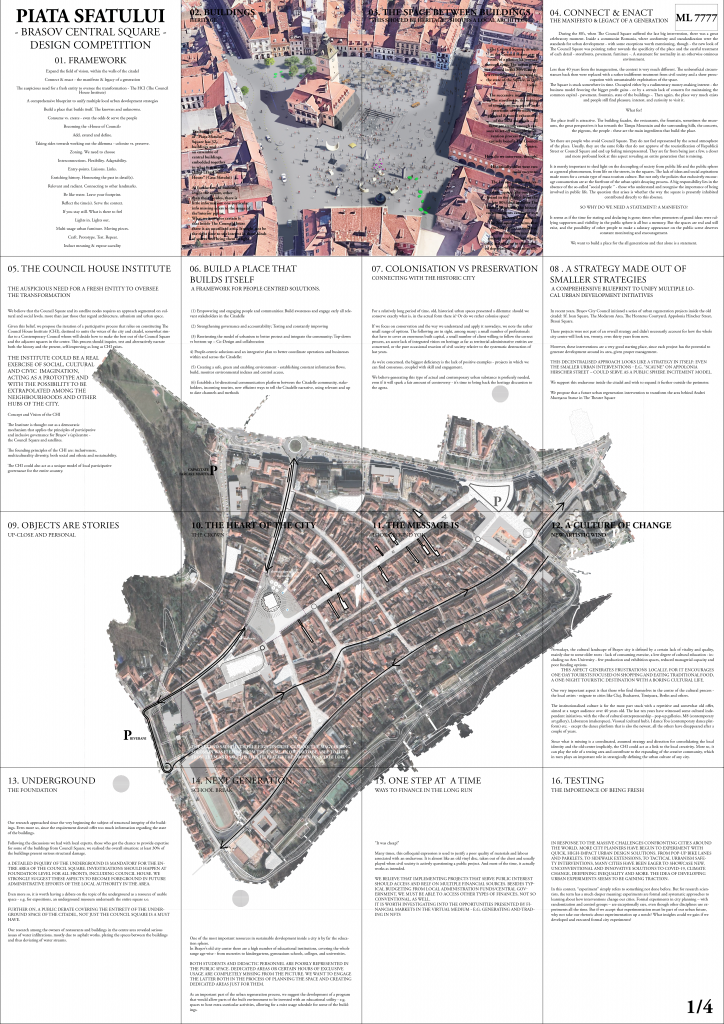
THE MANIFESTO & LEGACY OF A GENERATION
During the 80’s, when The Council Square suffered the last big intervention, there was a great celebratory moment. Inside a communist Romania, where conformity and standardization were the standards for urban development – with some exceptions worth mentioning, though – the new look of The Council Square was pointing rather towards the specificity of the place and the careful treatment of each detail – storefronts, pavement, furniture -. A statement for normality in an otherwise ominous environment.
Less than 40 years from the inauguration, the context is very much different. The unbeneficial circumstances back then were replaced with a rather indifferent treatment from civil society and a sheer preoccupation with unsustainable exploitation of the space.
The Square is stuck somewhere in time. Occupied either by a rudimentary money-making interest – the business model favoring the bigger profit gains – or by a certain lack of concern for maintaining the common capital – pavement, fountain, state of the buildings -. Then again, the place very much exists and people still find pleasure, interest, and curiosity to visit it.
What for?
The place itself is attractive. The building facades, the restaurants, the fountain, sometimes the museums, the great perspectives it has towards the Tâmpa Mountain and the surrounding hills, the concerts, the pigeons, the people – these are the main ingredients that build the place.
Yet there are people who avoid Council Square. They do not feel represented by the actual atmosphere of the place. Usually, they are the same folks that do not approve of the touristification of Republicii Street or Council Square and end up feeling misrepresented. They are far from being just a few, a closer and more profound look at this aspect revealing an entire generation that is missing.
It is merely important to shed light on the decoupling of society from public life and the public sphere as a general phenomenon, from life on the streets, in the squares. The lack of ideas and social aspirations made room for a certain type of mass tourism culture. But not only the policies that exclusively encourage consumerism are at the forefront of the urban spirit decaying process. A big responsibility lies in the absence of the so-called ”social people ” – those who understand and recognise the importance of being involved in public life. The question that arises is whether the way the square is presently inhabited contributed directly to this absence.
So why do we need a statement? A manifesto?
It seems as if the time for stating and declaring is gone; times when promoters of grand ideas were rallying supporters and visibility in the public sphere is all but a memory. But the spaces are real and still exist, and the possibility of other people to make a salutary appearance on the public scene deserves constant monitoring and encouragement.
We want to build a place for the all generations and that alone is a statement.
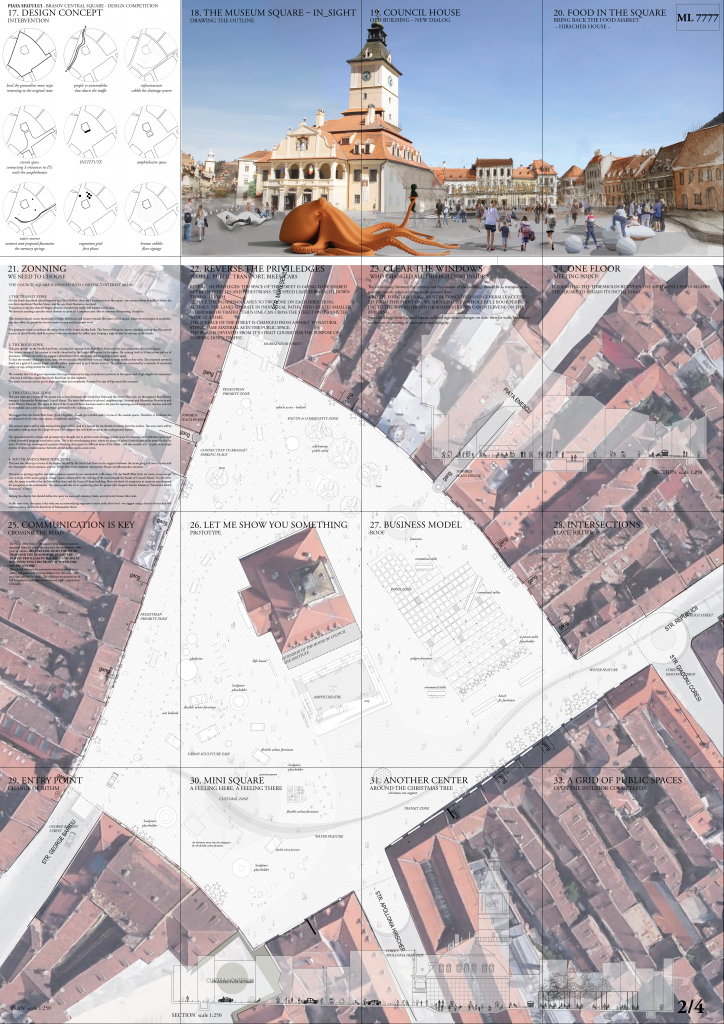
The Council Square is divided into 5 distinct areas:
1.The Transit zone
On the South-East flank (ȘirulPoamelor and ȘirulFlorilor) there are 3 access points to the square – the entrance from Republicii Street, the one from Apollonia Hirscher Street, and the one from Honterus courtyard. This points to the fact that the largest amount of pedestrian traffic will happen in this area.
We aimed at creating a specific visual element to unite all 3 entrances and offer an easy way of transiting, if need be.
This element doesn’t create thresholds or height differences and focuses towards the centre of the square, where we envisioned an amphitheatre that offers the possibility for the transit to stop and for people to sit.
The pavement seems to embrace the entire front of the houses on this flank. This front will keep its current schedule, noting that the covered terrace on ȘirulFlorilor shall be moved in the area destined for tables, only keeping a reduced area for serving, at the facade.
2. The Food Zone
This area spreads on the North-East front, covering the segment from Republicii Street and the access gang towards Enescu Square. The current set-up of the terraces is strictly connected to the height differences in the square. By coming back to a continuous surface of pavement, without any stairs, we suggest a detachment from the facade and occupying a wider space.
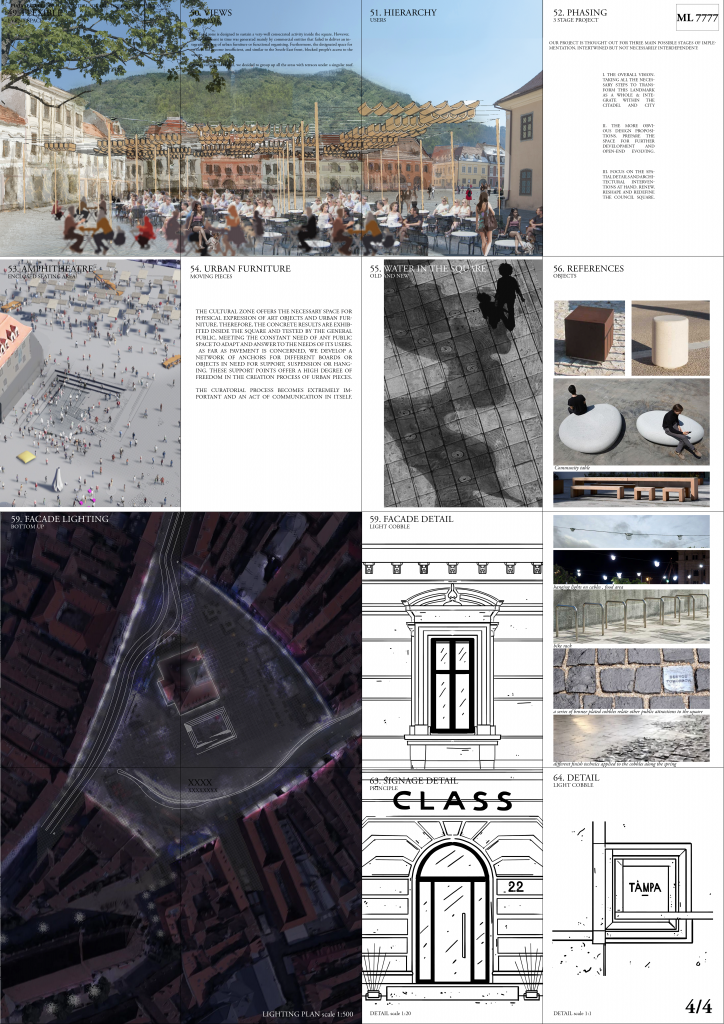
To face the weather challenges (sun, rain), we envisioned a flexible roof that can adapt to usage needs as they arise. The proposed system is based on a grid of 5 metres height metallic pillars, positioned at an 8 metres interval. The pillars are connected by a network of tensioned cables up top, acting as tires for the above fabric.
We consider that it is of great importance this supra-structure having a very discreet presence in the square and a high degree of transparency – this way it will also expose the North-East front on that segment.
The entire structure can be put in place and taken out completely if needed (in case of big events like concerts).
3. The Cultural Zone
This area takes-up a corner of the square and is found between the South-East front and the North-West one, on the segment from Barițiu entrance, Mureșenilor House and Council House. The main destination is cultural, neighbouring Cărturești and Humanitas libraries as well as the History Museum. The space in front of the Council House has been used in the past for exposing several temporary displays and will be embedded into a new curatorial vision destined for the cultural arena.
We suggest that the South-West front (ȘirulDogarilor) should get a similar utility to one of the outside spaces. Therefore, it facilitates the development of art cafes, expo spaces, art galleries, and so on.
The sanitary spaces will be relocated and the space will be used as a deposit for the flexible furniture from the market. The access stairs will be rescinded, making room for a large elevator (3×5 metres) that will allow access to the underground storage space.
The space destined for testing and prototyping is thought out to permit a mix of usages: public space for meetings and exhibition space with a fresh curatorial program once/twice a year. This is the everchanging space, where art pieces or urban furniture gets to be tested for the 1st time. To follow-up, we imagined a process of moving these pieces in different areas of the citadel – and also outside of it – as part of an ample process of inter-communication between several public spaces across town.
4. Youth and Community Zone
This area also takes up a corner of the square, limited by the Norh-East front on the segment between the access gang to Enescu Square and the Mureșenilor Street entrance, and the North-West front, between Mureșenilor House and Mureșenilor entrance.
This space is putting together two distinct spaces crossed by two automobile traffic lanes. On the North-West front we create a more ample area in front of the access gang to Brasai Square, enhanced by the curbing of the road towards the facade of Council House. On the other side, the space is confined by the North-East front and the Council House building. Here, we think it’s auspicious to create an area designed for youngsters in the community – the space could also act as a gathering place for people who frequent Sunday Masses at ”AdormireaMaiciiDomnului” Church.
Among the objects that should define the space we name self-cleaning toilets, security point boxes, bike racks.
At the same time, this space is the only one accommodating vegetation inserts at the floor level – we suggest using a bunch of trees that will continue along the North-East front of Mureșenilor Street.
5. Extension
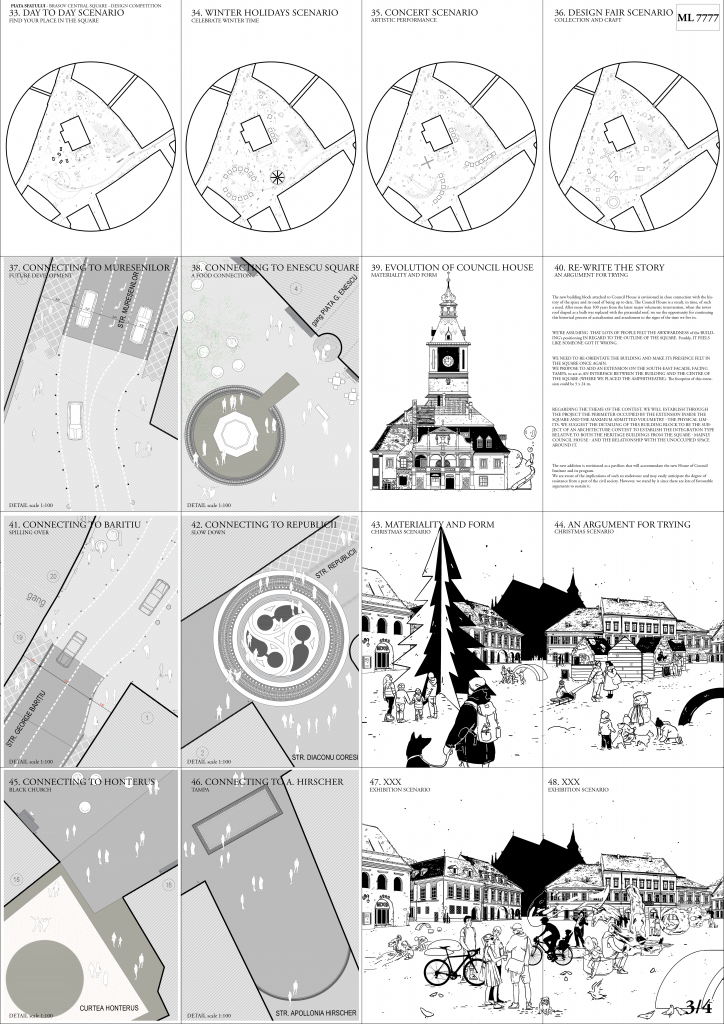
The new building block attached to Council House is envisioned in close connection with the history of the space and its need of being up to date. The Council House is a result, in time, of such a need. After more than 100 years from the latest major volumetric intervention, when the roof shaped as a bulb was replaced with the pyramidal roof, we see the opportunity for continuing this historical process of actualization and attachment to the signs of the time we live in.
We are assuming that lots of people felt the awkwardness of the building’s positioning in regard to the outline of the square. Frankly, it feels like someone got it wrong.
We need to re-orientate the building and make its presence felt in the square once again.
We propose to add an extension on the south-east façade, facing Tampa, to act as an interface between the building and the center of the square, where we placed the amphitheater.
Regarding the theme of the contest, we will establish through the project the perimeter occupied by the extension inside the square and the maximum admitted volumetry – the physical limits. We suggest the detailing of this building block to be the subject of an architecture contest to establish the integration type relative to both the heritage buildings from the square – mainly Council House – and the relationship with the unoccupied space around it.
The new addition is envisioned as a pavilion that will accommodate the new House of Council Institute and its program.
We are aware of the implications of such an endeavour and may easily anticipate the degree of resistance from a part of the civil society. However, we stand by it since there are lots of favourable arguments to sustain it.