





121 – XG1251 – MOLNÁR & VASS ARHITECȚI ASOCIAȚI SRL


Autori principali: MVAA & SEVA & MOSSFERN
Coautori: arh. Daniel Rațiu
Asociere:
- MOLNÁR & VASS ARHITECȚI ASOCIAȚI SRL – contribuția33.4%
- SEVA STUDIO SRL – contribuția 33.3%
- MOSSFERN SRL – contribuția 33.3%
Concept
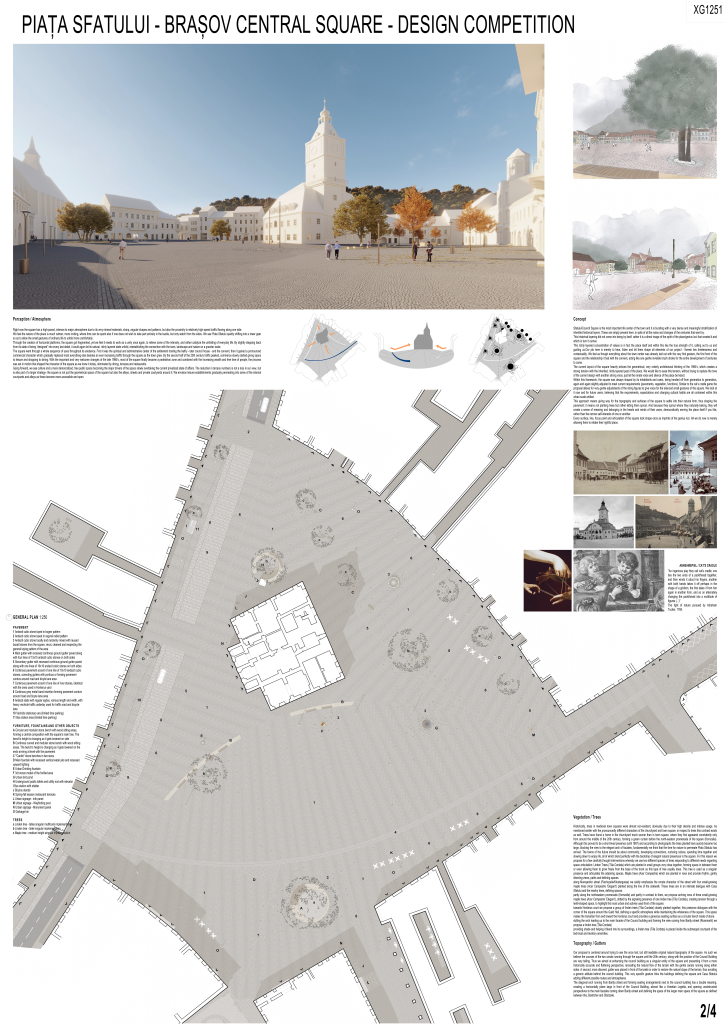
Sfatului/Council Square is the most important life center of the town and it is bursting with a very dense and meaningful stratification of inherited historical layers. These are simply present here, in spite of all the noise and changes of the centuries that went by.
This historical layering did not come into being by itself, rather it is a direct image of the spirit of the place/genius loci that created it and which in turn it carries.
This richly layered concentration of values is in fact the place itself and within this lies the true strength of it, calling out to us and guiding us.Our job here is merely to hear, listen and let them shape all elements of our project – therein lies timelessness and contextuality. We feel as though everything about the town center was already laid out with the very first gesture, the first front of the square and the relationship it had with the convent, acting like one gentle invisible brush stroke for the entire development of centuries to come.
The current layout of the square heavily echoes the geometrical, very orderly architectural thinking of the 1980’s, which creates a strong tension with the inherited, richly layered past of the place. We would like to ease this tension, without trying to replace the tone of the current design with another strong voice, just let the innate voice and silence of the place be heard.
Within this framework, the square was always shaped by its inhabitants and users, being handed off from generation to generation, again and again slightly adjusted to meet current requirements (pavements, vegetation, functions). Similar to the cat’s cradle game the proposal allows for very gentle adjustments of the string figures to give voice for the silenced small gestures of the square. We look at it now and for future users, believing that the requirements, expectations and changing cultural habits are all contained within this urban scale artifact.
This approach means giving way for the topography and surfaces of the square to settle into their natural form, thus shaping the pavement; it means not planting trees but rather letting them sprout. And because they sprout where they naturally belong, they will create a sense of meaning and belonging in the hearts and minds of their users, democratically serving the place itself if you like, rather than the narrow self-interests of one or another.
Every surface, line, focus point and articulation of the square took shape once as imprints of the genius loci. All we do now is merely allowing them to retake their rightful place.
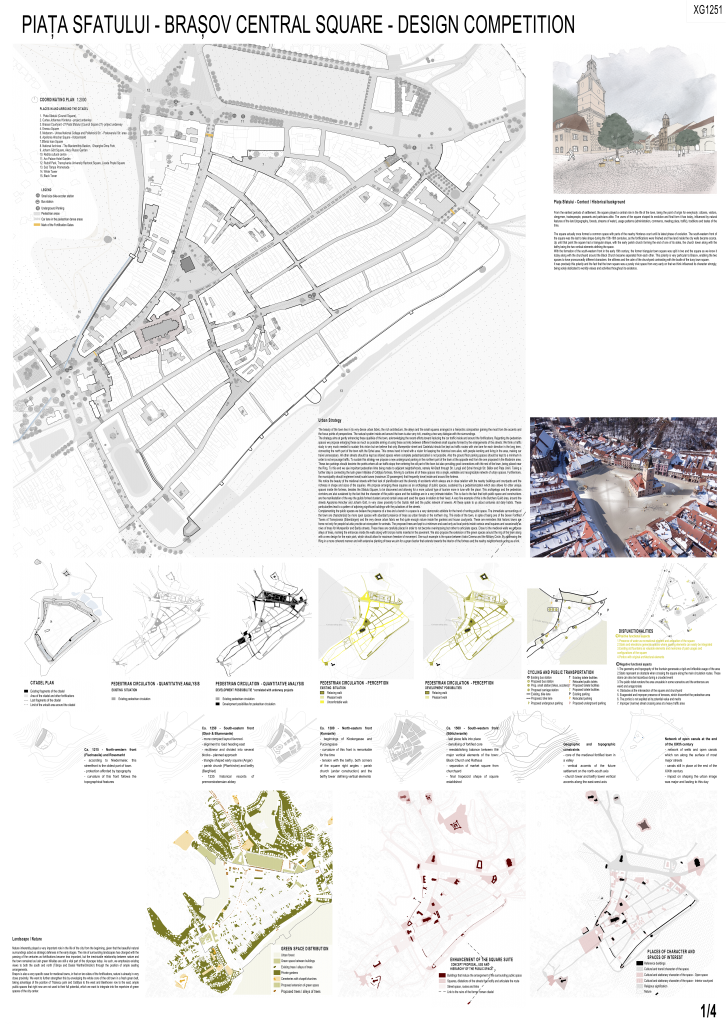
Piața Sfatului – Context / Historical background
From the earliest periods of settlement, the square played a central role in the life of the town, being the point of origin for everybody: citizens, visitors, clergymen, tradespeople, peasants and patricians alike. The users of the square shaped its evolution and final form it has today, influenced by natural features of the land (topography, forests, streams of water), usage patterns (administration, commerce, meeting place, traffic), traditions and tastes of the time.
The square actually once formed a common space with parts of the nearby Honterus court until its latest phase of evolution. The south-western front of the square was the last to take shape during the 15th-16th centuries, as the fortifications were finished and free land inside the city walls became scarce. Up until that point the square had a triangular shape, with the early parish church forming the end of one of its sides, the church tower along with the belfry being the two vertical elements defining the space.
With the formation of the south-western front in the early 16th century, the former triangular town square was split in two and the square as we know it today along with the churchyard around the Black Church became separated from each other. This polarity is very particular to Brasov, enabling the two spaces to have pronouncedly different characters: the stillness and the calm of the churchyard contrasting with the bustle of the busy town square.
It was precisely this polarity and the fact that the town square was a purely civic space from very early on that we think influenced its character strongly, being solely dedicated to worldly values and activities throughout its existence.
Perception / Atmosphere
Right now the square has a high-paced, intense do major atmosphere due to its very mineral materials, sharp, angular shapes and patterns, but also the proximity to relatively high-speed traffic flowing along one side.
We feel the nature of the place is much calmer, more inviting, where time can be spent also if one does not wish to take part actively in the bustle, but only watch from the sides. We see Piata Sfatului quietly shifting into a lower gear so as to allow the small gestures of ordinary life to unfold more comfortably.
Through the creation of horizontal platforms, the square got fragmented, yet we feel it needs to work as a unity once again, to relieve some of the intensity, and rather catalyze the unfolding of everyday life. By slightly stepping back from its state of being “designed” into every last detail, it could again let its natural, richly layered state unfold, reestablishing the connection with the town, landscape and nature on a grander scale.
The square went through a whole sequence of uses throughout its existence. First it was the spiritual and administrative center of the settlement hosting the belfry – later council house – and the convent, then it gained a pronounced commercial character which gradually replaced most everything else besides an ever increasing traffic through the square as the town grew. By the second half of the 20th century traffic peaked, commerce slowly started giving space to leisure and shopping to dining. With the important and very welcome changes of the late 1980’s, most of the square finally became a pedestrian zone and combined with the increasing wealth and free time of people, the process was set in motion that shaped the character of the square as we know it today, dominated by dining, terraces and restaurants.
Going forward, we see culture and a more democratized, free public space becoming the major drivers of the space slowly overtaking the current privatized state of affairs. The reduction in terrace numbers is not a loss in our view, but is also part of a larger strategy- the square is not just the geometrical space of the square but also the alleys, streets and private courtyards around it. We envision leisure establishments gradually permeating into some of the internal courtyards and alleys as these become more accessible and open.
Topography / Gutters
Our proposal is centered around trying to see the once lost, but still readable original natural topography of the square. As such we believe the courses of the two canals running through the square until the 20th century, along with the position of the Council Building are very telling. Thus we aimed at enhancing the council building as a singular entity of the square and presenting it from a more historically accurate and flattering perspective; recreating the natural flow of the terrain with the gentle canals running along either sides. A second, more discreet, gutter was placed in front of Kornzeile in order to restore the natural slope of the terrain, thus avoiding a generic attitude behind the council building. This very specific gesture links the buildings defining the square and Casa Sfatului adding different possible routes and atmospheres.
The diagonal arch running from Barițiu street and forming seating arrangements next to the council building has a double meaning, creating a horizontally plane largo in front of the Council Building, almost like a Venetian Logetta, and opening unobstructed perspectives to the main facades coming down Barițiu street and defining the space of the larger main space of the square as defined between this, Boettcher and Obstzeile.
Vegetation / Trees
Historically, trees in medieval town squares were almost non-existent, obviously due to their high density and intense usage. As mentioned earlier with the pronouncedly different characters of the churchyard and town square, in respect to trees this contrast exists as well. Trees have found a home in the churchyard much sooner than in town square, where they first appeared consistently only from around the middle of the 20th century, forming a green curtain before the north-eastern promenade of the square (Kornzeile). Although this proved to be a short-lived presence (until 1987) and according to photographs the trees planted here quickly became too large, blocking the view to the elegant arch of facades, fundamentally we think that the time for nature to permeate Piata Sfatului has arrived. The towns of the future should be about community, developing connections, nurturing culture, spending time together and slowing down to enjoy life, all of which blend perfectly with the backdrop of elegant natural presences in the square. For this reason we propose for a few carefully thought interventions whereby we use two different species of trees responding to different needs regarding space articulation: Linden Trees (Tilia Cordata) which are planted in small groups very close together, forming space in between them or even allowing them to grow freely from the base of the trunk as this type of tree usually does. This tree is used as a singular presence and articulates the adjoining spaces. Maple trees (Acer Campestre) which are planted in rows and provide rhythm, gently directing views, paths and defining spaces.
- along Mureșenilor street (Flachszeile/Klostergasse) we subtly emphasize the ornate character of the street with four small-growing maple trees (Acer Campestre ‘Elegant’) planted along the line of the sidewalk. These trees are in an intimate dialogue with Casa Sfatului and the nearby trees, defining spaces.
- partly along the northeastern promenade (Kornzeile) and partly in contrast to them, we propose arching rows of three small-growing maple trees (Acer Campestre ‘Elegant’), dotted by the signaling presence of one linden tree (Tilia Cordata), creating tension through a lentil-shaped space, to highlight this most urban and actively used front of the square.
- towards Honterus court we propose a group of linden trees (Tilia Cordata) closely planted together, this presence dialogues with the corner of the square around the Guild Hall, defining a specific atmosphere while maintaining the wholeness of the square. This space makes the transition from and toward the Honterus court and provides a generous seating surface as a circular bench made of stone.
- dotting the arch leading up to the main facade of the Council building and framing the view coming from Barițiu street (Rossmarkt) we propose a linden tree (Tilia Cordata)
- providing shade and helping it blend into its surroundings, a linden tree (Tilia Cordata) is placed inside the submerged courtyard of the technical and lavatory amenities.
Landscape / nature ASTA AS STERGE SAU MUTA LA COORDONATOR UNDE VORBIM DESPRE SPATII VERZI
Nature inherently played a very important role in the life of the city from the beginning, given that the beautiful natural surroundings acted as strategic defenses in the early stages. The role of surrounding landscapes has changed with the passing of the centuries as fortifications became less important, but the inextricable relationship between nature and the town remained as lush green hillsides are still a vital part of the cityscape today. As such, we emphasize existing views to both the south and north (Tâmpa and Dealul Warthe/Omizilor) through the position of ample seating arrangements.
Brașov is also a very specific case for medieval towns, in that on two sides of the fortifications, nature is already in very close proximity. We want to further strengthen this by enveloping the whole core of the old town in a fresh green belt, taking advantage of the position of Titulescu park and Cetățuia to the west and Beethoven row to the east, ample public spaces that right now are not used to their full potential, which we want to integrate into the repertoire of green spaces of the city center.
Materiality / Pavements / Materials
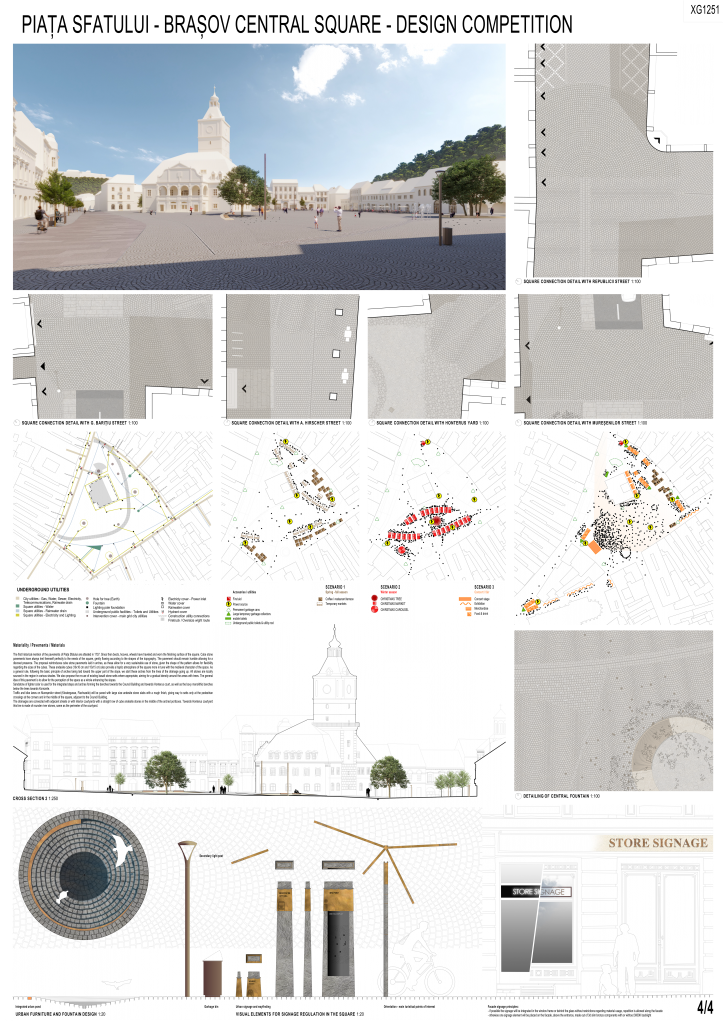
The first historical mention of the pavements of Piața Sfatului are attested in 1737. Since then boots, hooves, wheels have traveled and worn the finishing surface of the square. Cube stone pavements have always lent themself perfectly to the needs of the square, gently flowing according to the shapes of the topography. The pavement should remain humble allowing for a discreet presence. The proposal reintroduces cube stone pavements laid in arches, as these allow for a very sustainable use of stone, given the shape of the pattern allows for flexibility regarding the sizes of the cubes. These andesite cubes (10×10 cm and 15×15 cm) also provide a haptic atmosphere of the square more in tune with the medieval character of the space. As a general rule, following the basic principle of arches being laid toward the upper part of the slope, we start these arches from the lines of the drainage going up. All stones are locally sourced in the region in various shades. We also propose the re-use of existing basalt stone setts where appropriate, aiming for a gradual density around the areas with trees. The general idea of this pavement is to allow for the perception of the space as a whole enhancing the slopes.
Sandstone of lighter color is used for the integrated steps and arches forming the benches towards the Council Building and towards Honterus court, as well as the boxy monolithic benches below the trees towards Kornzeile.
Traffic and bike lanes on Mureșenilor street (Klostergasse, Flachszeile) will be paved with large size andesite stone slabs with a rough finish, giving way to setts only at the pedestrian crossings at the corners and in the middle of the square, adjacent to the Council Building.
The drainages are connected with adjacent streets or with interior courtyards with a straight row of cube andesite stones in the middle of the arched porticoes. Towards Honterus courtyard this line is made of rounder river stones, same as the perimeter of the courtyard.
Water
Water played a primordial role in defining the path of streets and cvartals of the city, and specifically in the case of the town square we believe it was in close relation also to the topography. The relationship of people with water has always been a complex one as well, with streams forming the shape of settlements and in turn being also shaped by the settlers. Through time water became an ever-present artifact of daily life. Our proposal evokes the long lost memories of these paths that defined the topology of the town center, by forming subtle drainings at their natural position as defined by the recovered topography of the site. We believe our proposal also subtly echoes Honterus court, by making a gentle nod to the rainwater gutters thereof which have lasted through the centuries.
Water has historically been an integral part of the townscape, surface gutters being always present along city streets. This changed only at the beginning of the 20th century (1907) when modern sewage was introduced below ground. Furthermore, there was a well maintained network of wells and two bathhouses in town, which were maintained by the council for the use of all citizens.
Water is present in various instances throughout the square. We propose that the main artesian fountain of the current square be replaced with a more subtle and less intrusive splash fountain mounted in the pavement floor, along the diagonal gutter traversing the square. This is placed close to the linden trees adjacent to the south-western front, thus freeing up the central space of the square to be used more flexibly for large scale events when needed.
The historical fountain adjacent to the entrance to Enescu square is kept in its original place and shape. As the bird bath fountain of the 1987 project was sadly damaged and is not in its initial shape, we propose rebuilding it in the same spirit but with similar materials to the pavement. A new drinking fountain is placed in proximity to the Council Building. The design of this fountain is inspired along with some other urban furniture elements from the symbol of the medieval town, the crown.
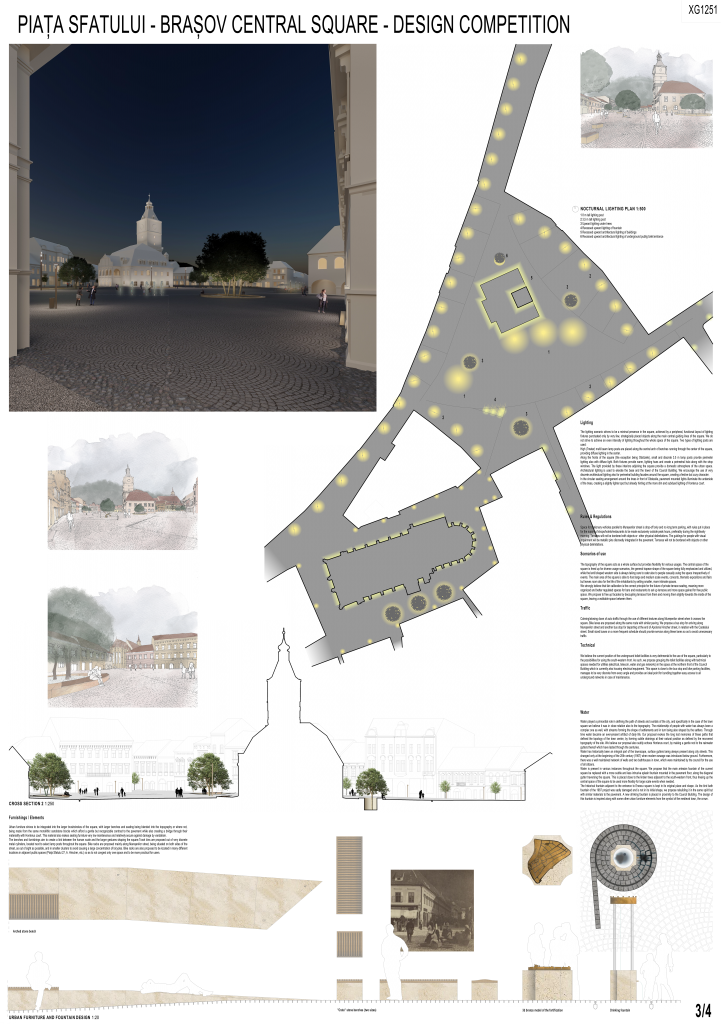
Lighting
The lighting scenario strives to be a minimal presence in the square, achieved by a peripheral, functional layout of lighting fixtures punctuated only by very few, strategically placed objects along the main central guiding lines of the square. We do not strive to achieve an even intensity of lighting throughout the whole space of the square. Two types of lighting posts are used:
High (7meter) multi beam lamp posts are placed along the central arch of benches running through the center of the square, providing diffuse lighting in the center.
Along the fronts of the square (the exception being Obstzeile), small and discrete 3.5 m lamp posts provide perimeter lighting also with diffuse light. Both fixtures provide warm, lighting hues and create a perimetral halo along with the shop windows. The light provided by these interiors adjoining the square provide a domestic atmosphere of the urban space. Architectural lighting is used to elevate the base and the tower of the Council Building. We encourage the use of very discrete architectural lighting also for perimetral building facades around the square, creating a festive but cozy character.
In the circular seating arrangement around the trees in front of Obstzeile, pavement mounted lights illuminate the underside of the trees, creating a slightly lighter spot but already hinting at the more dim and subdued lighting of Honterus court.
Furnishings / Elements
Urban furniture strives to be integrated into the larger brushstrokes of the square, with larger benches and seating being blended into the topography or where not, being made from the same monolithic sandstone blocks which afford a gentle but recognizable contrast to the pavement while also creating a bridge through their materiality with Honterus court. This material also makes seating furniture very low maintenance and relatively secure against damage by vandalism.
The benches and furnishings aim to create a link between the human scale and the larger gestures shaping the square.Trash bins are proposed out of very discrete metal cylinders, located next to select lamp posts throughout the square. Bike racks are proposed mainly along Mureșenilor street, being situated on both sides of the street, as out of sight as possible, and in smaller clusters to avoid causing a large concentration of bicycles. Bike racks are also proposed to be located in many different locations in adjacent public spaces (Piața Sfatului 27, A. Hirscher, etc.) so as to not congest only one space and to be more practical for users.
Urban Strategy
The beauty of the town lies in its very dense urban fabric, the rich architecture, the alleys and the small squares arranged in a hierarchic composition gaining the most from the accents and the focus points of perspectives. The natural system inside and around the town is also very rich, creating a two way dialogue with the surroundings.
The strategy aims at gently enhancing these qualities of the town, acknowledging the recent efforts toward reducing the car traffic inside and around the fortifications. Regarding the pedestrian spaces we propose enlarging these as much as possible aiming at using these as links between different medieval small squares formed by the enlargements of the streets. We think a traffic study is very much needed to sustain this vision but we believe that only Mureșenilor street and Castelului should be kept as traffic routes with one lane for each direction in the long term, connecting the north part of the town with the Șchei area. This comes hand in hand with a vision for keeping the historical core alive, with people working and living in the area, making car travel unnecessary. All other streets should be kept as shared spaces where complete pedestrianization is not possible. Also the ground floor parking spaces should be kept to a minimum in order to not encourage traffic. To sustain this strategy we propose a new underground parking in the northern part of the town at the opposite end from the one proposed in the Modarom area. These two parkings should become the points where all car traffic stops from entering the old part of the town but also providing good connections with the rest of the town, being placed near the Ring. To this end we see important pedestrian links being made to adjacent neighborhoods, namely Alt-Stadt through Str. Lungă and Șchei through Str. Băilor and Piața Unirii. Taking a further step is connecting the lush green hillsides of Cetățuia fortress, thriving to combine all of these spaces into a single, walkable and recognizable network of urban spaces. Furthermore, the municipality should implement small scale buses (maximum 30 passengers) that frequently travel inside and around the fortress.
We notice the beauty of the medieval streets with their lack of planification and the diversity of accidents which always are in close relation with the nearby buildings and courtyards and the richness in shape and sizes of the squares. We propose arranging these squares as an archipelago of public spaces, sustained by a pedestrianization which also allows for other unique spaces inside the fortress, besides the Sfatului Square, to be discovered and allowing for a more cultural type of tourism more in tune with the place. This archipelago and the pedestrian corridors are also sustained by the fact that the character of the public space and the buildings are in a very intimate relation. This is due to the fact that both public space and constructions are the manifestation of the way the guilds formed clusters around certain areas and used the space in relation to their need. A very fine example of this is the Butchers Guild area, around the streets Appolonia Hirscher and Johann Gott, in very close proximity to the Guilds Hall and the public network of sewers. All these speak to us about centuries old daily habits. These particularities lead to a pattern of adjoining significant buildings with the pulsations of the streets.
Complementing the public spaces we believe the presence of a tree and a bench in a space is a very democratic antidote for the trend of renting public space. The immediate surroundings of the town are characterized by more open spaces with abundant presence of trees as urban forests or the northern ring. The inside of the town, in spite of being one of the Seven Fortified Towns of Transylvania (Sibenbürgen) and the very dense urban fabric we find quite enough nature inside the gardens and house courtyards. These are reminders that historic towns are home not only for people but also provide an ecosystem for animals. The proposed trees are kept to a minimum and used only as focal points inside various small squares and occasionally as rows of trees for Mureșenilor and Barițiu streets. These trees are carefully placed in order to not become overimposing but rather to articulate space. Close to the medieval walls we propose alleys of trees, marking the entrances inside the walls along with bronze marks inserted in the pavement. We also propose the extension of the green spaces around the ring of the town along with a new design for the main park, which should allow for maximum freedom of movement. One such example is the space between Astra Cinema and the Military Circle. By addressing the Ring in a more coherent manner and with extensive planting of trees we aim for a green barrier that extends towards the interior of the fortress and the nearby neighborhoods acting as a link.
Rules & Regulations
Space for stationary vehicles parallel to Mureșenilor street is drop-off only and no long term parking, with rules put in place for the supply of shops/hotels/restaurants to be made exclusively outside peak hours, preferably during the night/early morning. Terraces will not be bordered with objects or other physical delimitations. The guidings for people with visual impairment will be metallic pins discreetly integrated in the pavement. Terraces will not be bordered with objects or other physical delimitations.
Scenarios of use
The topography of the square acts as a whole surface but provides flexibility for various usages. The central space of the square is freed up for diverse usage scenarios, the general trapeze shape of the square being fully emphasized and utilized, while the lentil shaped western side is always taking care to cater also to people casually using the space irrespectively of events. The main area of the square is able to host large and medium scale events, concerts, thematic expositions and fairs but leaves room also for the life of the inhabitants by setting smaller, more intimate spaces.
We strongly believe that fair calibration is the correct principle for the future of private terrace seating, meaning more organized and better regulated spaces for bars and restaurants to set up terraces and more space gained for free public space. We propose to free up facades by decoupling terraces from them and moving them slightly towards the inside of the square, leaving a walkable space between them.
Traffic
Calming/slowing down of auto traffic through the use of different textures along Mureșenilor street when it crosses the square. Bike lanes are proposed along the same route with similar paving. We propose a bus stop for arriving along Mureșenilor street and another bus stop for departing at the end of Apolonia Hirscher street, in relation with the Castelului street. Small sized buses on a more frequent schedule should provide service along these lanes so as to avoid unnecessary traffic.
Technical
We believe the current position of the underground toilet facilities is very detrimental to the use of the square, particularly to the possibilities for using the south-western front. As such, we propose grouping the toilet facilities along with technical spaces needed for utilities (electrical, telecom, water and gas networks) in the space at the northern front of the Council Building which is currently also housing electrical equipment. This space is close to the bus stop and bike parking facilities, manages to be very discrete from every angle and provides an ideal point for bundling together easy access to all underground networks in case of maintenance.