





106 – SB0626 – SFERA ARHITECTURA SRL


Autor principal: Alexandru Sabău, Adrian-Ovidiu Bucin, Silviu-Claudiu Borș, Ioana-Andreea Sabău, Patricia Sabina Simedru, Teodora Maria Jinga, Ilinca Ioana Ilovan, Alexandru Gherman
Colaboratori arhitectură: Tudor Roșca, Ștefania Mârzac,
Colaboratori specialități: peis. Alexandra-Mara Buz
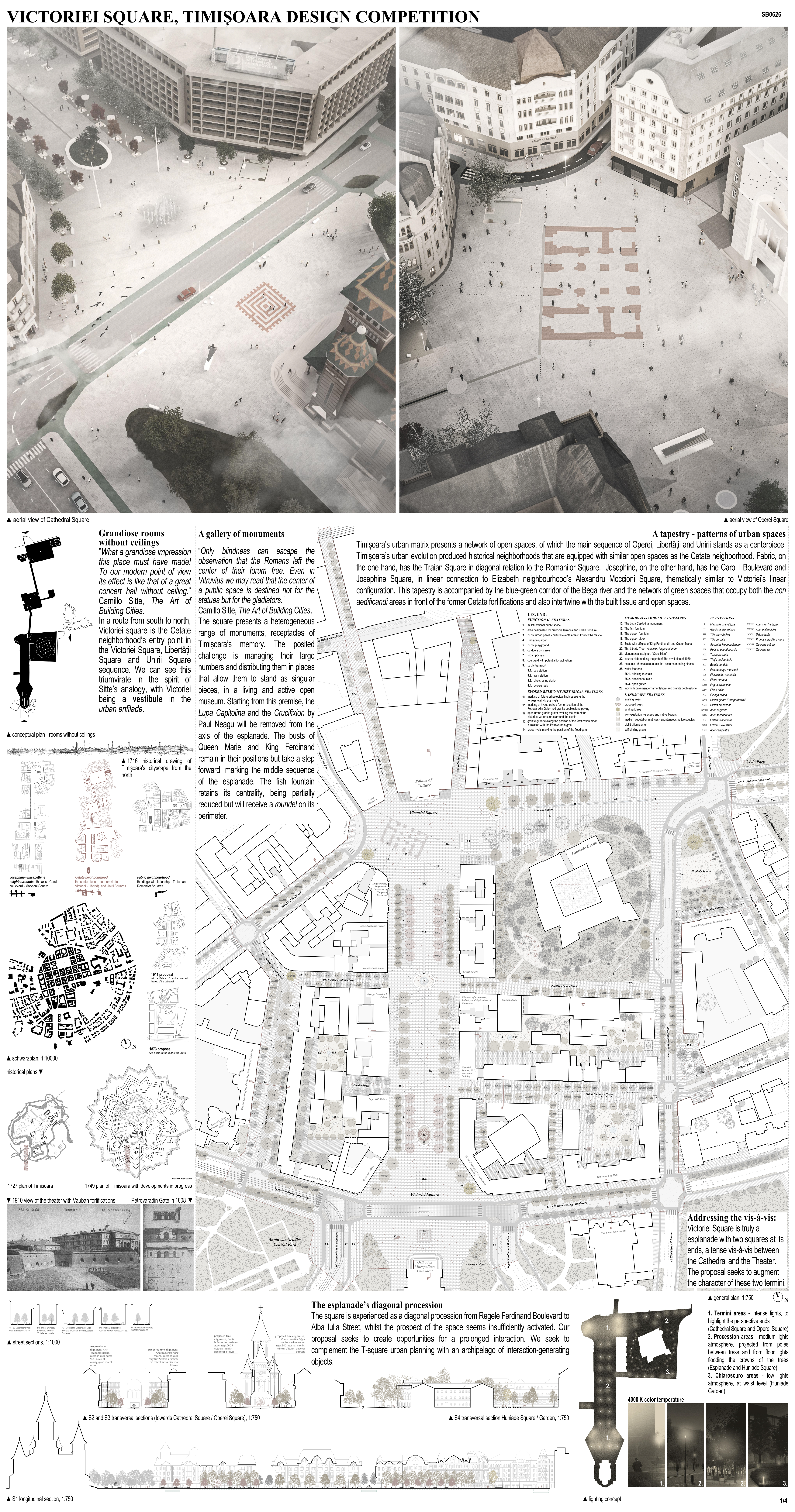
A tapestry – patterns of urban spaces
Timișoara’s urban matrix presents a network of open spaces, of which the main sequence of Operei, Libertății and Unirii stands as a centerpiece. Timișoara’s urban evolution produced historical neighborhoods that are equipped with similar open spaces as the Cetate neighborhood. Fabric, on the one hand, has the Traian Square in diagonal relation to the Romanilor Square. Josephine, on the other hand, has the Carol I Boulevard and Josephine Square, in linear connection to Elizabeth neighbourhood’s Alexandru Moccioni Square, thematically similar to Victoriei’s linear configuration. This tapestry is accompanied by the blue-green corridor of the Bega river and the network of green spaces that occupy both the non aedificandi areas in front of the former Cetate fortifications and also intertwine with the built tissue and open spaces.
Grandiose rooms without ceilings
”What a grandiose impression this place must have made! To our modern point of view its effect is like that of a great concert hall without ceiling.” Camillo Sitte, The Art of Building Cities.
In a route from south to north, Victoriei square is the Cetate neighborhood’s entry point in the Victoriei Square, Libertății Square and Unirii Square sequence. We can see this triumvirate in the spirit of Sitte’s analogy, with Victoriei being a vestibule in the urban enfilade.
A gallery of monuments
“Only blindness can escape the observation that the Romans left the center of their forum free. Even in Vitruvius we may read that the center of a public space is destined not for the statues but for the gladiators.” Camillo Sitte, The Art of Building Cities.
The square presents a heterogeneous range of monuments, receptacles of Timișoara’s memory. The posited challenge is managing their large numbers and distributing them in places that allow them to stand as singular pieces, in a living and active open museum. Starting from this premise, the Lupa Capitolina and the Crucifixion by Paul Neagu will be removed from the axis of the esplanade. The busts of Queen Marie and King Ferdinand remain in their positions but take a step forward, marking the middle sequence of the esplanade. The fish fountain retains its centrality, being partially reduced but will receive a roundel on its perimeter.
The esplanade’s diagonal procession
The square is experienced as a diagonal procession from Regele Ferdinand Boulevard to Alba Iulia Street, whilst the prospect of the space seems insufficiently activated. Our proposal seeks to create opportunities for a prolonged interaction. We seek to complement the T-square urban planning with an archipelago of interaction-generating objects.
Addressing the vis-à-vis:
Victoriei Square is truly a esplanade with two squares at its ends, a tense vis-à-vis between the Cathedral and the Theater. The proposal seeks to augment these two termini.
The Theater’s Square
The node that intersects six threads. The proposal seeks to augment this composition by rethinking the relationship with the Huniade Square and Park, transforming the eastern entry point from I.C. Brătianu Boulevard into a geometrical and metaphorical funnel.
A castle in a garden – the hortus apertus
At the beginning of the 20th century, the painter Stefan Jäger captured the Huniade castle surrounded by rich vegetation. The painting invites one to contemplate this object as somehow hidden in the treescape. Our project seeks to enrich this hortus apertus that surrounds the castle.
We propose a ring alley that surrounds the castle and accumulates events in its unfolding – a playground, sports equipment, various sitting furniture.
The main façade of the castle, towards Huniade square, receives a détente area separated from the mineral square with a threshold where the history and morphological evolution of this important edifice is presented.
Traces of the Vauban fortress
Operei Square’s floor drawings are fragments of past existence, specifically elements of the Vauban fortress and its specific landscape. By overlaying historical maps, we hypothesize the location of a relevant Vauban trace that we present in a detailed manner – the Petrovaradin gate, in front of the Lloyd Palace. Directions and general dimensions of other Vauban elements will be marked with metal rivets.
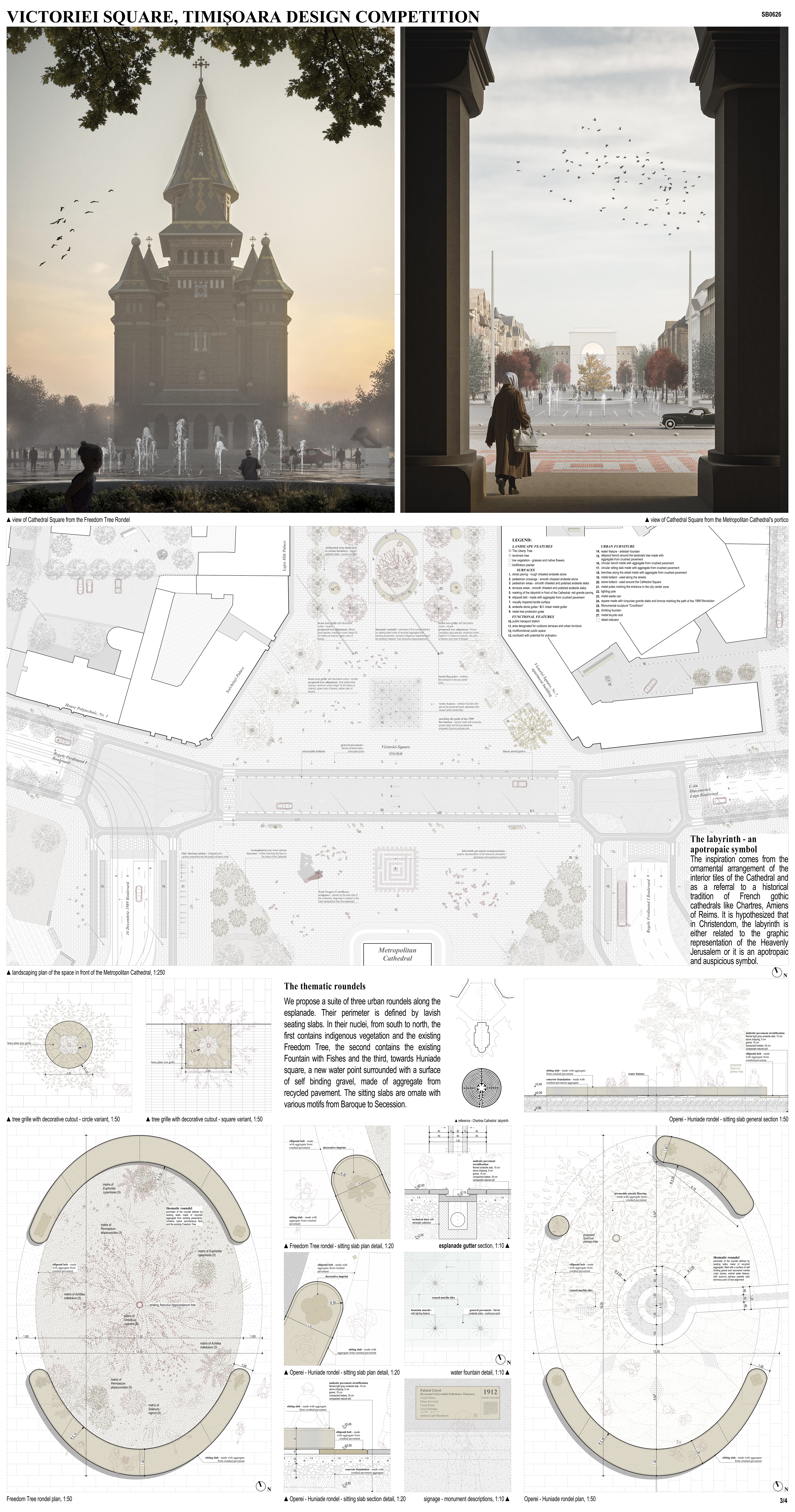
The labyrinth – an apotropaic symbol
This inspiration comes from the ornamental arrangement of the interior tiles of the Cathedral and as a referral to a historical tradition of French gothic cathedrals like Chartres, Amiens of Reims. It is hypothesized that in Christendom, the labyrinth is either related to the graphic representation of the Heavenly Jerusalem or it is an apotropaic and auspicious symbol.
The thematic roundels
We propose a suite of three urban roundels along the esplanade. Their perimeter is defined by lavish seating slabs. In their nuclei, from south to north, the first contains indigenous vegetation and the existing Freedom Tree, the second contains the existing Fountain with Fishes and the third, towards Huniade square, a new water point surrounded with a surface of self binding gravel, made of aggregate from recycled pavement. The sitting slabs are ornate with various motifs from Baroque to Secession.
Landscape concept
To improve the stormwater management, we propose bioswales to collect surface runoff and recharge groundwater.
The planting system proposed for the flowering vegetation is one made up of matrices, these being made up of spontaneous native species (Achillea millefolium, Euphorbia cyparissias, Umbilicus rupestris, Solanum nigrum) and Pennisetum alopecuroides.
The line of trees on the axis that connects the cathedral and the opera is made up of Prunus cerasifera ‘Nigra’, Acer platanoides species that are already in the existing line, but which are proposed in a different order, the existing ones being transplanted and supplemented with new ones of Betula lenta to accentuate a sense of gradualness of height in the broad street prospect.
Quercus petraea is the proposed outstanding species. These trees have an important ecological role, as they support various insects and their fruit (acorns) provide a valuable food source for many birds and mammals. The canopy allows a fair amount of light to pass through, permitting a diverse and enriched understory. The tree is a light-demanding, pioneer species and is able to vigorously coppice.