





52 – DS7615 – S.C. REDGRAPH S.R.L.


Autori principali: dr. arh. Mihai Codreanu
Coautori: dr. arh. Driscu Mihai, dr. arh. Gradinaru Tudor
Colaboratori arhitectură: Enuta Alexandra, Gavrila Emilian, Grigoroaea Bogdan, Munteanu Madalina, Padure Antonina, Tarabuta Alexandra, Tarnauceanu Ana
Colaboratori specialităţi:
ing. Ivasc Cornel – drumuri si poduri, sistematizare verticală
arh. Roxana Pascu, arh. Gheorghita Carmina – peisagistică
INTRODUCTION
The approach initiated by the contest for the elaboration of a viable solution for the development of the park is part of the current policies for the revitalization of the abandoned areas of the cities, the way of returning them to the citizens and the adaptation of these spaces to the proactive needs of the community.
The neighborhood of the park is characterized by great spatial and functional complexity.
This is a major advantage that can be exploited by adapting the intervention solutions to the needs of the community.
The size of the city and its cultural potential influence the urban development policy.
Through the present activities carried out by the members of the Cluj community in addition with the continous change of paradigms at European level regarding the public green spaces denotes the necessity of creating new and large areas adaptable to polyfunctional integration in time and space.
The goal of the project is to create an solution for an adaptable prototype of public space integrated into the community and defined by it.
The subject of the proposal consists in a study of the existing situation, of the urban development potential of the area, as well as proposals for functional, volumetric and technical organization, aiming also to organize the entire surface studied in compact and compatible functional areas in the report of them, and with the neighbors, the elements of the existing natural framework, the traffic arteries and the possibilities of including the studied area in the urban space of Cluj-Napoca.
Some malfunctions were also found in the area:
- Poor degradation and / or poor condition of access roads;
- Relatively poor connection of the studied area with the city, the wather front and Armatura Park;
- Lack of sidewalks for pedestrian traffic and the impossibility of widening the traffic arteries in some areas;
- Absence of public lighting;
- Visibility of urban networks facilities resulting in visual and functional discomfort.
CONCEPT
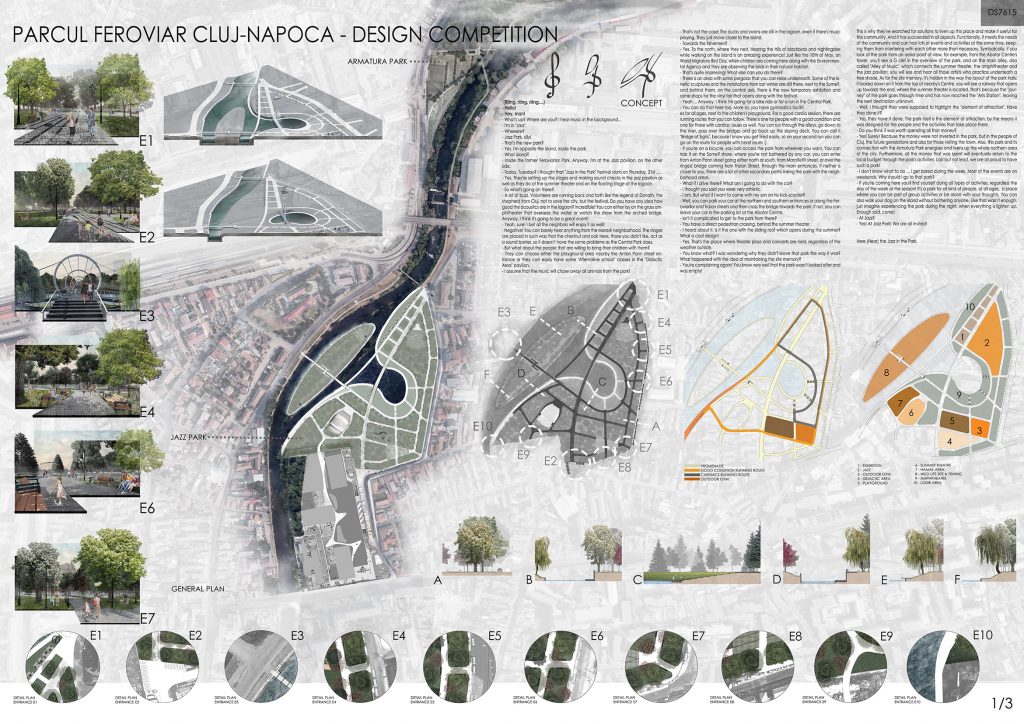
The concept underlying the presented solution integrates a successful event activating of the nowadays life named “Jazz in the Park”, taking over at the formal level the stylized image of the musical symbol ” G clef ” with the beauty of its Baroque form and its integration into a way of modeling the whole built and unbuilt ensemble, taking over the elementary influences of the rembrance of the studied place.
Symbolically, if you look at the park from an aerial point of view, for example, from the Abator Centre’s tower, you’ll see a „G clef” in the overview of the park, and on the main alley, also called “Alley of Music”, which connects the summer theater, the amphitheater and the jazz pavilion.
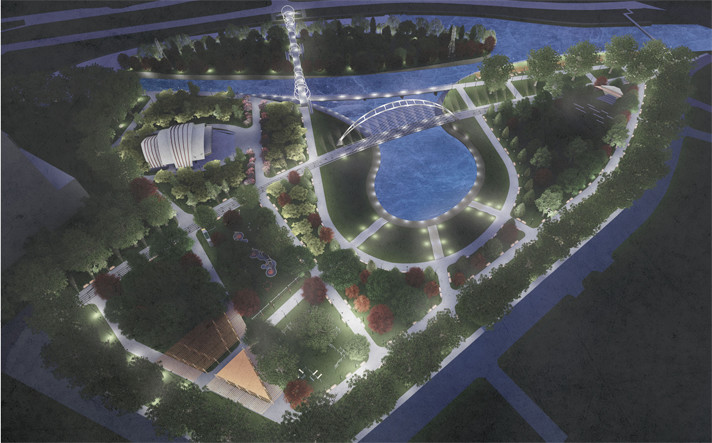
The site memory it’s hidden in the way the layout of the park trails: if looked down on it from the top of nearby’s Centre, you can see a railway that opens up towards the end, where the summer theater is located. That’s because the “journey” of the park goes through time and has now reached the “Arts Station”, leaving the next destination unknown.
FUNCTIONAL REQUIREMENTS
From a functional point of view, there were identified the categories of functions and activities based on which was structured the whole park design solution.
The structure of access routes and major traffic through the park has generated the modalities of location of each active or passive function considered.
Considering the design requirements, the park features the following categories of functions:
Active functions:
- Promenade areas throughout the park by the pedestrian alleyway network and their extension into lawn areas. The general structure of the proposed park starts from the idea of not having accessibility limitations in the planted areas, each plot delimited by the alley network being integrated into a possible route with stops in rest areas. This way it is possible to solve the necessities of satisfying the need for isolation by going through a contemplative route, the way of planting the vegetation according to the functional zoning by going throw spaces with wide or limited accessibility, depending on the mood of each individual. On the promenade routes there are spaces for group or reunion activities that locally harbor the planted areas.
- The internal circulation network is accessible at both pedestrian and for practicing outdoor sports. In the central area of the park there are playgrounds for children and those for fitness fitting by adults. Circuits have been delineated for running taking into account the health of each individual. These trails were thought of with a different degree of muscular strain, age or health. It was studied the possibility of linking the city park for cycling through the key access points and the clearly delineation of the aleys for bicycles area.
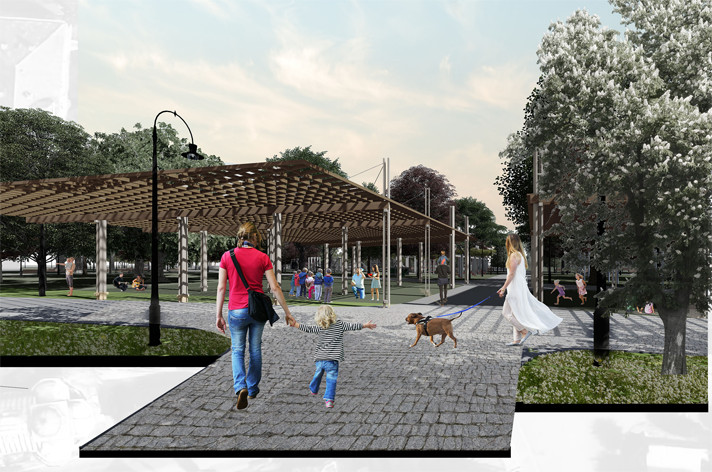
- The children’s playground was provided in the vicinity of the teaching area in order to increase the need to make pauses in the didactic process. Playgrounds for children were made with the following facilities: Sand box, swings device, partner swing device, net climbing device, positions swing device, climbing board and 4 tower device. Playgrounds for children are adapted to children’s play and fun according to their different age categories. All the parts of the children’s playground assemblies will be constructed in accordance with European standards EN 1176 – Part 1-7, which include the general safety rules and requirements and test methods, the specific risks of cradles, slides, cable trains, rockers, as well as and their installation, inspection, maintenance and operation aspects and the European Standard EN 1177 on Safety Surfaces.
- There were areas for meetings and group activities with facilities areas in their vicinity. These areas are located either in protected areas with pergolas or outdoors on the banks of the river or in planted areas using existing urban furniture elements or hammocks depending on the offered intimacy degree. The accessibility of planted areas also allows them to be used as picnic areas.
- The water front area is largely doubled by generous pedestrian traffic usable for rest, walking, sports and fishing. It is also possible to practice water sports as boat and hydro-bike rides.
- For pet lovers have been set up special areas in which they can left free pets to run and play with their owners.
- People with disabilities will have access to all the areas of the park.
The sports facilities will be grouped into three main categories, namely practicable summer sports and practicable winter sports, as well as a practicable sports class at any time of the year, in specially designed areas. In fact, these three categories form the basis of the functional zonification of the terrain, creating 2 compact functional area, developing along the main axis of composition of the ensemble, in the south to north direction, the middle point of this axis having a central space comprising the lagoon area.
Pasive functions:
- cinema – summer theater provided with mobile shading and protection systems;
- areas for temporary or permanent exposure and workshops;
- protected areas for children and areas for adults, including the disabled persons;
- children’s teaching area;
- study areas of wildlife in natural environment;
- loisir area and relaxation on Somes’ waterfront.
Access areas will have specific information facilities. There is the possibility of placing thematic commercial spaces, depending on the season or event. We will meet the needs of organic sanitary groups and by gender.
ACCESIBILITY SOLUTION
In order to ensure better circulation of motor vehicles, it is proposed to achieve a major access on the site in the middle of it, from the direction of Marasesti street, as well as the modernization of access from the Armatura Park area.
At street level, it is proposed to build a street lighting network, as well as to create pedestrian walkways.
The alleys will have widths between 2 and 8 m, which is a bay specially designated for cyclists. The cycle track will be continued to the city center.
It is also planned to build parking areas adjacent to the area, sufficient to serve the proposed activities, the number of parking spaces being calculated according to the norms. All these will be dimensioned and marked with markings and traffic signs in accordance with applicable laws. There will be a park area at the northern and southern entrances or along the Feroviarilor and Traian streets and then cross the bridge towards the park. If not, you can leave your car in the parking lot at the Abator Centre, having a direct pedestrian crossing, behind the summer theater.
If you’re on a bicycle, you can access the park from wherever you want. You can ride it on the Somes shore, where you’re not bothered by any car, you can enter from Anton Pann street going either north or south, from Marasesti street, or over the ringed bridge coming from Traian Street, through the main entrances. If neither is closer to you, there are a lot of other secondary paths linking the park with the neighborhood areas.
ENVIRONMENTAL MOTIVATION
The intention of this proposal is to create an optimally used space with a main leisure, relaxation and leisure function, an area free from atmospheric noise and noise, predominantly green, attracting both the inhabitants of Cluj-Napoca and tourists from other areas.
Considering the landscape analysis, it was decided to keep as much as possible the existing planting material and to make additional plantings according to the functional and design concept. Items without landscape value will be removed.
We propose an concept of all directions accessible and high-visibility park image.
Planting species of trees was made by considering the long-lasting tolerance of the species chosen to resist untill reaching maturity with minimal maintenance needs.
The chosen arboriculture material allows sheltering of a large number of bird species.
The choice of tree species followed the following principles:
- Increased visibility of the park area and adjacent areas;
- Proper shading of the proposed functional areas in the park;
- appropriate landscape image in all seasons;
- reaching all proposed levels of vegetation with the accentuation of the perceptible areas from the surrounding areas.
The planting material consists of the following species: Linden, Locust, Willow, Oak, Maple, Cestnut, Pine, Spruce and Lilac.
Our project is trying to fit into the current concerns about the notions of ‘landscape’ in Europe, according to the European Landscape Convention. We know that the landscape plays an important role in the field of culture, ecology and social and is the support of economic activity. We are aware that landscapes contribute to the formation of local cultures and that they constitute a core component of Europe’s cultural and natural heritage, contributing to human well-being and strengthening Europe’s identity. We want to respond to the demands of the public to enjoy high-quality landscapes and to play an active role in their development.
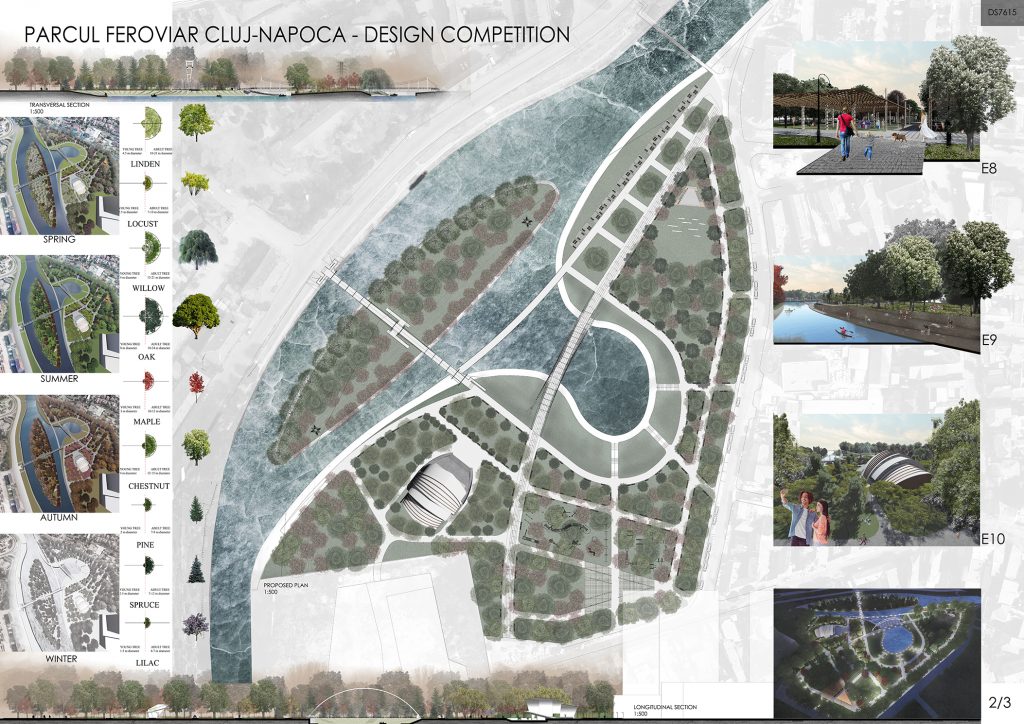
The location of the park allows access to the population from different areas of the city. The concept is to create a park that offers a wide variety of ambiance, landscaping techniques and opportunities to organize cultural events.
The park is trying to integrate itself into the history of garden art and landscape by developing contemporary concepts while participating in the creation of the European tomorrow’s heritage.
Today’s garden has to play a role as a socially accessible, socially accessible, educational educator for all. To accomplish this, we suggest placing labels on trees with names, species, and family. Negative events such as vandalism and thieves can find a solution through education and participation in public projects through information, communication and participation.
ARCHITECTURAL SOLUTION
The proposed solution aims at achieving three major architectural objectives: the summer theater, the jazz stage and the didactic area.
The Summer Theater is a construction made of reinforced concrete with a mobile uper-structure built in wooden-plastic panels to ensure the performance of theater, concerts or film screenings, neither of the atmospheric conditions.
The stage for jazz is made of reinforced concrete with decorative elements made of wooden-plastic panels. The proposed landscaping creates an open amphitheater area in front of it as a protection against disturbance of neighbors.
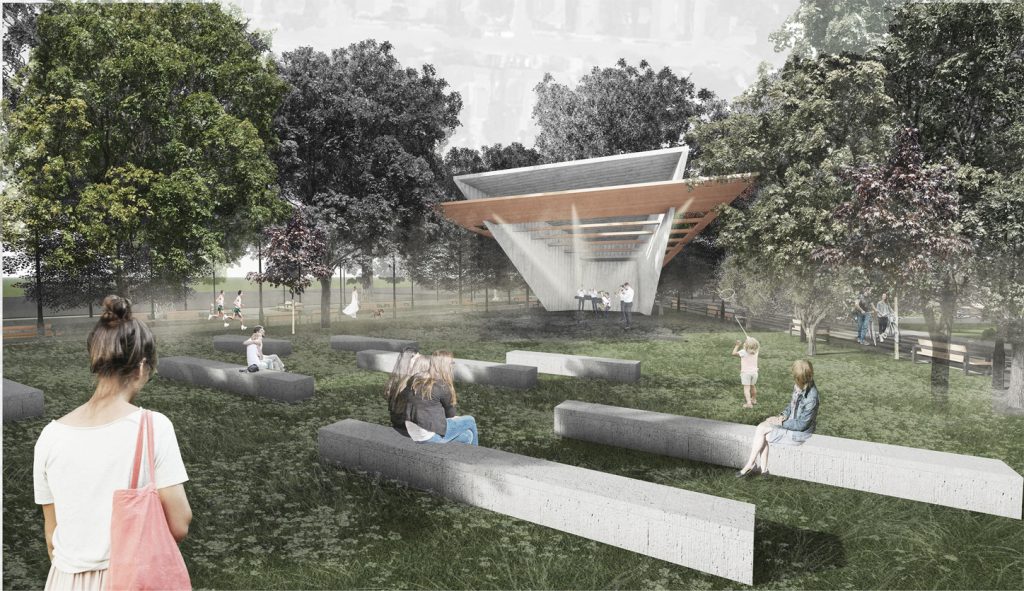
The didactic area is made of a plated wood pergola with an area of protection against the weather.
The position of the architectural built elements in the park is made in such a way that it meets the following requirements:
- Allowing multiple events to take place simultaneously;
- To be able to accommodate a wide range of events;
- Not to disturb the inhabited neighborhood in the ongoing events.
Bridges are also an attractive element of the park, in addition to providing good accessibility and favorable prospects. The framing of the bridges in the landscape is done taking into account the main directions of view and accessibility, being well integrated into the image of the area and also announcing the existence of an interesting area to visit.
All buildings are valued both by their location and overnight by adequate illumination to speculate the volumetric elements. Exterior lighting will be made using pole-shaped luminaires with a metal halide light source on the access paths and with shaft-oriented projectors. Circuit lighting control will be done through a twilight sensor, guard lighting will be commanded by pulse from the public lighting of the area. The circuits will be made with buried copper cables buried in the ground.
THE ATTRACTOR AND RE-BRANDING
The park itself is the element of attraction, by the means it was designed for the people and the activities that take place there.
From the careful analysis of the presented solution, it can be identifyed elements like an attraction element, but the intention was not to unleash a single reconcilable element but several hidden elements to invite you to discover the park exploring each area.
For this reason, our day’s parks need not only to be identified with a particular element but must create a surprising sensation.
The park must address not only the mind through a unique image or object but must stimulate all your senses, imagination, memory and the spirit of adventure.
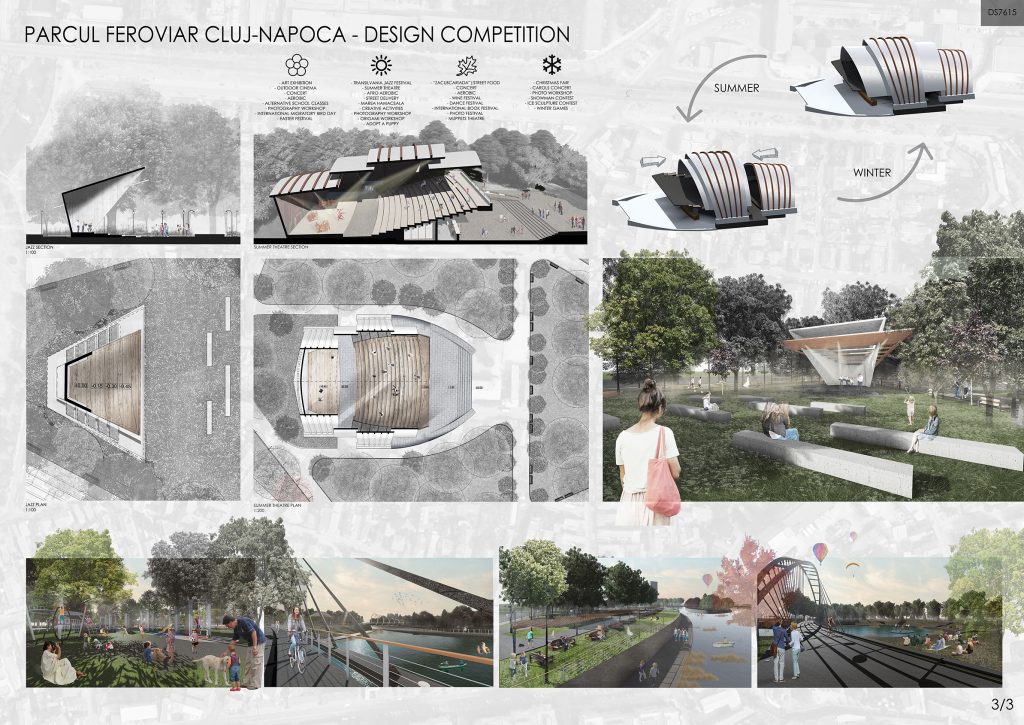
Bridges, lagoons or hidden symbols in the design of the concept can themselves be attractive ellements, but must be integrated into a context that interferes with the spirit, the psyche and the experience of each people, each people finding his own attractor element in the park based to his own experiences and needs.
Through the conceptual analogies made and as a result of the concept design, we chose to rebrand the park as Jazz Park, a music park with alleys named in order of importance in the hierarchy of pedestrian traffic, with musical symbols drawn on the pedestrian alleys, with soft music to create the atmosphere of peace and inner peace.
That’s because the journey of the park goes through time and has now reached the Arts Station, leaving the next destination unknown to all of us.
CONCLUSIONS
The entire area offer by positioning a special unstructured area for Cluj-Napoca with surrounding areas in continuous development.
Local administrative and the population promotes the development of this area with functions of leisure and recreation, regarded as part of the axis of possible development of Cluj-Napoca waterfront, offering multiple benefits both investors and City Hall.
The main opportunity is the presence of the site in the vicinity of a quiet area, located at relatively large distances from the car traffic, the almost virgin area in terms of human interventions. An important component is also the presence of urban technical networks in the area.
In this space, it would be advisable to develop functions that can give a dynamic space and complete the area with green spaces, landscaping arrangements and urban furniture.
The site features a variety of attractive natural assets that can be exploited: land unevenness, perspective towards built and unbuilt neighborhoods, elements that can compete with an organic architecture, on the ground, with lots of green spaces and openings to nature.
All functions in the studied area will be non-polluting, taking all measures to eliminate water-air-soil pollution. In order to prevent natural hazards, the foundation conditions will be respected and special attention will be given to vertical systematization.
The aleas will have the appropriate cross-sections and profiles for good use and good drainage of meteoric waters.
Domestic waste will be collected in special containers and taken over by an authorized firm and taken to a specially arranged warehouse.
All the plots will be inerbate. Maintaining the quality of the environment between acceptable limits with the tendency to bring natural parameters is an essential strategic line of an environmental management program for ecological reconstruction and ensuring its sustainable development.
Depending on the financing possibilities for the execution of the works or the restrictions imposed by the necessary permits for drawing up the project, the proposed solution may undergo small structural and functional changes in order to respond as well as can do to the imposed conditions and to the social desire.