





105 – RE7777 – REAL ESTATE INNOVATION STUDIO SRL


Autor principal: urb. Dora Alexa-Morcov
Coautori: arh. Crina Alexandra Stanciu, arh. Camelia Șerban, arh. Andrei Nitu Sararu
Colaboratori arhitectură: stud. arh. Diana Giorgiana Chițian, stud. arh. Alexandru Zoheir Chakhachiro, stud. arh. Victor Gogiu, stud. arh. Mihai-Ionuț Vasilescu
Colaboratori specialități: inginer structurist ing. Dragoș-Ionuț Alexandrescu – expert tehnic A1&A2, ing. Cristian Lucian Ginghină; peisagistică: ing. peis. Cornelia Bogdan, ing. peis. Maria Gabriela Duda, ing. peis. Adina-Maria Vaideș
Experiencing the Fabric of Nature
1/ The “Fabric of Nature” aims to become an experimental model for the decontamination and purification of polluted sites through nature-based solutions. The site in question has been significantly affected by pollution, impacting water, soil, and air quality. This ongoing pollution continues to degrade the environment, affecting not only the soil and groundwater but also nearby surface waters, such as the Timiș River.
We aim to create a living laboratory of a botanical garden that follows nature’s ability to reclaim and thrive amidst the ruins. The approach focuses on minimal intervention in the existing industrial structures, allowing the natural environment to flourish in spaces that favor vegetation growth.
Drainage and Water Purification
The first layer of intervention is focused on the drainage and purification of polluted waters. Notably, this intervention involves creating a drainage network that originates from the existing drains structures within the industrial hall. These drains facilitate the establishment of a rectangular grid pattern in the site’s landscape, reminiscent of the old fabric of the area.
By integrating these historical elements into the new design, we aim to honor the site’s industrial heritage while promoting ecological restoration.
Rainwater Harvesting
In addition, we propose rain gardens (raingardens) as a key feature. These are designed to capture and filter rainwater runoff, helping to manage stormwater naturally while also supporting biodiversity. The rain gardens will serve both a functional and aesthetic purpose, contributing to the overall sustainability of the site while creating green spaces that encourage the return of local wildlife and flora.
Vegetation layers
We also propose interventions such as creating layered vegetation systems, adapted and directed to address various environmental mediums—water, soil, and air. These layers will be designed to enhance the decontamination and regeneration processes, with specific plant species chosen for their ability to filter pollutants, stabilize the soil, and improve air quality.
Environment High-Bio Technology Campus
In line with our proposal for a bio-laboratory focused on polluted environments, we propose to concentrate in the site various functions to establish a campus dedicated to advanced technologies. This includes one of the largest buildings historically constructed for high technology—specifically in the aeronautical field—alongside an exhibition complex designed to bring together scientists and companies from around the world. Additionally, the campus will feature coworking spaces and laboratories, fostering collaboration and innovation in addressing environmental challenges.
2/ Senzorial Experience of the Fabric
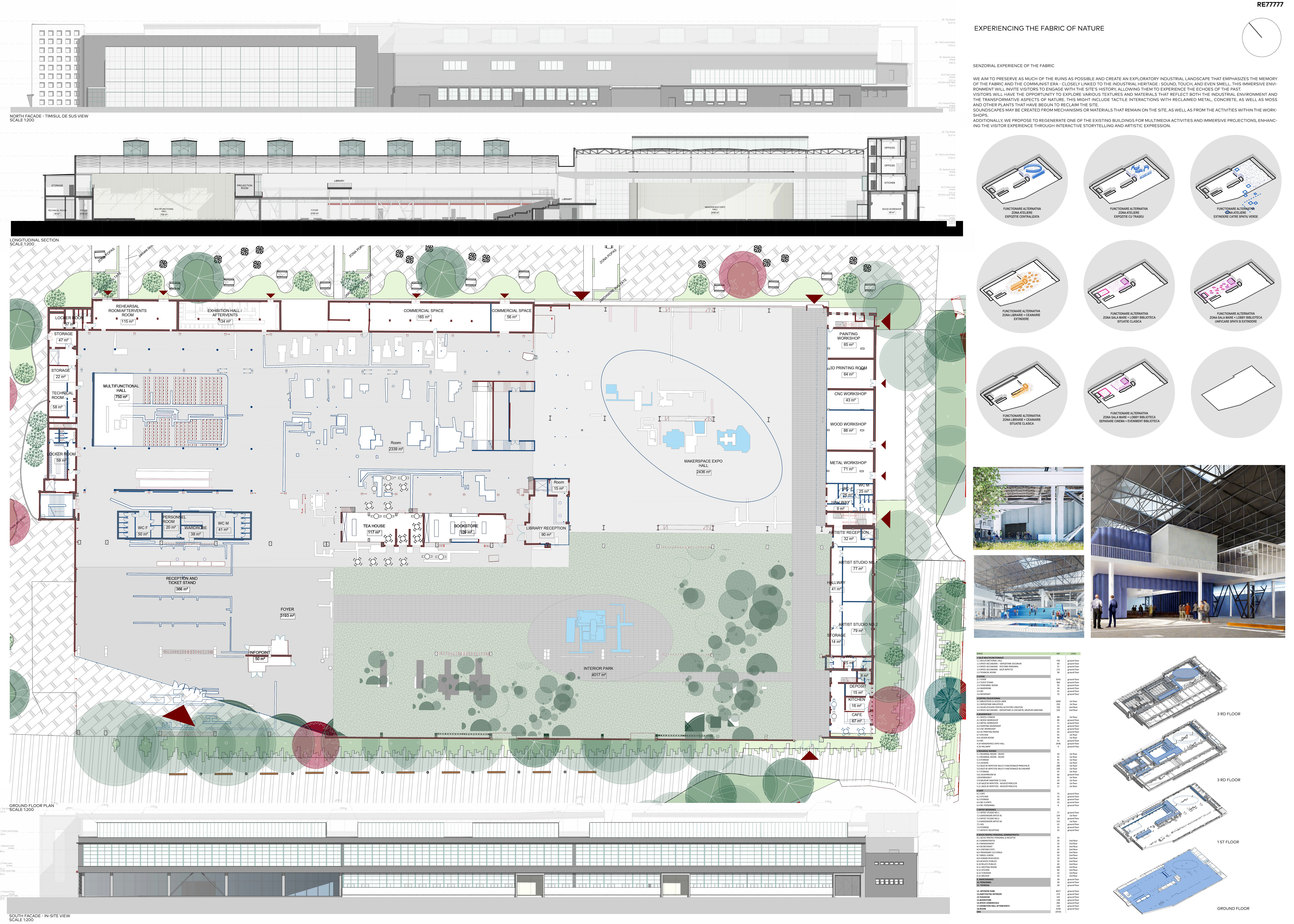
We aim to preserve as much of the ruins as possible and create an exploratory industrial landscape that emphasizes the memory of the fabric and the communist era – closely linked to the industrial heritage : sound, touch, and even smell. This immersive environment will invite visitors to engage with the site’s history, allowing them to experience the echoes of the past.
Visitors will have the opportunity to explore various textures and materials that reflect both the industrial environment and the transformative aspects of nature. This might include tactile interactions with reclaimed metal, concrete, as well as moss and other plants that have begun to reclaim the site.
Soundscapes may be created from mechanisms or materials that remain on the site, as well as from the activities within the workshops.
Additionally, we propose to regenerate one of the existing buildings for multimedia activities and immersive projections, enhancing the visitor experience through interactive storytelling and artistic expression.
3/ Historical Urban Fabric
The structure of the grid upon which the factory is built reflects the historical evolution of the peripheral area of Brașov—a rectangular grid. Our proposals aim to highlight this historical grid through both water drainage systems and the design of circulation paths and vegetation islands.
4/ Urban/Rural Relation – Urban Periphery Context
Beekeeping
The periphery of Brașov, particularly the studied area, has been marked by the growth of beekeeping, to the extent that the nearby hill, Lempes, was historically known as Honey Hill. The vicinity of the site was historically referred to as the “Garden of the Bees”. This activity has diminished over time, leading to concerns about its revitalization as early as the 1940s.
We propose to integrate beekeeping into the site’s ecosystem to contribute to pollination and support the development of local flora. By creating designated spaces for beekeeping within the landscape, we can enhance biodiversity and foster a more resilient ecosystem. Additionally, this initiative can serve as an educational platform, raising awareness about the importance of pollinators and sustainable agricultural practices within the community.
Factory Gardening – The deprivation experienced during the communist era compelled people to create alternative systems for survival. One of the primary strategies was to utilize any available piece of land to produce daily sustenance. This was often the case in factories (due to the fact that the workers had been farmers), where gardens of vegetables or even small orchards could be found. Employees would cultivate these crops and, in some cases, even process secondary products like tomato paste or jam within the factory premises. We believe it is very important to make these practices known to today’s generations by identifying areas where such activities can be recreated. During the project, we even met a family who worked in the factory and provided us with concrete information about these practices and the specific locations where they were carried out.
UNESCO Heritage Nearby Localities
Both Brașov and the neighboring localities with rich heritage, such as Prejmer, Sânpetru, and Hărman, boast a profound history of craftsmanship. However, they currently face a shortage of highly skilled artisans capable of addressing the challenges of preserving their architectural and artistic heritage.
This decline in traditional skills threatens the integrity of these historic sites, which are vital to the region’s cultural identity. To tackle this issue, we propose creating dedicated spaces within the site to host workshops for artisans, as well as educational facilities focused on traditional crafts.
These initiatives will not only help revive and promote local craftsmanship but will also serve as a valuable resource for training the next generation of skilled artisans. Additionally, we aim to enhance the visibility of these workshops by incorporating open spaces for public circulation and even outdoor activities, inviting community engagement and interaction with the crafts being showcased.
Technical approach
Removing trusses – buildings 25a, 25b, 25c
The architectural concept involves removing the roof covering and, at the same time, certain secondary trusses at the roof level so that the dimensions of a grid will allow the placement of trees inside the hall. The trees will be of considerable height and will be placed in such a way that they extend through the roof.
From a structural point of view, the solution involves, first and foremost, the removal of the covering system made of prefabricated structures from purlins and reinforced concrete slabs. To make this possible, it will be necessary to introduce a system that ensures horizontal connections at the upper part of the trusses, which was previously provided by the prefabricated concrete structure. This aspect involves the creation of a horizontal bracing system, appropriately sized to ensure lateral stability, positioned at the upper part of the trusses.
Secondly, the removal of certain secondary trusses, in specific grid sections, to allow the placement of tall trees, will involve strengthening the trusses that border this newly created gap.
Additionally, in areas where the roof covering will be retained, interventions will be required at the structural system level of the roof to handle certain additional loads from wind forces.
Creating vegetation areas inside the halls
In cases where the architectural concept involves placing vegetation inside the halls, floor interventions will be required. If there is only a floor poured on compacted soil, it can be removed in the necessary locations, creating a reinforced concrete basin with walls that are appropriately sized and reinforced. Solutions will be provided to prevent water infiltration from rain or irrigation into the foundation areas.
Technological channels can be used to place soil layers necessary for vegetation, but only if certain interventions are carried out to ensure the structural integrity of these channels. Solutions will also be provided to prevent water infiltration in the foundation layers.
Metal hangar structures
The metal structures to be built for the creation of cultural, commercial, or relaxation spaces will have a foundation system independent of the existing foundation system.
The balconies provided in the concept will have one side supported by the new reinforced concrete structure (also used for the reinforcement of the masonry annex) and tension rods that will take the vertical loads of the balcony and ensure its lateral stability. The balcony floor will be made of a lightweight metal solution.
Reinforcement of reinforced concrete structures (walls or frames) to be preserved
Certain annexes will be preserved and used in the presented concept. These will require a level of structural safety that can be achieved through the reinforcement project. The solutions presented in the reinforcement project will generally involve increasing the capacities of structural elements (underpinning or jacket reinforcement of the foundations, jacket reinforcement of vertical elements, reinforcement of beams with jackets or metal elements, and of slabs through concrete overlays) or by adding new elements (vertical elements of reinforced concrete or metal together with a foundation system, metal or reinforced concrete beams, and closing openings). The reinforcement project will be drafted in accordance with the technical expertise.