





100 – AS1992 – SFERA ARHITECTURA SRL


Autori principali: Alexandru Sabău, Adrian-Ovidiu Bucin, Silviu-Claudiu Borș, Ioana-Andreea Sabău, Patricia Sabina Simedru
Colaboratori arhitectură: Tudor Roșca, Ștefania Mârzac
Conceptual premises
Learning is a continuous process, the uninterrupted passing of information from the experienced, towards the less experienced. It is a marker of life, an innate need to pass knowledge, a trait common to all living beings. The human species distinguishes itself as the only organism which does it in an organized, structured manner, hence the phenomenon which we today call education – an elaborate system revolving around the exchange of information.
We write “exchange” given the fact that modern education accepts learning as a two-way street which connects the educator with the educated, with these two roles interchanging not only within their interaction but also over time, with those educated becoming educators, and educators being educated a priori. In this sense, education is both ever evolving and a generator of evolution.
A school thus becomes a space for an everchanging dance, a constant shell for an ever-shading ouroboros, a canvas for a continuous painting – a permanent exquisite corpse. From an architectural point of view, a school must offer a tectonic shape for a complex process. A building which must by default be both simple and easy to experience, but also captivating and exciting, synchronized with modern-day requirements.
Considerations on the educational infrastructure of the neighborhood
Trying to read the built environment of the Gheorgheni neighborhood felt like staring towards a De Stijl painting – parallel and perpendicular lines, with only a few exceptions: the educational institutions. Exception to these exceptions – the two existing buildings on the intervention area. Too quietly and comfortably adhering to the urban morphology of a predominantly housing area, they cannot help but feel incomplete, unlike the other schools and kindergartens surrounding the territory.
The northern site is occupied by a linear object with a double tract. The existing object is marked by rather unflattering interior circulations. The southern site is occupied by a linear object, marked by ramifications at both its ends. The interior spaces are distributed through the means of a simple tract, giving the interior transitions a natural feeling. However, both architectural objects occupy the sites in an almost fragmentary manner, highlighting a need to resolve coherent compositions.
The other schools, such as Nicolae Titulescu, Constantin Brâncuși, but also the Little Prince and Dumbrăvioara kindergartens have more complex organizational structures, with their morphological typologies generating courtyards and valuable exterior spaces. It is worth noting that all the educational buildings within the neighbourhood are based on type projects developed by Romania’s Architectural Design Institutes in the 1960’s and 1970’s, with the constructions on the competition sites presenting signs of unfinished projects.
Urban Proposal
One of the main missions of the approach was to connect the two poles of the school. In this sense, we proposed a linear connection which relies on new green areas and trees – with the aligning vegetation offering a more clear structure of the refurbished streets, a friendlier and more sustainable approach to traffic and circulations, and richer scenic and pedestrian areas – in other words, a healing of the existing urban tissue, by placing the neighbourhood school back to its original place – that of an active component of the built environment and the community which it encompasses. A particular layer of the connection, and a tongue in cheek play on the term “smart street” – the principles of which our proposal most definitely follows – is the insertion of a cultural icon walk fame, which transforms the route between the two schools into an inspirational journey.
Architectural proposal
Le cadavre exquis represents a conceptual, game-like approach developed by surrealist artists, in which a totality is being drawn with subsequent gestures, by multiple participants. Given the existing buildings, which serve as a starting point for the proposed intervention, our intention was to create a continuous composition consisting of individual parts with distinct personalities, connected by different typologies of articulations, such as canopies and walkways.
One of the first things humans instinctively learn, in all cultures, is colour. Experienced directly, through sight, it represents an individual’s perception of the visible spectrum. Civilizations selected spots within the spectrum and gave them names and significance, based on direct experiences.
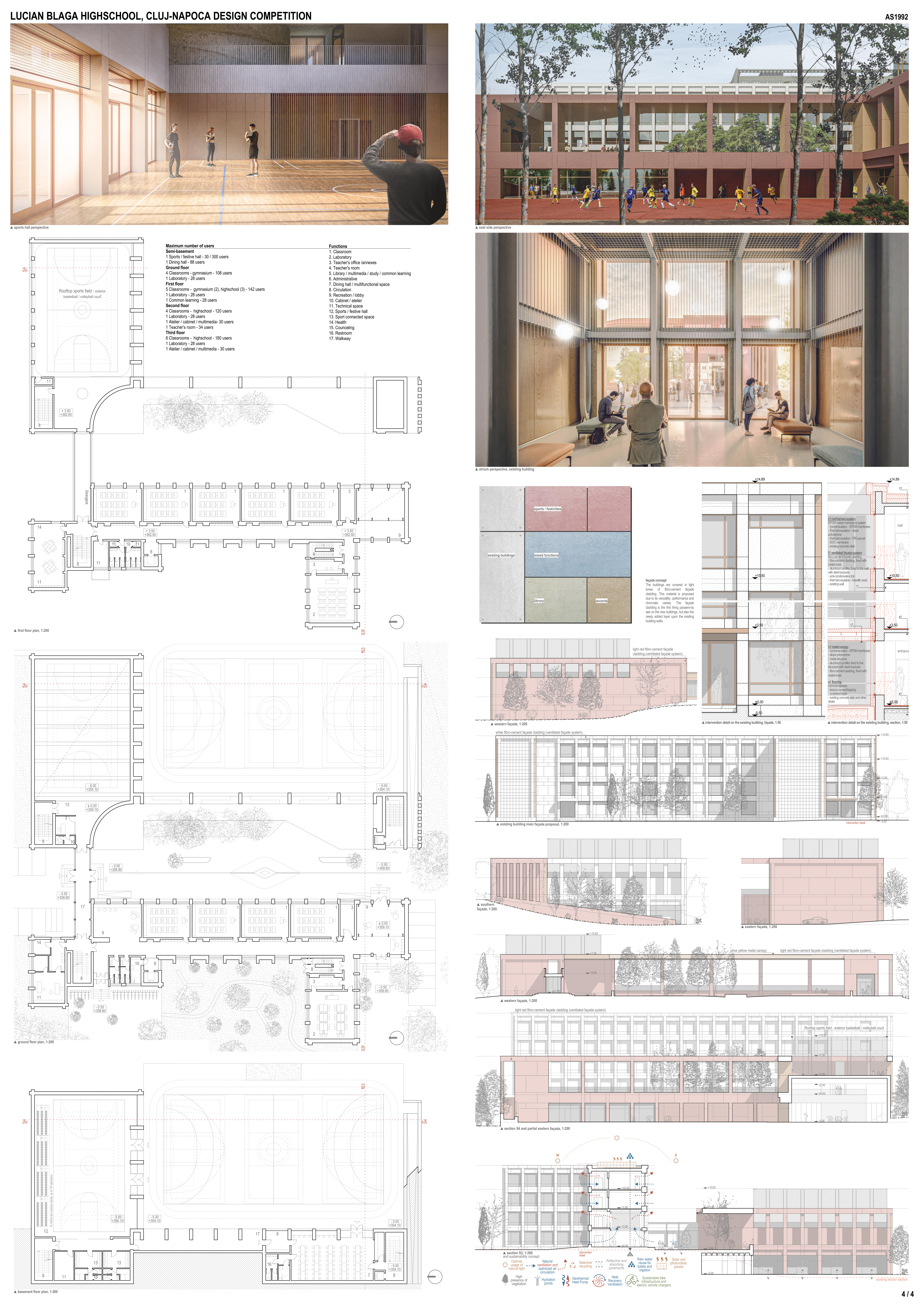
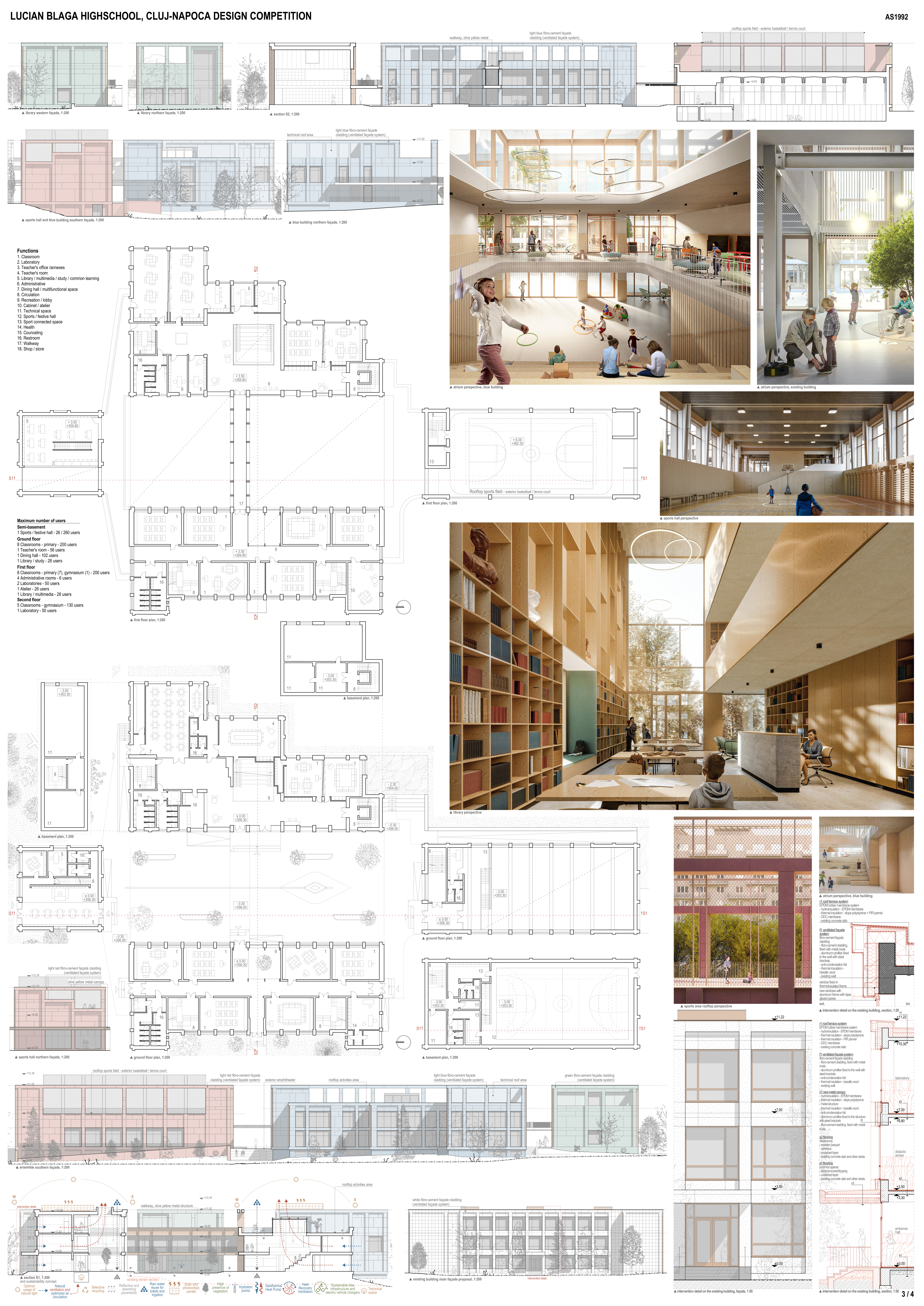
In our proposal, we followed a similar exercise – we isolated certain components of the architectural program of the school, and we colour coded them based on several connections between the perception of a certain colour and an activity within a specific architectural object. We thus proposed a series of new buildings which encompass contemporary educational values in light tones of primary colours – red, blue, and green.
The new components of each site aim to complete the unsure nature of the existing buildings, while their architectural vocabulary acknowledges and highlights the fragmentary state of the ensembles. All proposed architectural objects have an independent character, allowing a gradual development.
Even though we used the term “architectural program”, we underline a necessity to overcome the classic delimitations of educational space. In relation to the existing buildings within the site, we proposed a – albeit limited, in concern with the structural state of the architectural objects – number of healing gestures, which aim to bring up to date the old components of the school and to create the connections with the newly proposed buildings. We also aimed at keeping as few alterations as possible to the visual language of the existing buildings, with all the new attributes of the schools being rooted in the original ensemble. The existing buildings are kept in a neutral white.
We followed a similar organizational structure on both sites, creating a succession of functional ribbons which span among the courtyards. As such, the northern site is marked by a sequence heading from north to south, which encompasses – a garden, a schoolyard with scenic qualities, and the sports area. The southern site’s outline progresses from west to east with the garden, the school, the courtyard, and the sporting area being displayed in a linear order.