





109 – TB1324 – B.B. & ASOCIAȚII DESIGN SRL


Autori principali: arh. Babici Pavel Bogdan
Coautori: Streza Eliodor, Streza Monica, Ichim Anca Florentina, Brandiburg Bogdan, Neagu Teodor, Moise Alina, Veriotti Sabrina, Vlad Patru
Agri-food market building and Cibin Market parking
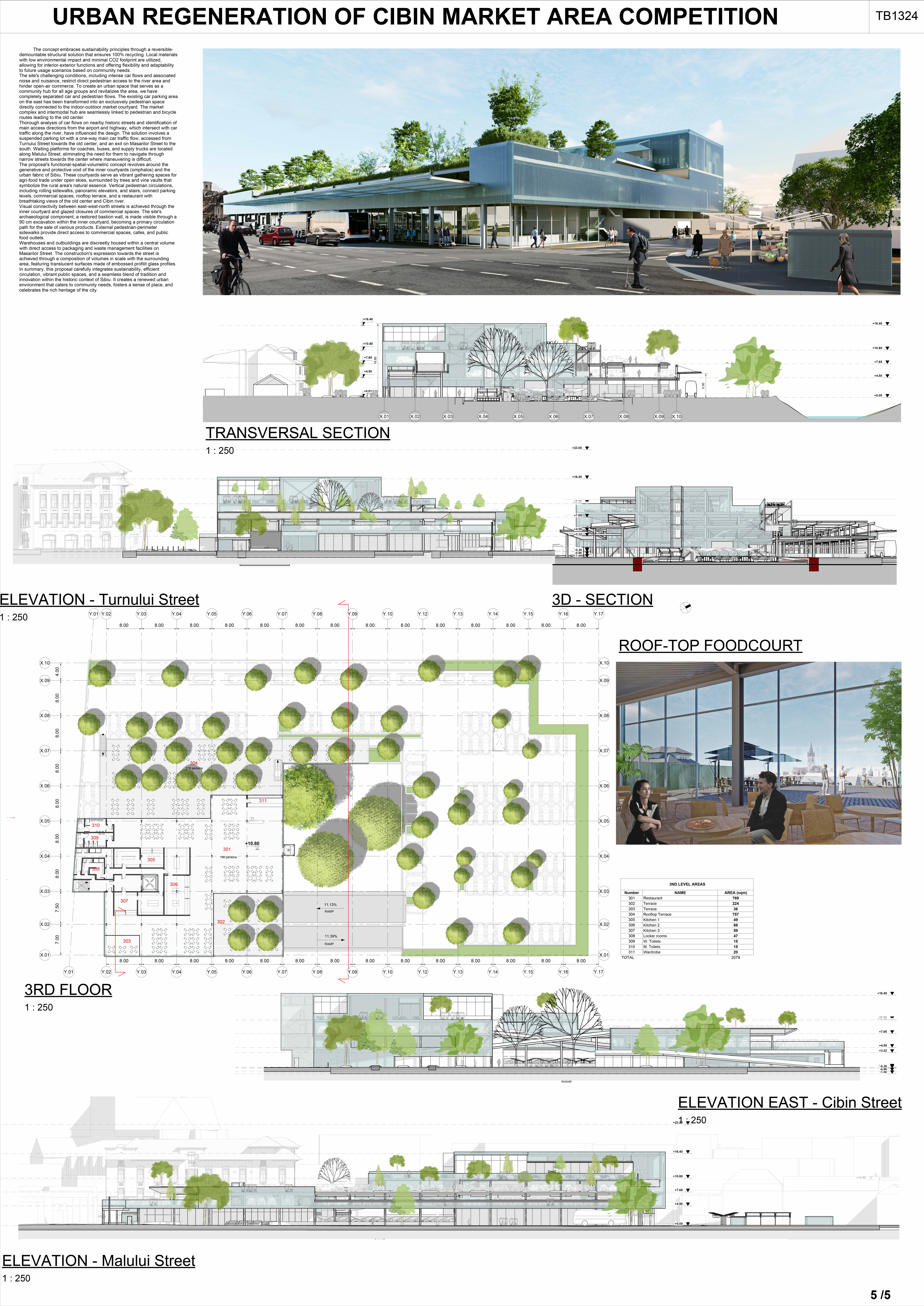
The concept embraces sustainability principles through a reversible-demountable structural solution that ensures 100% recycling. Local materials with low environmental impact and minimal CO2 footprint are utilized, allowing for interior-exterior functions and offering flexibility and adaptability to future usage scenarios based on community needs.
The site’s challenging conditions, including intense car flows and associated noise and nuisance, restrict direct pedestrian access to the river area and hinder open-air commerce. To create an urban space that serves as a community hub for all age groups and revitalizes the area, we have completely separated car and pedestrian flows.
The existing car parking area on the east has been transformed into an exclusively pedestrian space directly connected to the indoor-outdoor market courtyard. The market complex and intermodal hub are seamlessly linked to pedestrian and bicycle routes leading to the old center.
Thorough analysis of car flows on nearby historic streets and identification of main access directions from the airport and highway, which intersect with car traffic along the river, have influenced the design. The solution involves a suspended parking lot with a one-way main car traffic flow, accessed from Turnului Street towards the old center, and an exit on Masarilor Street to the south. Waiting platforms for coaches, buses, and supply trucks are located along Malului Street, eliminating the need for them to navigate through narrow streets towards the center where maneuvering is difficult.
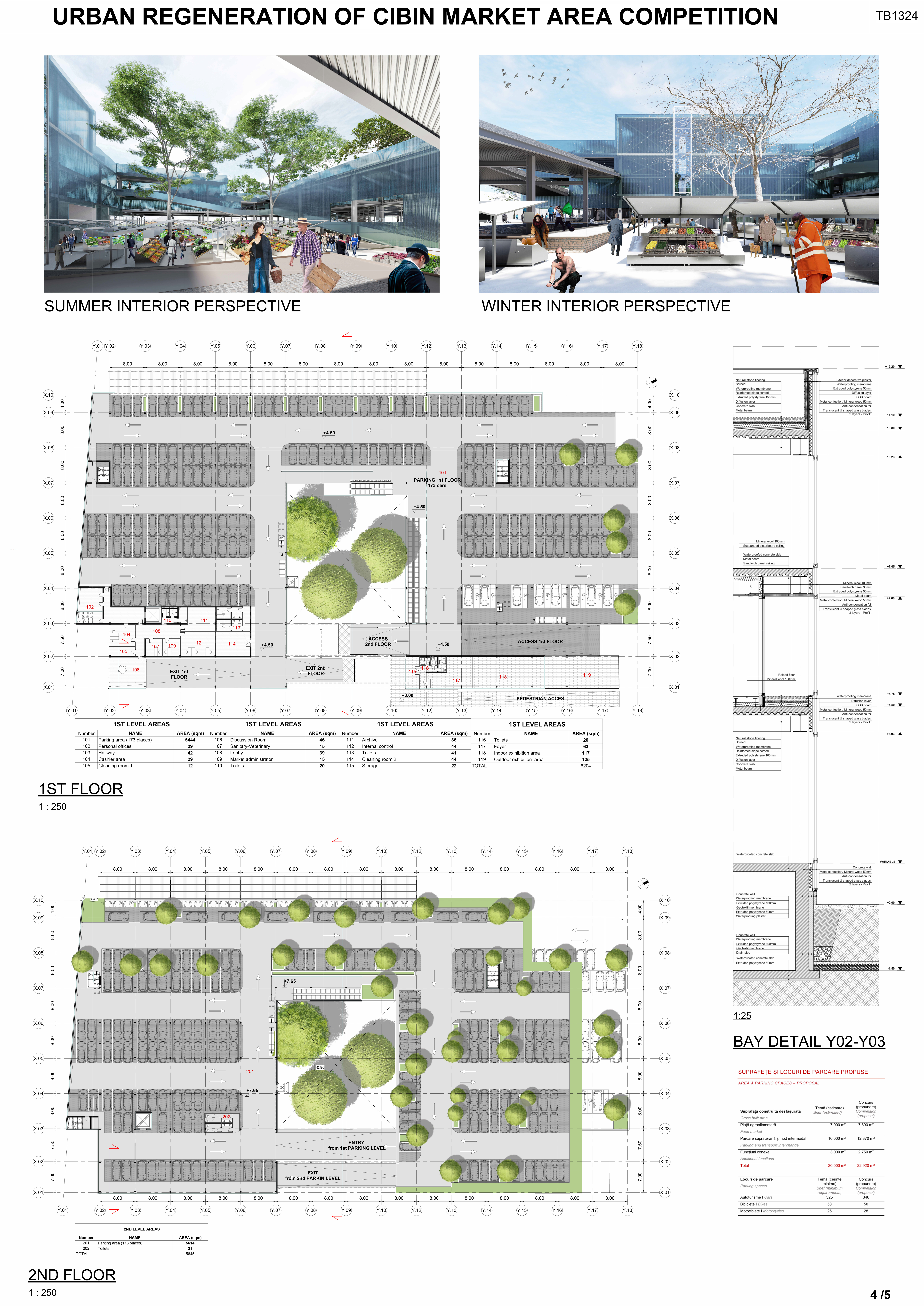
The proposal’s functional-spatial-volumetric concept revolves around the generative and protective void of the inner courtyards (omphalos) and the urban fabric of Sibiu. These courtyards serve as vibrant gathering spaces for agri-food trade under open skies, surrounded by trees and vine vaults that symbolize the rural area’s natural essence. Vertical pedestrian circulations, including rolling sidewalks, panoramic elevators, and stairs, connect parking levels, commercial spaces, rooftop terrace, and a restaurant with breathtaking views of the old center and Cibin river.
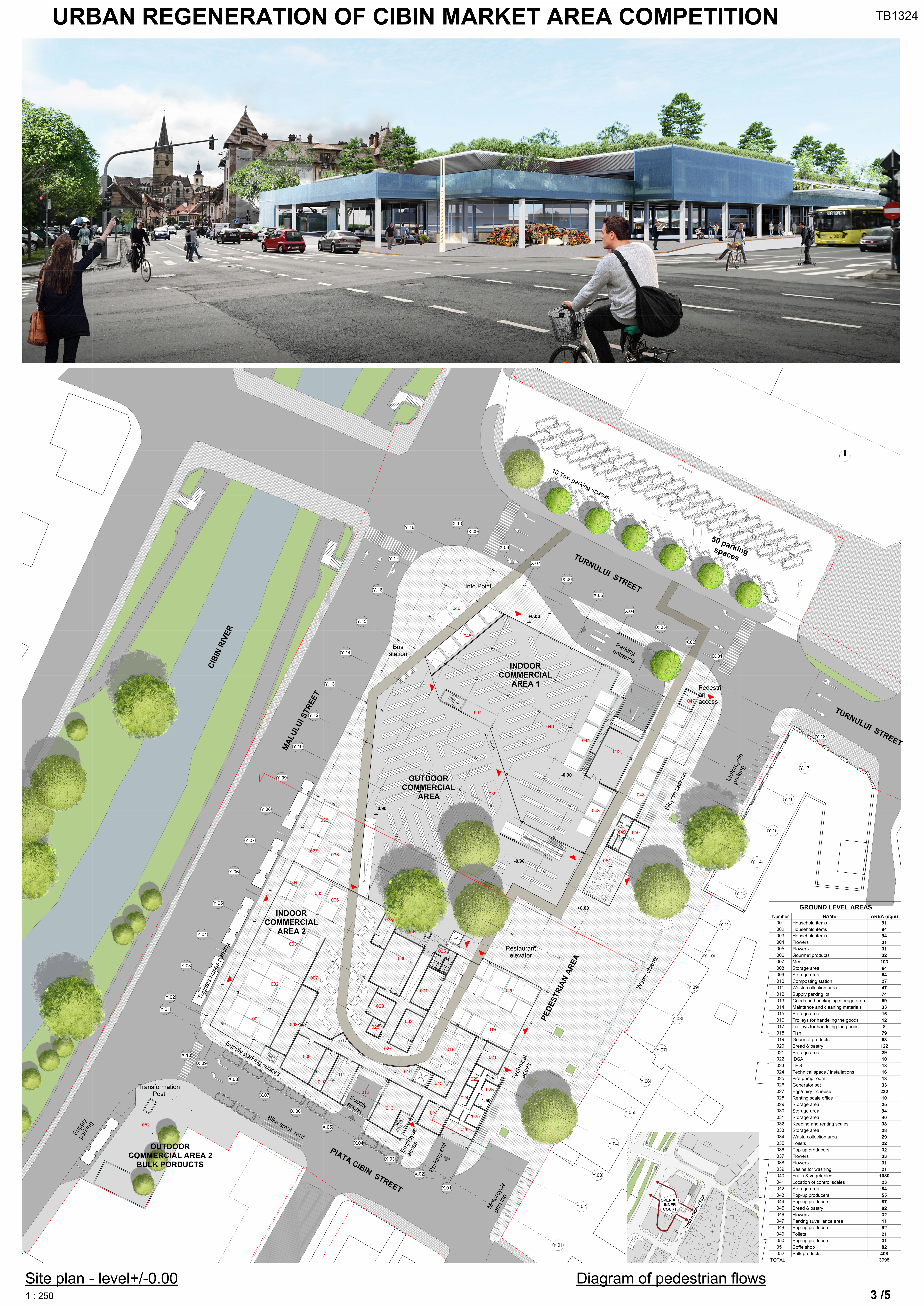
Visual connectivity between east-west-north streets is achieved through the inner courtyard and glazed closures of commercial spaces. The site’s archaeological component, a restored bastion wall, is made visible through a 90 cm excavation within the inner courtyard, becoming a primary circulation path for the sale of various products. External pedestrian-perimeter sidewalks provide direct access to commercial spaces, cafes, and public food outlets.
Warehouses and outbuildings are discreetly housed within a central volume with direct access to packaging and waste management facilities on Masarilor Street. The construction’s expression towards the street is achieved through a composition of volumes in scale with the surrounding area, featuring translucent surfaces made of embossed profilit glass profiles.
In summary, this proposal carefully integrates sustainability, efficient circulation, vibrant public spaces, and a seamless blend of tradition and innovation within the historic context of Sibiu. It creates a renewed urban environment that caters to community needs, fosters a sense of place, and celebrates the rich heritage of the city.
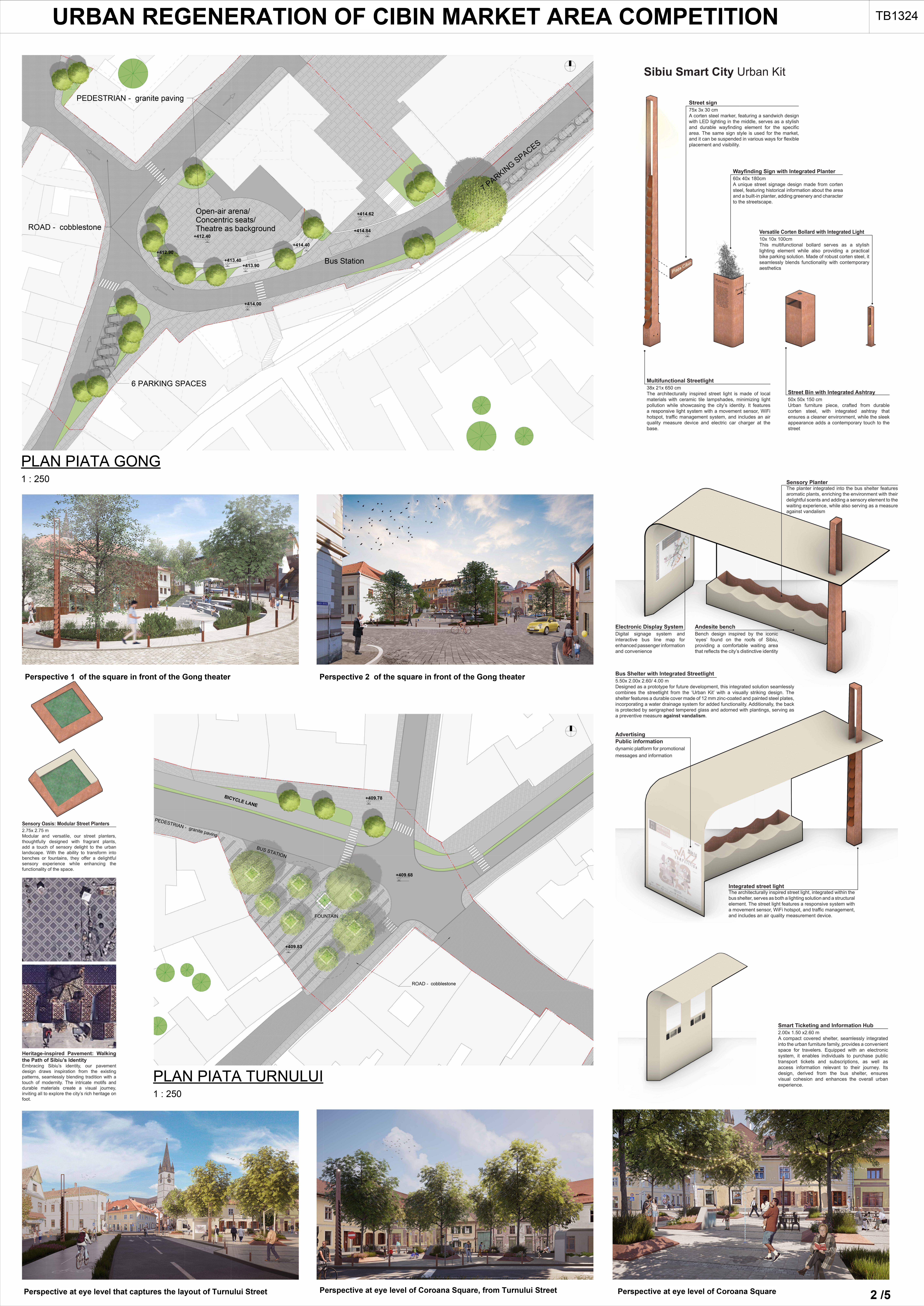
Urban planning of public spaces
The unique topography between Cibin and Piata Mare has shaped the arrangement of constructions and street plantings, creating an urban texture with volumes ranging from 10 to 12 meters in height. The ascending geography between Cibin and Piata Mare has shaped the unique urban texture, characterized by volumes and interstitial spaces filled with tall trees. The agri-food market design reflects this with cascading volumes, terraces, and suspended gardens around a spacious inner courtyard.
While the terraces primarily serve as parking spaces, their design allows for additional uses. With their large openings and favorable orientation towards points of interest in the area, these terraces can also host various socio-cultural activities, concerts, celebrations, cinematographic projections, and outdoor shows. The highest part features a panoramic terrace and restaurant area. Landscaped surfaces and tall trees embedded in floor slabs enhance the design.
A pedestrian circuit extends from Cibin River to Piața Mare, looping back to Masarilor Street. This circuit connects a series of distinct spaces, squares, and urban pockets that hold a special charm for the Sibiu community. Walking through these areas offers diverse sensory experiences, from tasting agri-food products to savoring fragrances of plants and trees.
Proposal includes reconfiguring Cibin Square, transforming the eastern parking lot into a pedestrian area, and rehabilitating of Piața Târgul Peștelui, Piața Coroana, and Piața Gong. These interventions aim to create a vibrant urban ensemble that enhances the historical value of the area. By offering a range of complementary functions, these revitalized spaces aim to enhances the historical value of the area and attracts visitors, fostering economic prosperity.
To ensure a unified visual identity, all squares along the cultural pedestrian route will feature pavements made of slates and andesite cubes, mirroring the stereotoms found in Piata Mare. Additionally, tall trees will be planted in landscaped green spaces throughout these squares, adding beauty and tranquility. Tall trees and uniform urban furniture will enhance the experience, the texture of the green spaces and contribute to a more sustainable environment (appealing pleasant shade).
To ensure a cohesive and culturally authentic image, we propose an “URBAN KIT” consisting of furniture and urban equipment. Crafted from local materials and inspired by the area’s cultural elements, including ceramic tiles, sinusoidal lines reminiscent of roof textures, and oxidized metal, this kit will enhance the distinct aesthetic of the space.
Advanced features such as air quality and traffic monitoring sensors, surveillance cameras, Wi-Fi hotspots, and electric vehicle charging sockets will be integrated into the proposed street lighting and infopoints. These elements will seamlessly connect to the city’s smart infrastructure, collecting data and centrally managed through the municipality’s software platform. Dedicated mobile applications will grant citizens access to these amenities.
In summary, urban planning concept for Cibin Market area seeks to create a visually captivating, sustainable, and culturally rich urban space. By embracing the natural geography, integrating green spaces, fostering cultural connectivity, and implementing smart infrastructure, the proposal aims to transform the area into a vibrant and inclusive environment that honors the historical significance of the region.