





102 – IC6723 – STARH – ARHITECTURA, CONSTRUCTII, DESIGN SRL. – MENȚIUNE ONORIFICĂ


Autori principali: MARIA-IULIA STANCIU / COSMIN GĂLĂȚIANU / EDUARD DUMITRU UNTARU
Coautori: COSMIN VALENTIN GEORGESCU, ROBERTA IULIA FRUMUȘELU, OCTAVIAN BÎRSAN, ALEXANDRU CRISTIAN BEȘLIU, DAVID SEBASTIAN MIHAI, SEBASTIAN COSMIN CIULEI
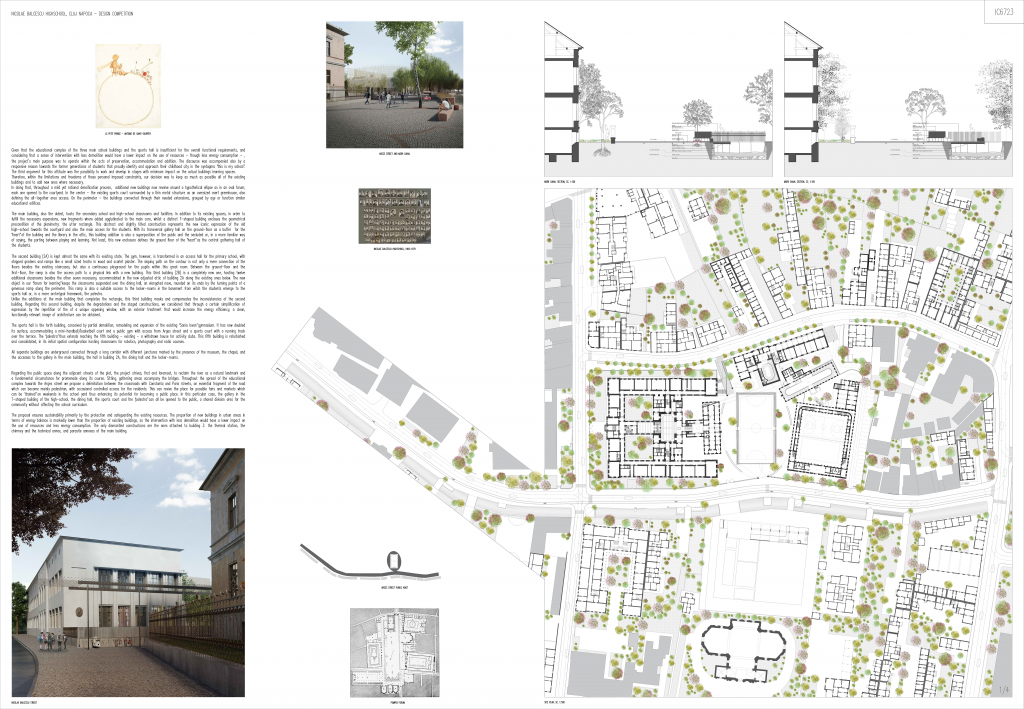
The forum
Given that the educational complex of the three main school buildings and the sports hall is insufficient for the overall functional requirements, and considering that a sense of intervention with less demolition would have a lower impact on the use of resources – though less energy consumption – , the project’s main purpose was to operate within the acts of preservation, accommodation and addition. The discourse was accompanied also by a responsive reason towards the former generations of students that proudly identify and approach their childhood city in the syntagma “this is my school”. The third argument for this attitude was the possibility to work and develop in stages with minimum impact on the actual buildings learning spaces.
Therefore, within the limitations and freedoms of these personal imposed constraints, our decision was to keep as much as possible all of the existing buildings and to add new ones where necessary.
In doing that, throughout a mild yet rational densification process, additional new buildings now revolve around a hypothetical ellipse as in an oval forum, each one opened to the courtyard. In the center – the existing sports court surrounded by a thin metal structure as an oversized overt greenhouse, also defining the all-together area access. On the perimeter – the buildings connected through their needed extensions, grouped by age or function similar educational edifices.
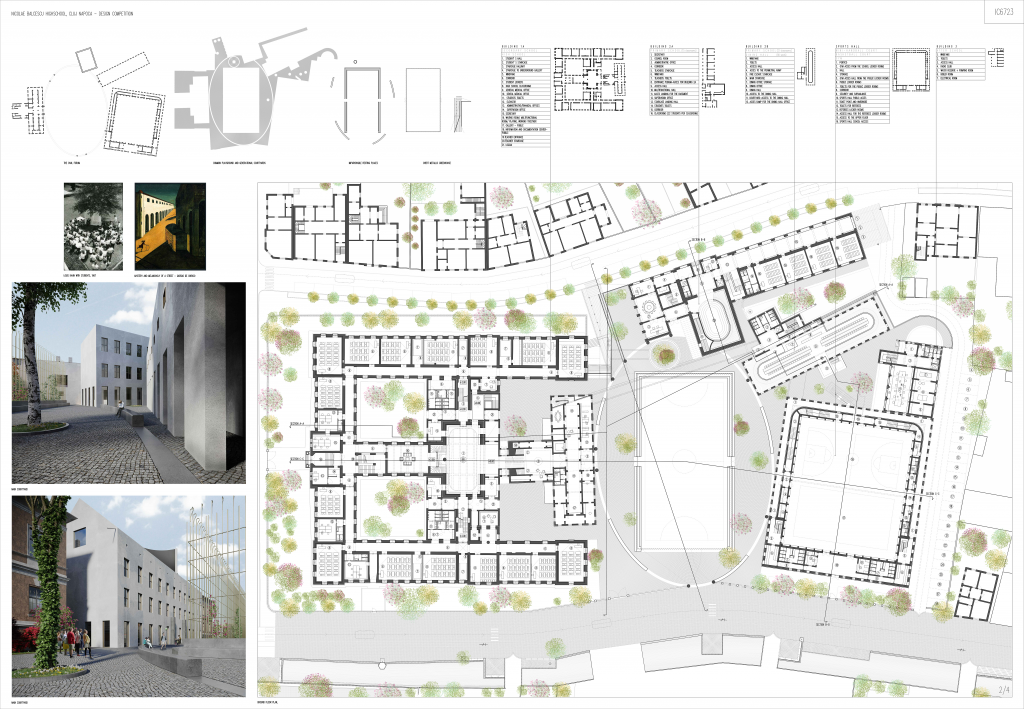
The main building, also the oldest, hosts the secondary school and high-school classrooms and facilities. In addition to its existing spaces, in order to fulfill the necessary expansions, new fragments where added agglutinated to the main core, whilst a distinct T-shaped building encloses the geometrical precondition of the planimetry: the utter rectangle. This abstract and slightly tilted construction represents the new iconic expression of the old high-school towards the courtyard and also the main access for the students. With its transversal gallery hall on the ground-floor as a buffer for the “heart” of the building and the library in the attic, this building addition is also a superpositionof the public and the secluded or, in a more familiar way of saying, the parting between playing and learning. Not least, this new enclosure defines the ground floor of the “heart” as the central gathering hall of the students.
The second building (2A) is kept almost the same with its existing state. The gym, however, is transformed in an access hall for the primary school, with stepped gradens and ramps like a small sized teatro in wood and scarlet plaster. The sloping path on the contour is not only a mere connection of the floors besides the existing staircases, but also a continuous playground for the pupils within this great room. Between the ground-floor and the first-floor, the ramp is also the access path to a physical link with a new building. This third building (2B) is a completely new one, hosting twelve additional classrooms besides the other seven necessary, accommodated in the new adjusted attic of building 2A along the existing ones below. The new object in our “forum for learning” keeps the classrooms suspended over the dining hall, an elongated nave, rounded on its ends by the turning points of a generous ramp along the perimeter. This ramp is also a suitable access to the locker-rooms in the basement from witch the students emerge to the sports hall or, in a more archetypal framework, the palestra.
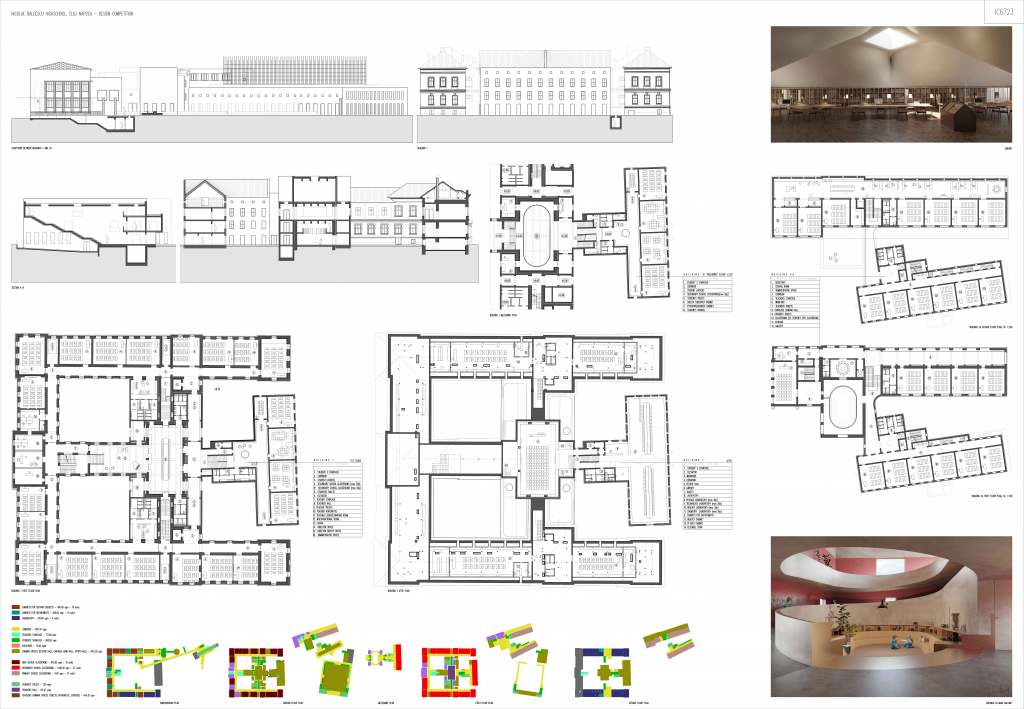
Unlike the additions at the main building that completes the rectangle, this third building masks and compensates the inconsistencies of the second building. Regarding this second building, despite the degradations and the staged constructions, we considered that through a certain simplification of expression by the repetition of the of a unique oppening window, with an exterior treatment that would increase the energy efficiency, a clean, functionally relevant image of architecture can be obtained.
The sports hallis the forth building, conceived by partial demolition, remodeling and expansion of the existing “Sonia Iovan” gymnasium. It has now doubled its surface, accommodating a mini-handball/basketball court and a public gym with access fromArges street and a sports court with a running track over the terrace. The “palestra” thus extends reaching the fifth building – existing – a withdrawn house for activity clubs. This fifth building is refurbished and consolidated, in its initial spatial configuration hosting classrooms for robotics, photography and radio courses.
All separate buildings are underground connected through a long corridor with different junctures marked by the presence of the museum, the chapel, and the accesses to the gallery in the main building, the hall in building 2A, the dining hall and the locker-rooms.
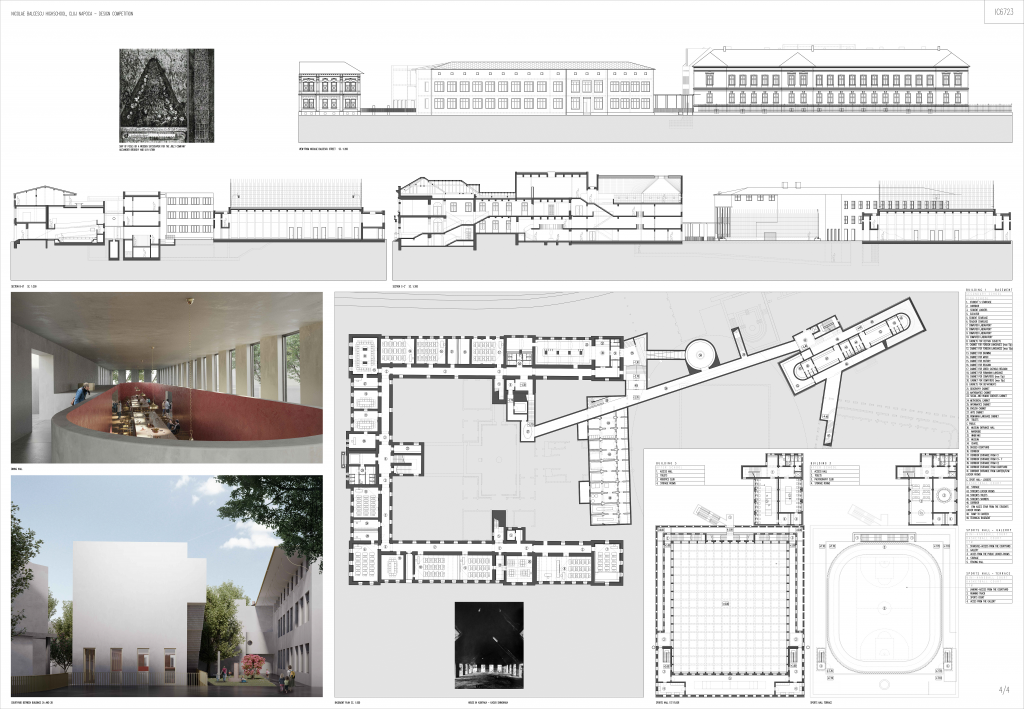
Regarding the public space along the adjacent streets of the plot, the project strives, first and foremost, to reclaim the river as a natural landmark and a fundamental circumstance for promenade along its course. Sitting, gathering areas accompany the bridges. Throughout the spread of the educational complex towards the Arges street we propose a delimitation between the crossroads with Constanta and Paris streets, an essential fragment of the road witch can become mainly pedestrian, with occasional controlled access for the residents. This can revive the place for possible fairs and markets which can be “drained” on weekends in the school yardthus enhancing its potential for becoming a public place. In this particular case, the gallery in the T-shaped building of the high-school, the dining hall, the sports court and the “palestra” can all be opened to the public, a shared division area for the community without affecting the school curriculum.
The proposal ensures sustainability primarily by the protection and safeguarding the existing resources. The proportion of new buildings in urban areas in terms of energy balance is markedly lower than the proportion of existing buildings, so the intervention with less demolition would have a lower impact on the use of resources and less energy consumption. The only dismanteled constructions are the ones attached to building 3: the thermal station, the chimney and the technical annex, and parasite annexes of the main building.