





114 – UM1111 – SC URBAN SCOPE SRL în asociere cu Manda Works și S.C. Artconcept Building S.R.L.


Autori principali: S.C. Urban Scope S.R.L.
Coautori: Mandaworks AB
Colaboratori arhitectură: S.C.Artconcept Building S.R.L.
Colaboratori specialități: Urbanist Negru Ana-Maria, Arhitect Ciobanu Enescu Daria
Asociere:
- SC URBAN SCOPE SRL (Lider) – servicii de proiectare privind realizarea Science Campus
- Manda Works – servicii de arhitectură
- S.C. Artconcept Building S.R.L – servicii de arhitectură
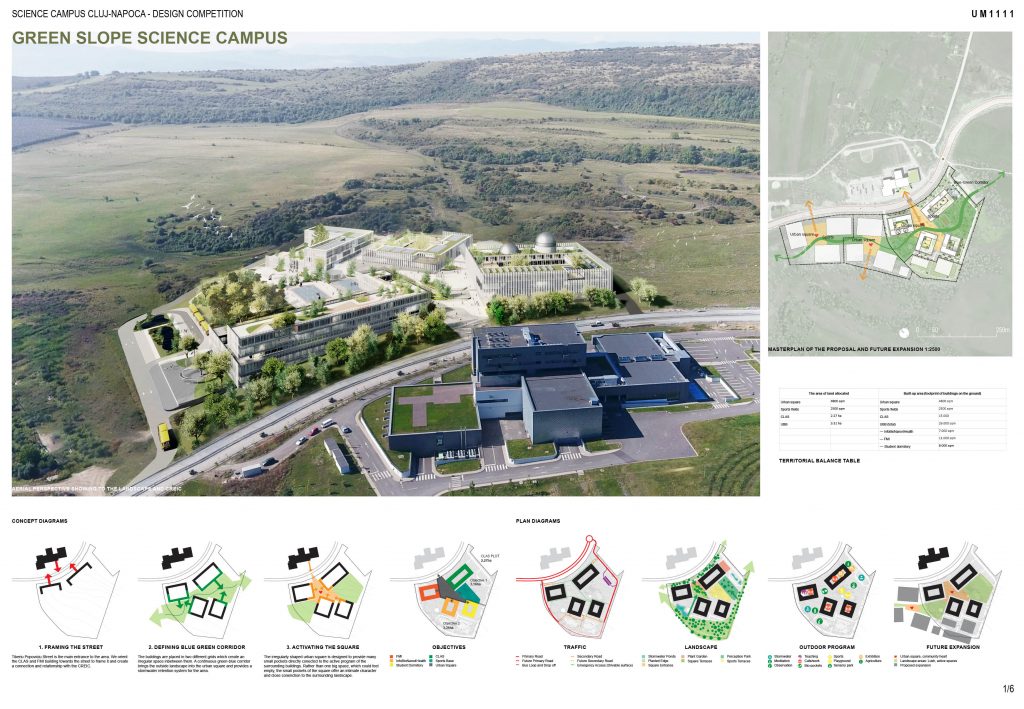
Science Campus Cluj-Napoca will be a modern campus that will integrate smart technologies in an environment that is nature friendly. The proposed approach is to integrate functions into the landscape therefore creating terraces that can serve aspects that relate to sustainability and urban life within the campus. The design concept follows the idea of a “hand” where the fingers serve as the main functions that push into the landscape with different pressures and that have in between them green and blue connections to the surrounding environment.
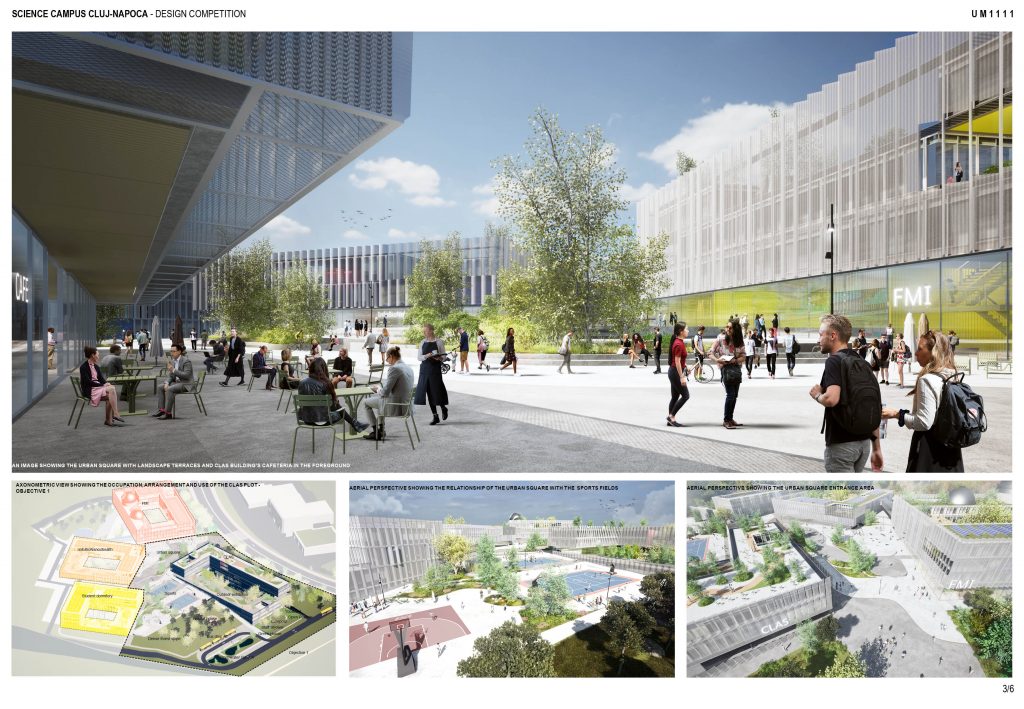
Each of the buildings proposed will have an emblematic status, but they will fit into the ensamble without competing visually with each other as for the urban space and greenery to be the predominat features of the proposal. Having this reasoning behind one of the design strategies was to let nature “flood” the insides of the buildings by creating interior courtyards.Another essential methodology looks at creating double skins for each one of buildingswith a gradient of different opacities as to seem the building is breathing in the nature proportionally to the interior functions.
In order to support the sustainability of the site in terms of energy efficiency as well as changing environmental conditions the proposed approach uses the flat roofs for solar panels, stormwater management ponds where water can be collected during heavy rainfall and reused for the irrigation system, wind and solar powered light poles that are also telemanaged as to reduce the energy usage and a more permeable site flooring that will absorb much of the solar exposure.
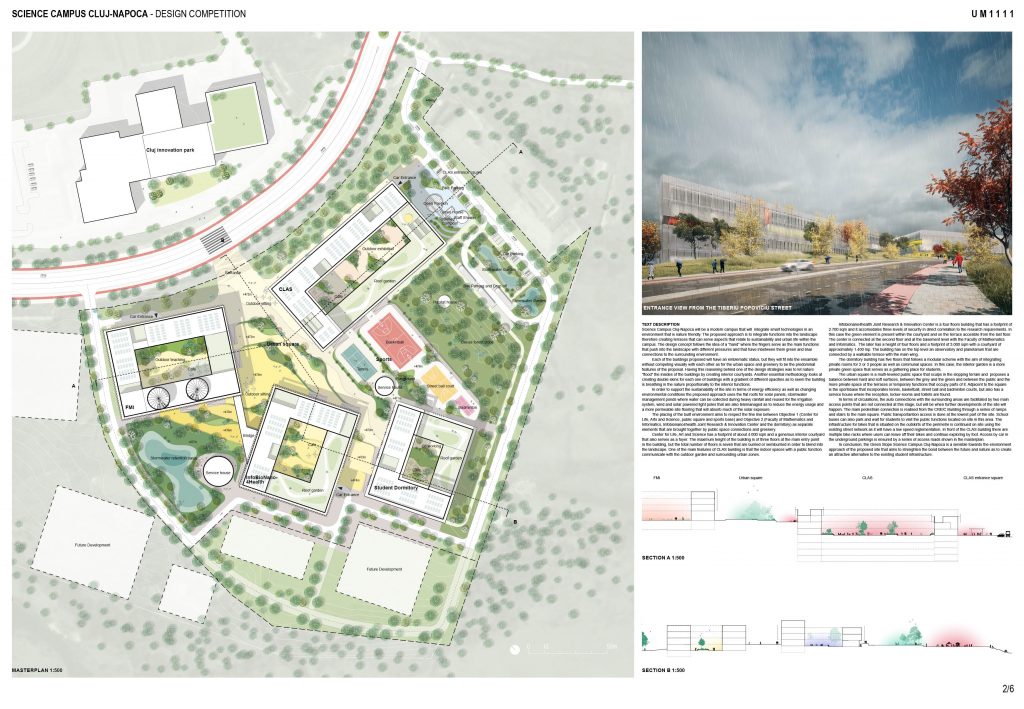
The placing of the built environment aims to respect the fine line between Objective 1 (Center for Life, Arts and Science, public square and sports base) and Objective 2 (Faculty of Mathematics and Informatics, Infobionano4life Joint Research & InnovationCenter and the dormitory) as separate elements that are brought together by public space connections and greenery.
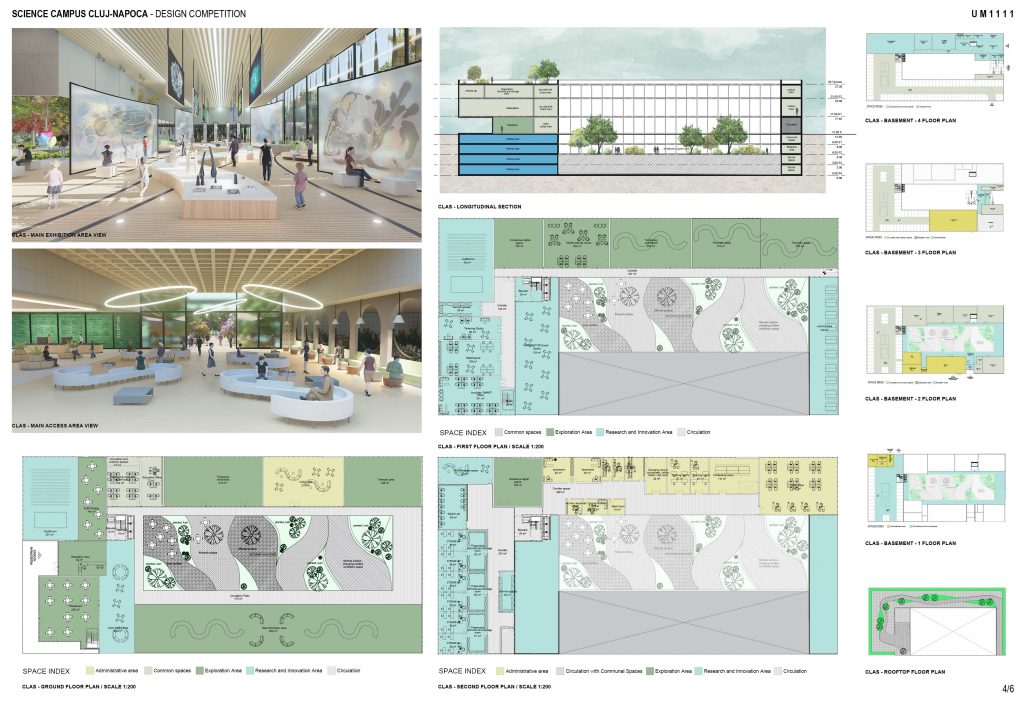
Center for Life, Art and Science has a footprint of about 4.000 sqm and a generous interior courtyard that also serves as a foyer. The maximum height of the building is of three floors at the main entry point in the building, but the total number of floors is seven that are burried or semiburried in order to blend into the landscape. One of the main features of CLAS building is thatthe indoor spaces with a public function communicate with the outdoor garden and surrounding urbanzones.
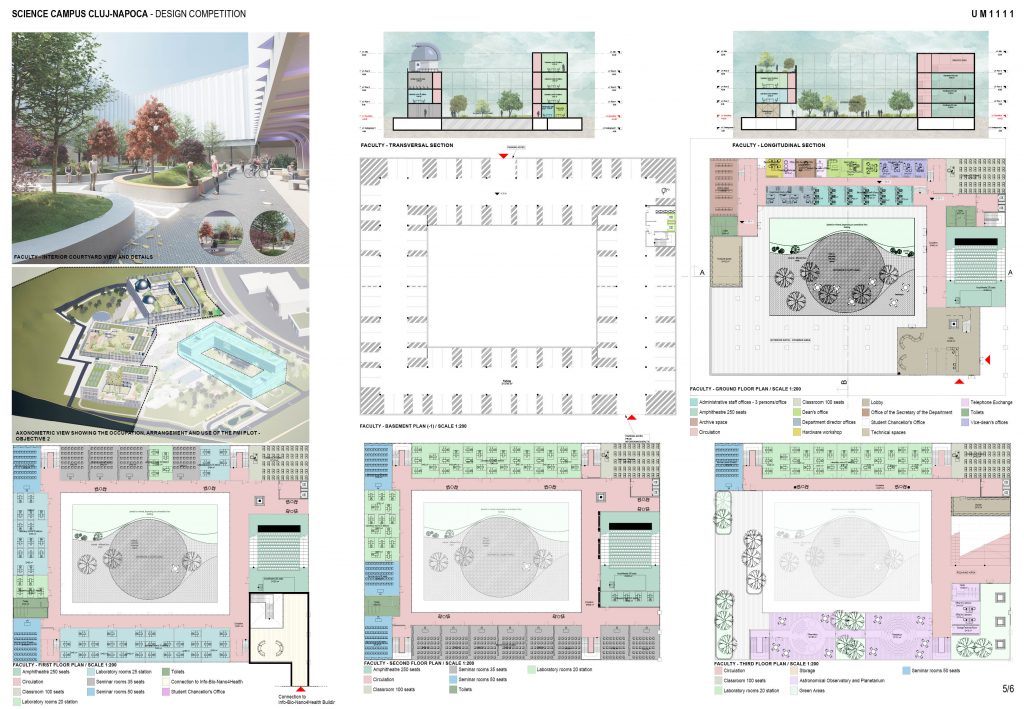
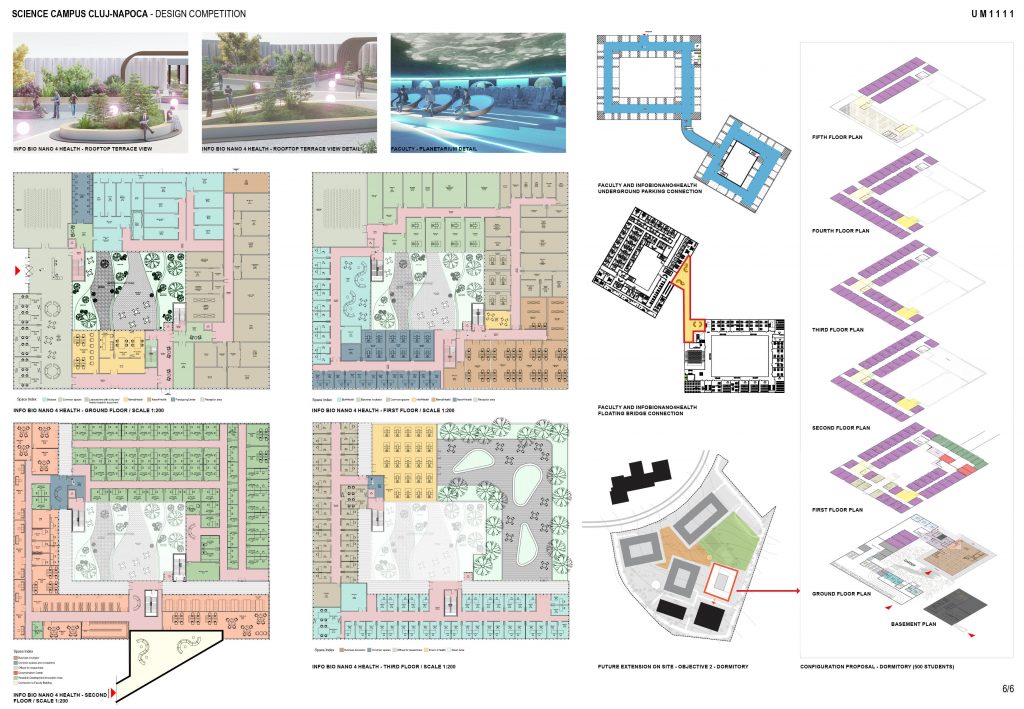
Infobionano4life Joint Research & Innovation Center is a four floors building that has a footprint of 2.700 sqm and it accomodates three levels of security in direct correlation to the research requirements. In this case the green element is present within the courtyard and on the terrace accesible from the last floor. The center is connected at the second floor and at the basement level with the Faculty of Mathematics and Informatics. The later has a height of four floors and a footprint of 3.000 sqm with a courtyard of approximately 1.400 mp. The building has on the top level an observatory and planetarium that are connected by a walkable terrace with the main wing.
The dormitory building has five floors that follows a modular scheme with the aim of integrating private rooms for 2 or 3 people as well as communal spaces. In this case, the interior garden is a more private green space that serves as a gathering place for students.
The urban square is a multi-leveled public space that sculps in the slopping terrain and proposes a balance between hard and soft surfaces, between the grey and the green and between the public and the more private space of the terraces or temporary functions that occupy parts of it. Adjacent to the square is the sportsbase that incorporates tennis, basketball, street ball and badminton courts, but also has a service house where the reception, locker-rooms and toillets are found.
In terms of circulations, the auto connections with the surrounding areas are facilitated by two main access points that are not connected at this stage, but will be when further developments of the site will happen. The main pedestrian connection is realised from the CREIC Building through a series of ramps and stairs to the main square. Public transportantion access is done at the lowest part of the site. School buses can also park and wait for students to visit the public functions located on site in this area. The infrastructure for bikes that is situated on the outskirts of the perimetre is continued on site using the existing street network as it will have a low speed reglementation. In front of the CLAS building there are multiple bike racks where users can leave off their bikes and continue exploring by foot. Access by car in the underground parkings is ensured by a series of access roads shown in the masterplan.
In conclusion, the Green Slope Science Campus Cluj-Napoca is a sensible towards the environment approach of the proposed site that aims to strenghten the bond between the future and nature as to create an attractive alternative to the existing student infrastructure.