





112 – PB3316 – Studio 82 SRL


Autor principal: Studio 82 S.R.L. și Vlad Sebastian Rusu B.I.A
Coautori: arh. Octav Silviu Olănescu, arh. Vlad Sebastian Rusu, arh. Ștefania Boca, arh. Petrică Maier-Drăgan, arh. Miruna Moldovan, arh. Andrada Pinte
Colaboratori specialităţi:
Peisagistică: peis. Claudia Uglea, peis. Alex Cotoz
Horticultură: ing. hort. Valentin Sebastian Dan
Biolog: biol. Zoltán D. Szabó
ASOCIERE
Studio 82 S.R.L., 50%
Vlad Sebastian Rusu Birou Individual de Arhitectură, 50%
INTRODUCTION
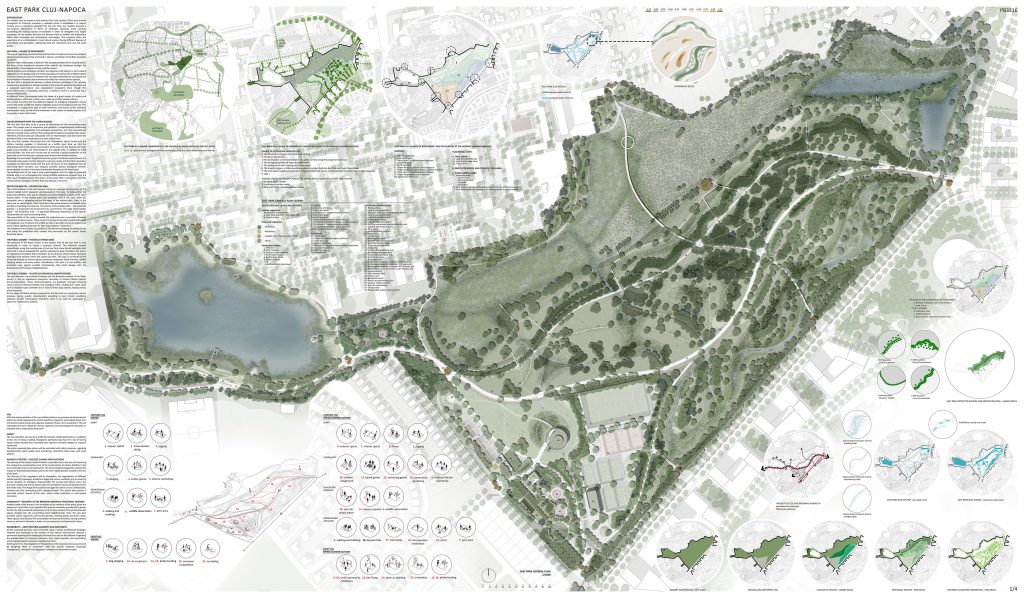
Our project aims to preserve and enhance the main quality of this area, present throughout its historical evolution: a wetland which is embedded in a natural scenery and in a priceless ecosystem for the city. Thus, our solution presents a non-invasive intervention in terms of anthropic elements, while carefully completing the existing natural environment in order to strengthen this fragile ecosystem. All the project decisions are focused more on wildlife and biodiversity, rather than landscape and architectural over-design. This proposal offers the experience of a contemplated or lived natural scenery, having different degrees of accessibility and perception, addressing both the individual users and the small groups.
EAST PARK – SOURCE OF BIODIVERSITY
The way of organizing and structuring the East Park is based on the use of ecological elements and processes that are found in nature, consisting of local flora and plant structures.
The main idea of the project is based on the conceptualization of the studied area in the form of the constituent elements that underlie the landscape ecology: the habitat patch, the ecological corridor and the mosaic.
Habitat patches and ecological corridors are organized with natural or semi-natural vegetation on the background of a mosaic (background matrix) with a different plant structure. Hence the close link between the way these elements are structured and the formation of habitats and movement corridors for various animal species.
The East Park is designed to become a hybrid structure consisting of the valuable spontaneous development already available in the area (the protected biotope) and a proposed quasi-natural area (engineered ecosystem). Even though this quasi-natural area is essentially man-built, it performs, and it is structured like a natural habitat patch.
At different scale, the proposal takes the shape of a great mosaic of clusters and habitat patches, which are, in their core, made up of other smaller patches.
This nested hierarchy that has different degrees of ecological integration can be used in the study of different species migration across the ecological construct. This movement is ranging from that of small mammals and insects at the individual habitat patch scale, to that of bird movement at the cluster of habitat patches or of the greater mosaic patch scale.
THE RELATIONSHIP WITH THE SURROUNDINGS
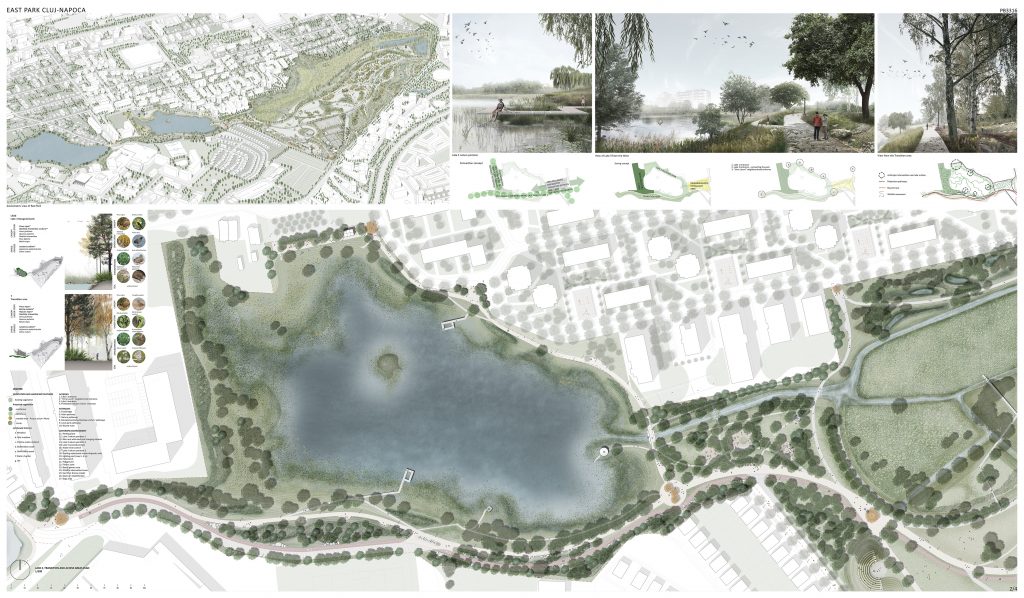
The new East Park aims to be a source of biodiversity for the surrounding green areas. The project aims to emphasise and establish a straightforward relationship both in terms of accessibility and ecological connectivity, with the manufactured character of Lake 1 area, which is thus prologued through the proposed Lake 3 area. Therefore, the two lakes are articulated with an intermediate area that marks the transition from a man-made zone to a more natural one.
The area that includes the access from the Gheorgheni Sports Centre and the military housing complex, is structured as a buffer zone: here we find the anthropized area of the natural environment of the park. On this account, the main public access facilities are concentrated in this specific area. In addition to these lively facilities, this area also has the role of ensuring a passive protection of the more natural part of the park, using physical distance and plant structures.
Regarding the new Sopor Neighbourhood the project introduces and enhances the proposed major green corridor (along the main gas route) and the other secondary ecological corridors that blend with the built structures of the neighbourhood. By continuing these corridors, our proposal provides specific ecological services: movement corridors that ensure biodiversity throughout the whole area.
The northern part of the Lake 3 area mixed together with the edge of protected biotope area, is an anthropized one, having multiple pedestrian accesses from the Intre Lacuri Neighbourhood. This area is at the same time a connection point for various future ecological corridors that may develop in this area.
PROTECTED BIOTOPE – PROTECTION AREA
The entire proposal of the park focuses mainly on ensuring the protection of the natural habitat which appeared spontaneously in this area. To achieve this, the proposed protection area and its adjacent area were designed as parts of the same habitat patch. In this habitat patch the protected area is the core, while the protection area is spreading around the edges of the habitat patch. Here, in the same way as nature works, most interactions take place between the habitat patch and the surrounding environment. The interior of the habitat patch – the protected biotope – is proposed to be preserved in its current form. The edge of the habitat patch – the protection area – is organized differently depending on the specific characteristics of each surrounding areas.
The accessibility of the visitors towards the protected area is punctual, following special non-invasive routes. These routes (consisting of elevated metallic pathways) are designed so as to disturb the wildlife as little as possible and are arranged so as not to create additional barriers for the living creatures’ movement.
The limitation of the visitors’ accessibility is also done by arranging an additional wet area along the protection area, crossed only punctually by the special routes described above.
THE PUBLIC GARDEN – THE BECAS STREAM AREA
The presence of the Becas at the eastern limit of the East Park is used structurally in order to create a diversion channel. This diversion channel reconstitutes along the crossing area of the East Park many formal typologies that are found in nature alongside this specific watercourse type. Therefore, this area is an engineered ecosystem that contributes to the diversity of the natural structural typologies that develop within the whole East Park. This area is connected to the protected biotope by various natural structures: temporary flood channels, habitat stepping stones and many others. Nonetheless, this area is a real biofilter and protection area against possible shortcomings that could emerge with the development of the Sopor Neighbourhood.
THE PUBLIC GARDEN – CLUSTER OF INDIVIDUAL HABITAT PATCHES
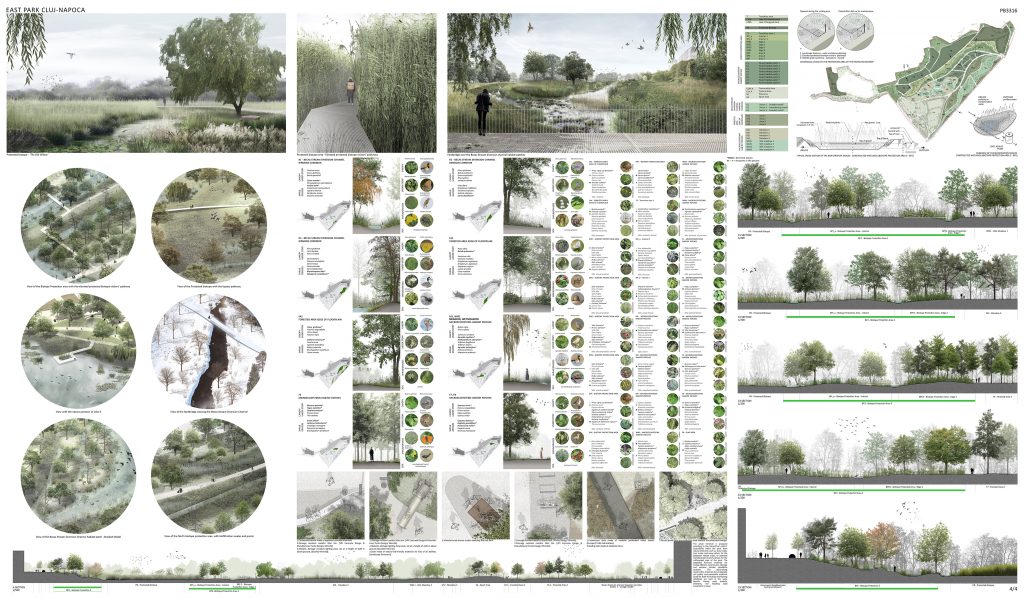
The area between the protected biotope and the diversion channel of the Becas stream is also an engineered ecosystem consisting of various habitat patches (micro-ecosystems). These micro-ecosystems are gradually arranged following various areas of interconnectivity and ecological limits, ranging from open areas such as meadow types (whether dry or wet) to forest type patches, having various plant structures.
All the types of habitat patches proposed for the East Park are inspired by natural biotopes, having specific characteristics according to local climatic conditions (altitude, climatic microregion). Therefore, there is no need for specialized or expensive maintenance systems.
SOIL
With the implementation of the new habitat patches, we propose soil improvement actions or partial replacements of with specific soil types for each habitat patch. This will lead to a more precise and vigorous shaping of these micro-ecosystems. The soil represents the main habitat for various organisms and microorganisms that play an essential role in shaping the food chain.
WATER
The new East Park will also be a buffer for extreme rainfall phenomena. In addition to the role of being a habitat, floodplains (wetlands) also have the role of storing surplus water resulted from torrential rains, specific to climate changes or seasonal succession.
The entire proposed blue system will be controlled with safety measures regarding hydrotechnical works (water level monitoring, controlled intake areas and many others).
PHASING ACTIVITIES – ACCESSES, ZONING AND FUNCTIONS
The phasing of the project implementation is possible due to the way of structuring the proposal by concentrating most of the constructions of various facilities in the more anthropic area (in the southwest). This concentrated arrangement reduces the impact on the protected biotope and on the new habitat patches created in the rest of the park.
The diversity of the vegetation and its disposition, the organization of different habitat patches typologies, protection edges and various wetlands, are all meant to ensure diversity of ecological characteristics for current and future users: the diversity of plant and animal species that will provide the source of biodiversity for the whole area. The design of the park encourages the active use on a limited area, situated near the surrounding built neighbourhoods. This aspect also ensures a semi-wild surface reserve of the park, which invites individual or small group incursions.
COMMUNITY – RECOVERY OF THE BREEDING GROUND’S FUNCTIONAL HERITAGE
Another stake of the project is the evocation of the memory of the place, given the existence of the initial nursery garden that used to constantly provide plant species for the city. We considered recovering one of its areas and use it for prevalent public spaces, located near the surrounding build neighborhoods. Thus, the new park provides various spaces for community gardens, meeting places and picnic spots. These spaces contribute to the consolidation of local communities, having common concerns and social interests in order to raise awareness and appreciate nature.
REVERSIBILITY – ARCHITECTURAL ELEMENTS AND EQUIPMENT
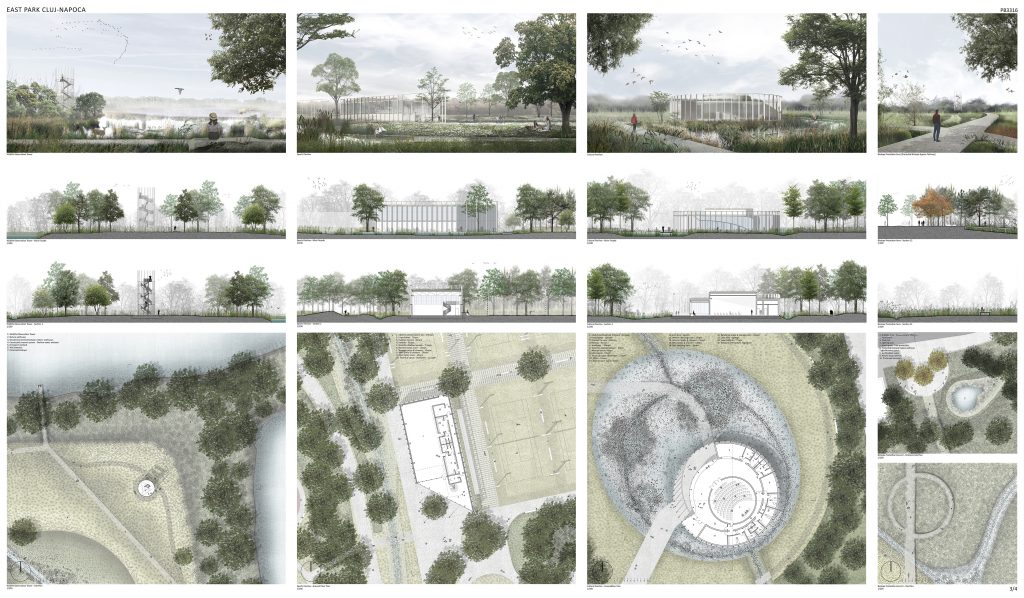
All the proposed pavilions were conceived using a unitary architectural language, retained and concealed in the scenery of the natural environment. Beyond a permanent opening to the landscape, the main focus was on the efficiency regarding the prefabrication of structural elements, their rapid assembly and reversibility, while maintaining the materials’ qualities over time.
At the same time, the integration of the pavilions in the natural scenery was ensured by designing them in connection with the specific wetlands landscape arrangements, aiming for the vegetation’s presence to dominate the park.