





122 – SC1206 – NHS


Autori principali: Maria Alexandrescu, Claudiu Forgaci, Sébastien Roussel
Coautori: Barbara Prezelj, Taraba Judit
Colaboratori arhitectură: Etienne Barré, Pierre-Alain Bouchetard
ASOCIERE
Interscalar, general partnership (V.O.F.), coautor
Barre Bouchetard Architecture, SARL, colaboratori arhitectură
A WATER LANDSCAPE
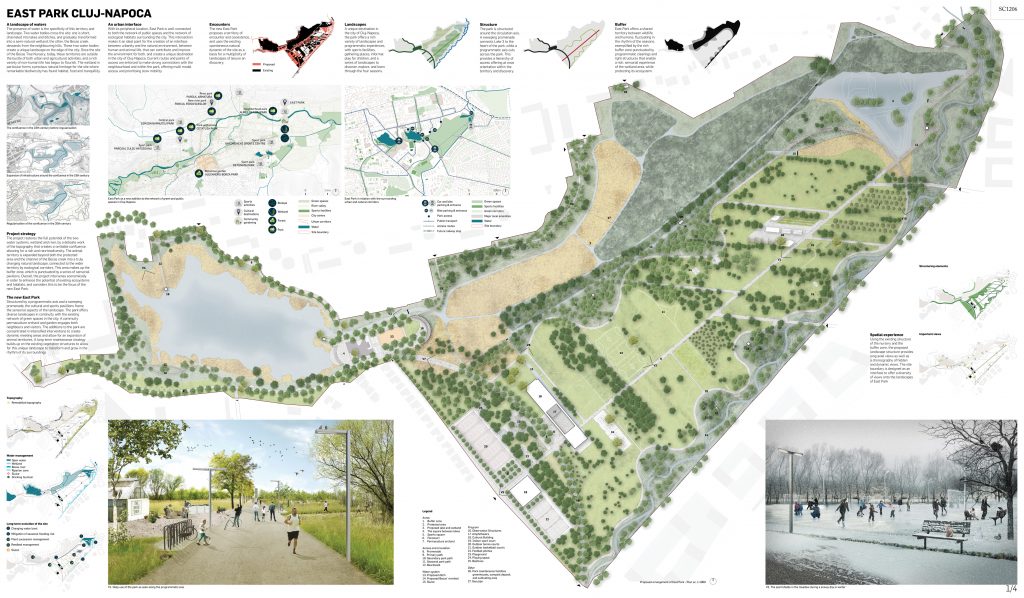
The presence of water is the specificity of this territory and landscape. Two water bodies cross the site: one is short, channelised into lakes and ditches, and gradually transformed into a semi-natural wetland; the other, the Becas creek, descends from the neighbouring hills. These two water bodies create a unique landscape on the edge of the city. Once the site of the Becas Tree Nursery, today, these territories are outside the bustle of both urban and agricultural activities, and a rich variety of non-human life has begun to flourish. The wetland in particular forms a precious natural heritage for the site where remarkable biodiversity has found habitat, food and tranquillity.
PROJECT STRATEGY
The project restores the full potential of the two water systems, wetland and river, by a delicate work of the topography that creates a veritable confluence, allowing for a rich and rare biodiversity. The animal territory is expanded beyond both the protected area and the channel of the Becas creek into a truly changing natural landscape, connected to the wider territory by ecological corridors. This area makes up the buffer zone, which is punctuated by a series of sensorial pavilions. Overall, the project intervenes economically in order to enhance the potential of existing ecosystems and habitats, and considers this to be the focus of the new East Park.
THE NEW EAST PARK
Structured by a programmatic axis and a sweeping promenade, the cultural and sports pavilions frame the sensorial aspects of the landscape. The park offers diverse landscapes in continuity with the existing network of green spaces in the city. A community permaculture orchard and garden engages both neighbours and visitors. The additions to the park are concentrated in intensified interventions to create dynamic meeting areas and allow for an expansion of animal territories. A long-term maintenance strategy builds up on the existing vegetation structures to allow for this unique landscape to transform and grow in the rhythm of its surroundings.
AN URBAN INTERFACE
With its peripheral location, East Park is well-connected to both the network of public spaces and the network of ecological habitats surrounding the city. This intersection makes it an ideal point for the creation of an interface between urbanity and the natural environment, between human and animal life, that can contribute and improve the environment for both, and create a unique destination in the city of Cluj-Napoca. Current routes and points of access are enforced to make strong connections with the neighbourhood and within the park, offering multi modal access and prioritising slow mobility.
Encounters — The new East Park proposes a territory of encounter and coexistence, and uses the existing spontaneous natural dynamic of the site as a basis for a multiplicity of landscapes of leisure and discovery.
Landscapes — A unique destination in the city of Cluj-Napoca, the park offers a rich variety of landscapes and programmatic experiences, with sports facilities, gathering places, informal play for children, and a series of landscapes to discover, explore, and learn through the four seasons.
Structure — The park is structured around the circulation axis. A sweeping promenade connects Lake 3 to the heart of the park, while a programmatic axis cuts across the park. This provides a hierarchy of access offering at once orientation within the territory and discovery.
Buffer — East Park offers a shared territory between wildlife and humans, fluctuating in the rhythm of the seasons, exemplified by the rich buffer zone punctuated by programmatic clearings and light structures that enable a rich, sensorial experience of the wetland area, while protecting its ecosystem.
SPATIAL EXPERIENCE
Using the existing structure of the nursery and the buffer zone, the proposed landscape structure provides long axial views as well as a choreography of hidden and dynamic views. The site boundary is designed as an interface to offer a diversity of views onto the landscapes of East Park
LAKE 3
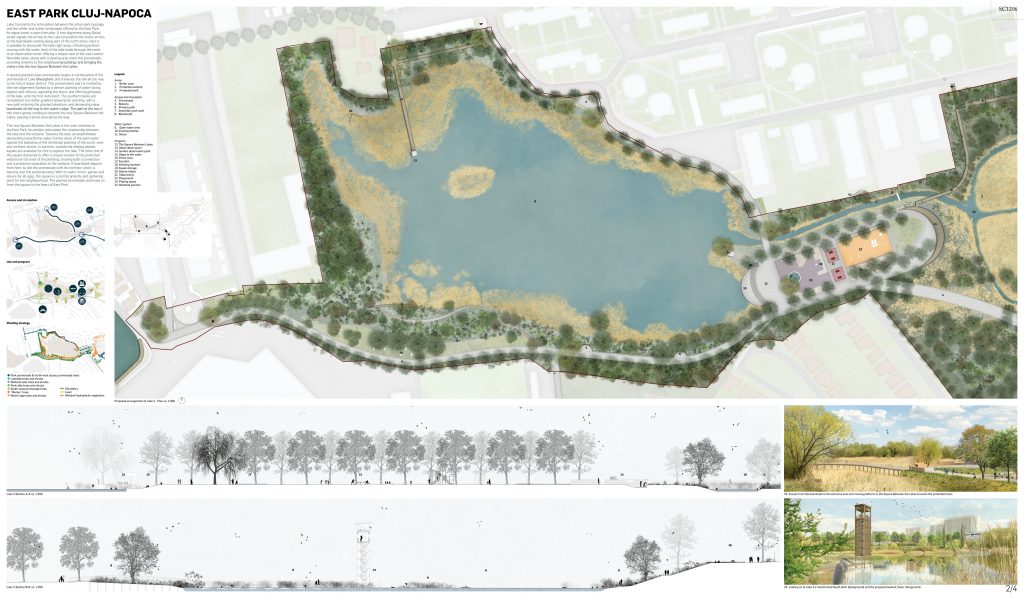
Lake 3 presents the articulation between the urban park typology and the wilder and lusher landscapes offered by the East Park. Its signal tower is seen from afar. A tree alignment along Galati street signals the arrival to the Lake long before the visitor arrives at the boardwalk running along part of the north shore. Here it is possible to encounter the lake right away: a floating pontoon moving with the water level of the lake leads through the reeds to an observation tower offering a unique view of the site’s extent. New bike lanes, along with a viewing area mark this promenade, providing amenity to the neighbouring buildings and bringing the visitors into the new Square Between the Lakes.
A second planted urban promenade, begins in continuation of the promenade of Lake Gheorgheni, and traverses the site all the way to the future Sopor district. This promenade’s start is marked by the tree alignment flanked by a denser planting of water-loving poplars and willows, signalling the shore, and offering glimpses of the lake, until the first vista point. The southern banks are remodelled to a softer gradient allowing for planting, with a new path entering the planted lakeshore, and descending via a boardwalk all the way to the water’s edge. The path at the top of this shore gently continues towards the new Square Between the Lakes, passing a picnic area along the way.
The new Square Between the Lakes is the main entrance to the East Park. Its position articulates the relationship between the lake and the wetland. Towards the lake, an amphitheatre descending towards the water frames views of the open water against the backdrop of the reinforced planting of the south, west and northern shores. In summer, outside the nesting season, kayaks are available for rent to explore the lake. The other end of the square descends to offer a unique window to the protected wetland at the level of the planting, creating both a connection and a protective separation to the wetland. A boardwalk departs from here, to link the promenade with the northern shore, a balcony over the protected area. With its water mirror, games and leisure for all ages, the square is a central amenity and gathering point for the neighbourhood. The planted promenade continues on from the square to the heart of East Park.
PAVILIONS AND OBSERVATION STRUCTURES
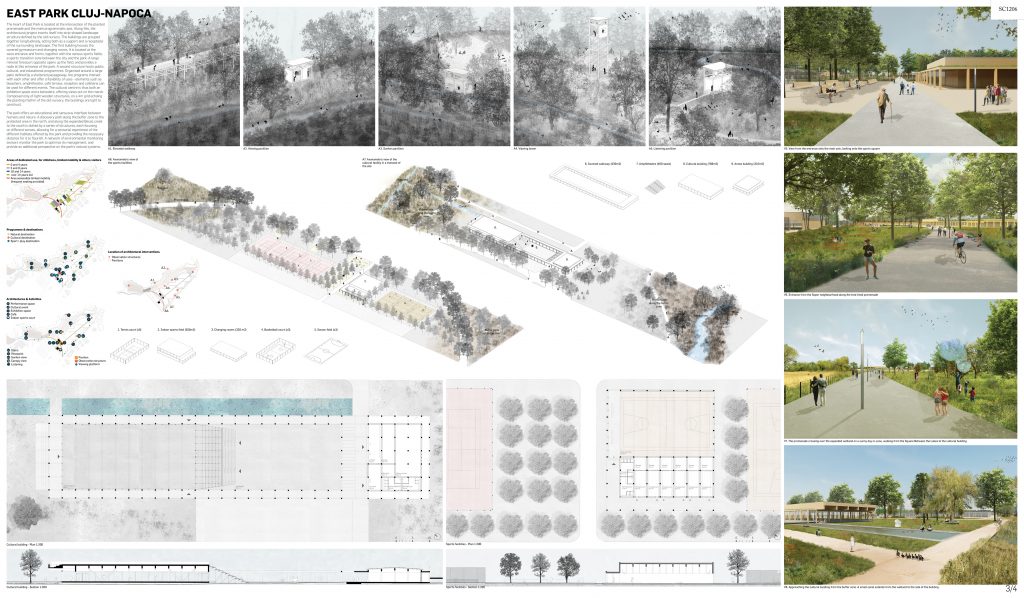
The heart of East Park is located at the intersection of the planted promenade and the main programmatic axis. Along this, the architectural project inserts itself into strip-shaped landscape structure defined by the old nursery. The buildings are grouped together longitudinally, acting both as a support and a receptacle of the surrounding landscape. The first building houses the covered gymnasium and changing rooms. It is located at the west entrance and forms, together with the various sports fields, a sports transition zone between the city and the park. A large mineral forecourt opposite opens up the field, and provides a node at this entrance of the park. A second structure hosts public, cultural, and educational programmes. Organised around a large patio defined by a sheltered passageway, the programs interact with each other and offer a flexibility of uses – elements such as bleachers, amphitheatre, café terrace, reception and cafeteria can be used for different events. The cultural centre is thus both an exhibition space and a belvedere, offering views out on the marsh. Composed only of light wooden structures, on a 4m grid echoing the planting rhythm of the old nursery, the buildings are light to construct.
The park offers an educational and sensuous interface between humans and nature. A discovery path along the buffer zone to the protected area in the north, and along the expanded Becas creek to the south is dotted by a series of structures, each focusing on different senses, allowing for a sensorial experience of the different habitats offered by the park and providing the necessary distance for it to flourish. A network of environmental monitoring sensors monitor the park to optimize its management, and provide an additional perspective on the park’s natural systems.
INFRASTRUCTURE
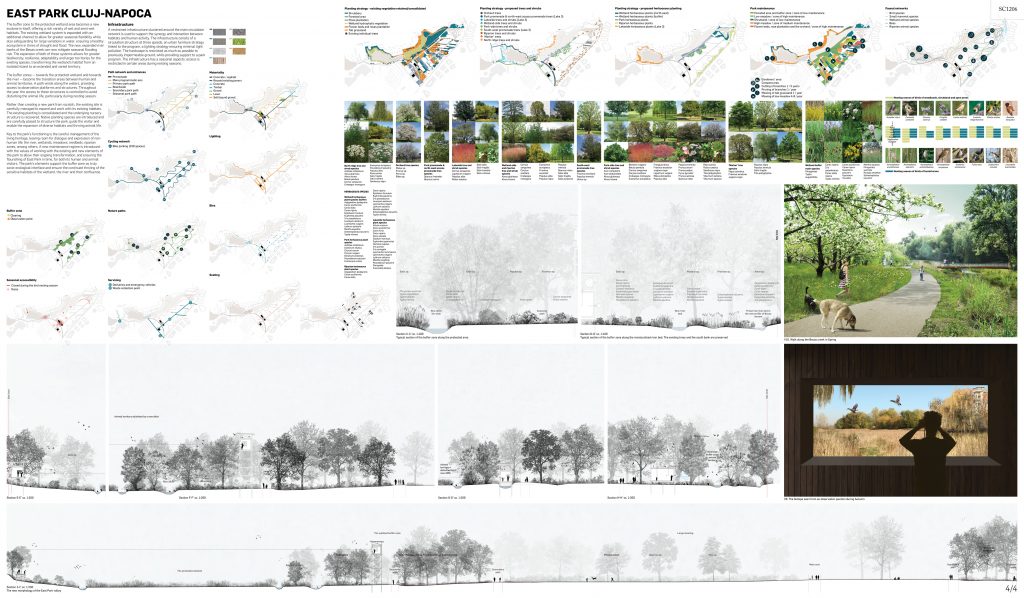
A restrained infrastructure clustered around the main circulation network is used to support the synergy and interaction between habitats and human activity. The infrastructure consits of a circulation structure at three speeds, an urban furniture strategy linked to the program, a lighting strategy ensuring minimal light pollution. The hardscape is restricted as much as possible to previously impermeable ground, while providing support to a park program. The infrastructure has a seasonal aspects: access is restricted in certain areas during nesting seasons.
THE BUFFER ZONE
The buffer zone to the protected wetland area becomes a new ecotone in itself, offering a rich variety of wet and semi-wet habitats. The existing wetland system is expanded with an additional channel to allow for greater seasonal flexibility while also safeguarding for large variations in water, ensuring a healthy ecosystem in times of drought and flood. The new, expanded river banks of the Becas creek can now mitigate seasonal flooding risk. The expansion of both of these systems allows for greater biodiversity, resilience, adaptability and larger territories for the existing species, transforming the wetland’s habitat from an isolated island to an extended and varied territory.
The buffer zones — towards the protected wetland and towards the river — become the transition areas between human and animal territories. A path winds along the waters, providing access to observation platforms and structures. Throughout the year, the access to these structures is controlled to avoid disturbing the animal life, particularly during nesting season.
Rather than creating a new park from scratch, the existing site is carefully managed to expand and work with its existing habitats. The existing planting is consolidated and the underlying nursery structure is recovered. Native planting species are introduced and are carefully placed to structure the park, guide the visitor and enable the expansion of diverse habitats and thriving animal life.
Key to the park’s functioning is the careful management of the living heritage, leaving room for dialogue and expression of non-human life: the river, wetlands, meadows, reedbeds, riparian zones, among others. A new maintenance regime is introduced: with the values of working with the existing and new elements of the park to allow their ongoing transformation, and ensuring the flourishing of East Park in time, for both its human and animal visitors. The park’s elements support the buffer zone as truly socio-ecological interface and ensure the continued thriving of the sensitive habitats of the wetland, the river and their confluence.