





108 – AB4711 – IOANNIS PANAGIOTOU – P9 ARCH STUDIO


Autori principali: Pangiotou Nikolaos Ioannis
Coautori: Anastasios Panagiotis Mpalatsoukas
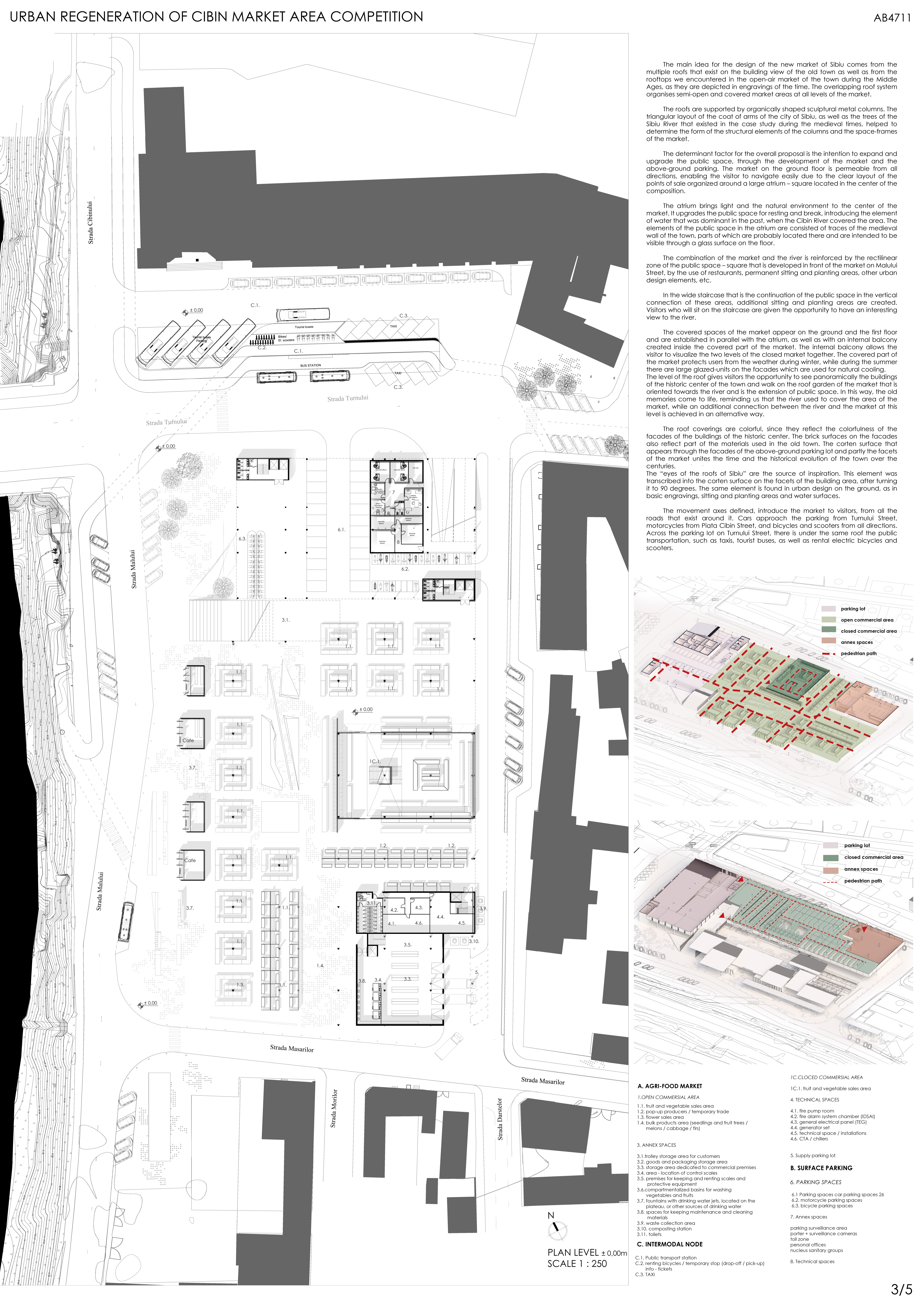
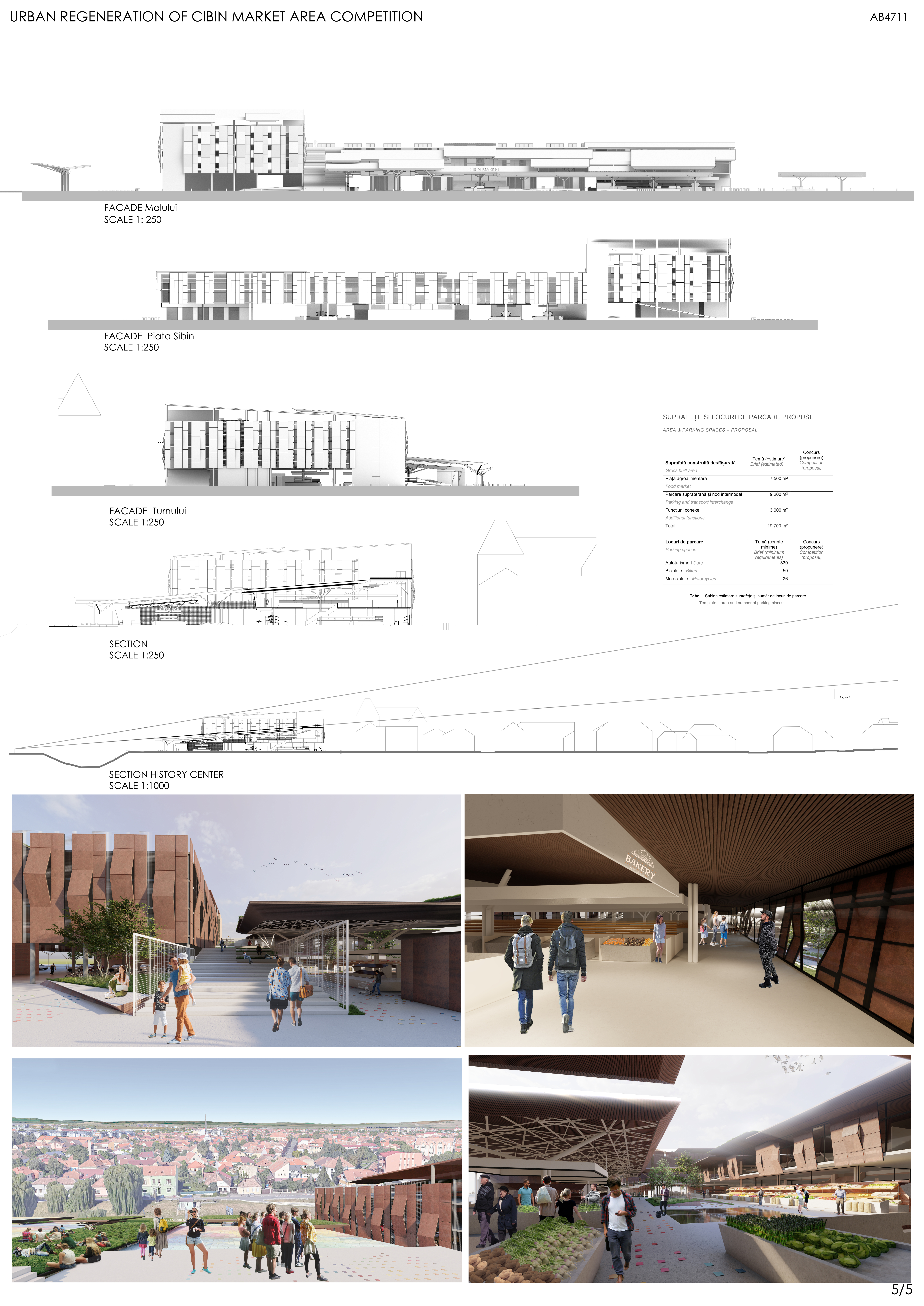
The main idea for the design of the new market of Sibiu comes from the multiple roofs that exist on the building view of the old town as well as from the rooftops we encountered in the open-air market of the town during the Middle Ages, as they are depicted in engravings of the time. The overlapping roof system organises semi-open and covered market areas at all levels of the market.
The roofs are supported by organically shaped sculptural metal columns. The triangular layout of the coat of arms of the city of Sibiu, as well as the trees of the Sibiu River that existed in the case study during the medieval times, helped to determine the form of the structural elements of the columns and the space-frames of the market.
The determinant factor for the overall proposal is the intention to expand and upgrade the public space, through the development of the market and the above-ground parking. The market on the ground floor is permeable from all directions, enabling the visitor to navigate easily due to the clear layout of the points of sale organized around a large atrium – square located in the center of the composition.
The atrium brings light and the natural environment to the center of the market. It upgrades the public space for resting and break, introducing the element of water that was dominant in the past, when the Cibin River covered the area. The elements of the public space in the atrium are consisted of traces of the medieval wall of the town, parts of which are probably located there and are intended to be visible through a glass surface on the floor.
The combination of the market and the river is reinforced by the rectilinear zone of the public space – square that is developed in front of the market on Malului Street, by the use of restaurants, permanent sitting and planting areas, other urban design elements, etc.
In the wide staircase that is the continuation of the public space in the vertical connection of these areas, additional sitting and planting areas are created. Visitors who will sit on the staircase are given the opportunity to have an interesting view to the river.
The covered spaces of the market appear on the ground and the first floor and are established in parallel with the atrium, as well as with an internal balcony created inside the covered part of the market. The internal balcony allows the visitor to visualize the two levels of the closed market together. The covered part of the market protects users from the weather during winter, while during the summer there are large glazed-units on the facades which are used for natural cooling.
The level of the roof gives visitors the opportunity to see panoramically the buildings of the historic center of the town and walk on the roof garden of the market that is oriented towards the river and is the extension of public space. In this way, the old memories come to life, reminding us that the river used to cover the area of the market, while an additional connection between the river and the market at this level is achieved in an alternative way.
The roof coverings are colorful, since they reflect the colorfulness of the facades of the buildings of the historic center. The brick surfaces on the facades also reflect part of the materials used in the old town. The corten surface that appears through the facades of the above-ground parking lot and partly the facets of the market unites the time and the historical evolution of the town over the centuries.
The “eyes of the roofs of Sibiu” are the source of inspiration. This element was transcribed into the corten surface on the facets of the building area, after turning it to 90 degrees. The same element is found in urban design on the ground, as in basic engravings, sitting and planting areas and water surfaces.
The movement axes defined, introduce the market to visitors, from all the roads that exist around it. Cars approach the parking from Turnului Street, motorcycles from Piata Cibin Street, and bicycles and scooters from all directions. Across the parking lot on Turnului Street, there is under the same roof the public transportation, such as taxis, tourist buses, as well as rental electric bicycles and scooters.
The renaturation of public spaces for pedestrians, cyclists and vehicles, was made to upgrade the public space. The proposal of mild traffic roads aims to soothe the roads of the case study from the unregulated parking of cars and return the public space to the residents of the town and visitors.
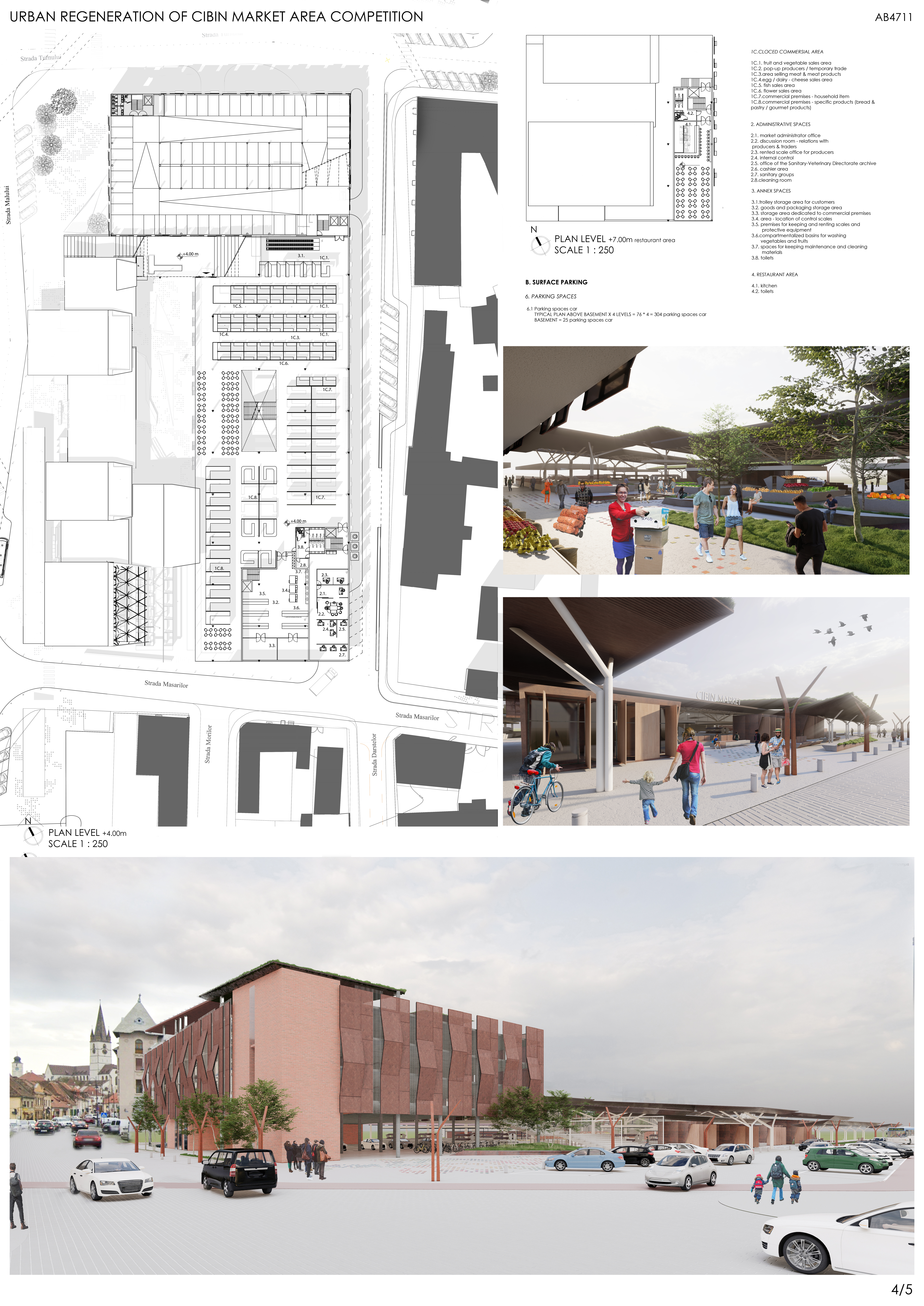
The basic designs that characterize the proposal are the dynamic lines in obtuse angles that stem from the triangular form of the town’s coat of arms and the transcription of the form of the “eyes of Sibiu” on the ground with many variations in sitting and planting areas and places with water.
The colorful facades of the town are reflected in the patterns of colorful tiles diffused in squares and other public areas, which aim to direct the visitor to the points of interest and connect the Cibin market with the historic town center, creating a cohesive walk.
The reorganization of functions and the new qualities in urban planning, mainly focus on Gong and Coroana squares. The proposal of the Gong Theater Square has as main goal to enlarge its useful space so that it could comfortably receive the flow of visitors to and from the theater during its operation. At the same time, the intention was for the square to be able to welcome artistic events that will derive from the theater itself or independently of it.
The facade of the theatre and its geometry formed the basis for the development of the synthetic idea, for the creation of living rooms and shading and planting surfaces. The morphology and slopes of the area were used so that the level of the square was submerged in relation to Alexandru Odobescu Street. The colored tiles on the floors create here a playful atmosphere around the theater.
The wider area of the Gong Theatre was upgraded with the rearrangement of the width of the streets and the pedestrian zones. Small urban gaps were exploited for the design of sitting and planting areas and a city bus stop.
Coroana Square and the intermediate points of interest shaped by rationalizing and resetting the axes of cars, pedestrians and vehicles, create a route that directs the visitor from the market to the landmarks of the town, among others “Saint Mary” Evangelical Cathedral and “The Stairs Tower”.
In Coroana Square it is chosen to immerse a part of it in order to delimit a large sitting room at the same time as the counterpoint created between the sitting areas and a water surface of the respective form. The composition develops around a short-width water flow line, marking the route to the pedestrianized section and the Cathedral. The colorful patterns on the floor are also used for the benefit of the visitor’s orientation. An extensive roof is used in order to provide shade in the square and acts as a planted roof such as the roofs of the market.
In the pedestrian part of Turnului Street the linear presence of water continues on the floor around which the colorful patterns develop, while at the same time two large sitting areas arranged as rest areas.
Based on the above synthetic principles, smaller-scale interventions are planned on the remaining roads located in the intervention area. Finally, a network of bicycle paths connecting the Cibin market is proposed and going from Turnului Street to Coroana Square and from Targu Pestelui and Targu Vinului (roads outside the intervention area) to Masarilor Street which ends again in the market area, thus completing a bicycle path ring in the town.